
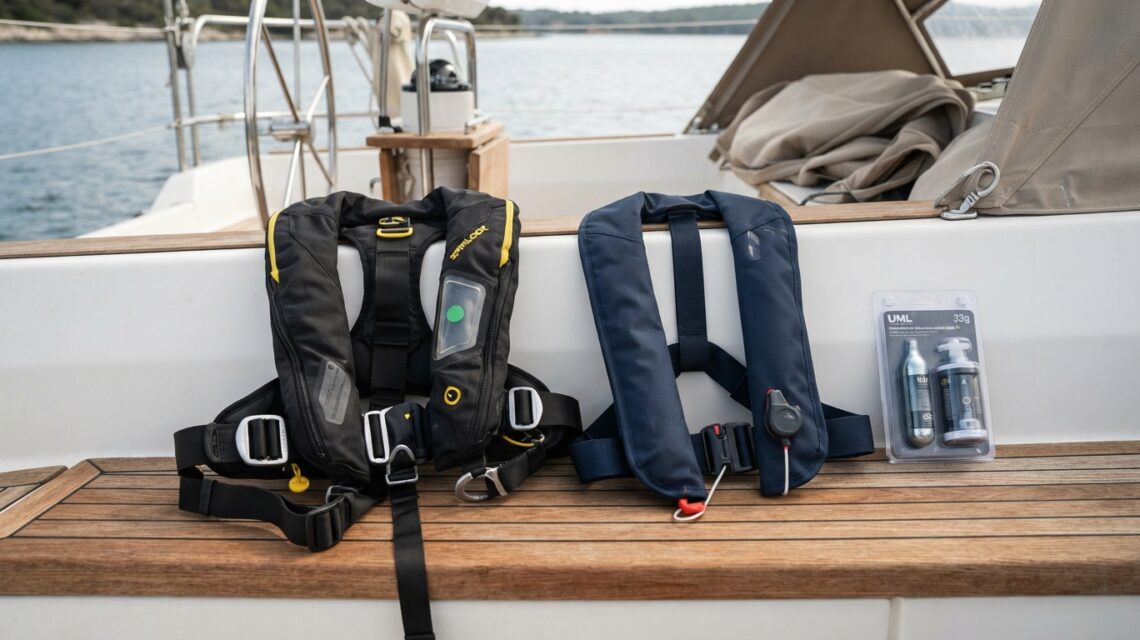
Hydrostatic life jackets offer greater resistance to accidental inflation in wet conditions, but conventional water-activated systems are easier to service and can cost considerably less to re-arm. Even premium offshore sailing equipment uses both technologies.
By Marcio Tamer
Updated November 19, 2026
An inflatable life jacket equipped with a Hammar hydrostatic inflator requires approximately four inches (10 centimeters) of submersion at its firing head before automatic inflation occurs. A conventional water-activated life jacket instead relies on a soluble element that releases its firing mechanism when sufficiently exposed to water.
That engineering difference explains why hydrostatic personal flotation devices (PFDs) are particularly attractive to offshore sailors working on decks repeatedly exposed to breaking waves. However, it also introduces a limitation that receives considerably less attention: buoyant foul-weather clothing can delay inflation by preventing the hydrostatic firing head from reaching the necessary depth.
The financial differences are equally significant. Mustang Survival lists conventional automatic re-arming kits at approximately $30 to $35, while its 33-gram Hammar hydrostatic replacement kit carries a regular price of $89.99.
Despite those differences, neither technology is universally superior. The appropriate life jacket depends on sailing conditions, certification, fit, maintenance requirements and the availability of compatible replacement components.
How hydrostatic and bobbin-activated inflatable PFDs work
Both technologies use compressed carbon dioxide to inflate a flotation chamber. Their principal difference lies in what releases the mechanism that pierces the gas cylinder.
Conventional automatic inflators use a water-sensitive element, commonly called a bobbin in Halkey-Roberts systems. When water reaches and sufficiently dissolves this element, the firing mechanism releases and punctures the CO2 cylinder. United Moulders (UML) systems use a similar water-sensitive principle, although their construction and replacement components differ.
Hammar hydrostatic inflators add a pressure-sensitive valve that controls water access to the activation mechanism. This makes them substantially less susceptible to inflation caused by rain, humidity and ordinary deck spray.
| Feature | Hydrostatic inflator | Conventional water-activated inflator |
|---|---|---|
| Automatic activation | Water pressure and immersion | Water reaching soluble element |
| Typical activation depth | Approximately 10 cm for Hammar | No equivalent hydrostatic threshold |
| Resistance to accidental inflation | Higher in very wet conditions | Depends on inflator design and exposure |
| Scheduled component replacement | Commonly up to five years for Hammar | Manufacturer-specific intervals |
| Example complete re-arming kit | $89.99 | $29.99–$34.99 |
| Manual inflation handle | Yes | Yes |
| Oral inflation tube | Yes | Yes |
| Routine inspection | Required | Required |
Modern water-activated systems also incorporate protective housings. Spinlock explains that certain UML and Halkey-Roberts designs require water to enter from below, limiting sensitivity to rain and spray running down the jacket.
Consequently, describing conventional automatic life jackets as devices that inflate whenever they become wet misrepresents how modern inflators work.
Why hydrostatic life jackets are popular with offshore sailors
During an offshore passage, sailors may spend hours exposed to spray, rain and water washing across the foredeck. An unexpected inflation while changing sails or handling equipment can restrict movement and leave the wearer without a ready-to-use life jacket until it is correctly re-armed.
Hydrostatic technology reduces this risk by requiring sufficient water pressure at the activation head. In typical Hammar-equipped systems, the CO2 cylinder is also positioned inside the flotation chamber, providing additional protection against environmental exposure.
However, Spinlock identifies an important limitation involving buoyant waterproof clothing. If the clothing prevents the firing head from becoming sufficiently submerged, automatic inflation may be delayed. The manual inflation handle remains available to a conscious wearer, but it cannot help someone who is unable to operate it.
Hydrostatic technology should therefore be understood as a way of reducing unwanted activation, not as proof that a particular life jacket will always inflate faster or perform better in every man-overboard incident.
Why some premium offshore life jackets still use water-activated inflators
One of the most revealing comparisons comes from British marine safety manufacturer Spinlock, which uses different inflation technologies across its premium sailing range.
Its Deckvest VITO incorporates a Hammar hydrostatic mechanism, while the Deckvest 6D uses the UML Pro Sensor Elite water-activated system. The latter is available in 170N and 275N buoyancy configurations and incorporates a certified deck safety harness.
| Life jacket | Inflation system | Main characteristic |
|---|---|---|
| Mustang Survival HIT | Hammar hydrostatic | Designed for demanding, wet boating environments |
| Spinlock Deckvest VITO | Hammar hydrostatic | Offshore sailing and integrated harness |
| Spinlock Deckvest 6D | UML Pro Sensor Elite | Offshore sailing with conventional automatic inflation |
| Mustang Survival MIT 70 Automatic | Water-activated | Compact flotation for suitable recreational activities |
The Deckvest 6D demonstrates that hydrostatic activation is not a prerequisite for offshore sailing equipment. Spinlock identifies easier servicing and wider replacement-parts availability as advantages of UML technology.
Sailors undertaking extended voyages should consider whether compatible re-arming components will be available at their destination, rather than assume all marine stores stock interchangeable cylinders and firing heads.
How much does it cost to maintain an inflatable life jacket?
Mustang Survival’s published US prices illustrate the difference between the two inflation technologies. Its hydrostatic replacement kit costs more than twice as much as several conventional automatic kits.
| Replacement component | Regular listed price |
|---|---|
| Mustang Re-Arm Kit L, 24g automatic/manual | $29.99 |
| Mustang Re-Arm Kit H, 17g automatic/manual | $34.99 |
| Mustang Re-Arm Kit D, 24g automatic/manual | $34.99 |
| Mustang Re-Arm Kit C, 33g Hammar hydrostatic | $89.99 |
For a four-person sailing crew, purchasing one $89.99 hydrostatic spare kit per life jacket would cost $359.96. Four conventional kits priced at $34.99 would cost $139.96, a difference of $220.
These examples involve different life jacket designs and gas cylinder capacities, so they are not direct comparisons of identically rated flotation equipment. Actual long-term maintenance costs also depend on component expiry dates, servicing requirements and how frequently the jackets are inflated.
A hydrostatic inflator with a five-year replacement interval may require fewer scheduled component changes. Conversely, a conventional automatic mechanism may allow its soluble firing element to be replaced separately without purchasing an entire re-arming kit.
Always use the exact replacement components specified for the life jacket model. Matching the CO2 cylinder weight alone does not establish compatibility.
Why a five-year hydrostatic inflator still needs regular inspections
The five-year service interval associated with certain Hammar inflators applies to the mechanism’s scheduled replacement, not the entire life jacket.
Inflatable flotation chambers can develop leaks, harness stitching can deteriorate, and buckles or straps can become damaged. These problems may exist even when the inflator’s readiness indicator remains green.
Before sailing, check the following:
- Readiness indicators: Confirm that all required indicators show the correct armed status.
- Expiry dates: Check the inflator and other dated components against the manufacturer’s instructions.
- Flotation chamber: Inspect for damage, abrasion and signs of deterioration.
- Harness and straps: Check stitching, buckles and crotch straps where fitted.
- Manual activation: Ensure the inflation handle is accessible.
- Periodic testing: Perform leak tests and scheduled servicing according to the owner’s manual.
The BoatUS Foundation recommends checking inflatable life jackets for leaks every two months by orally inflating the chamber and leaving it overnight. Individual manufacturers may prescribe different testing procedures and intervals.
Never disassemble a sealed hydrostatic inflator merely to inspect its cylinder. Store the jacket clean and dry, and arrange servicing if its condition is uncertain.
Does higher buoyancy automatically mean a better offshore life jacket?
Buoyancy and activation technology are separate considerations. A life jacket can offer substantial flotation while using either hydrostatic or conventional automatic inflation.
Under the ISO 12402 framework, performance levels such as 150 and 275 describe flotation and associated performance requirements. A manufacturer may advertise a jacket with 170N or 190N of actual buoyancy while certifying it under the Level 150 standard.
This distinction matters because 190N is not automatically a separate offshore certification category. Higher buoyancy may benefit sailors wearing heavy clothing, but fit, turning performance and the intended operating environment must also be considered.
For offshore sailing, additional features can include a sprayhood, emergency light, crotch straps, integrated deck harness and compatibility with personal man-overboard locator devices. A deck harness should carry the appropriate certification for tethered use.
American buyers must also distinguish ISO certification from U.S. Coast Guard approval. An ISO-certified European life jacket does not automatically satisfy American recreational boating carriage requirements.
Can you take an inflatable life jacket on an airplane?
The Federal Aviation Administration’s guidance, updated in April 2026, allows passengers to transport up to two self-inflating personal safety devices under specified conditions.
Each device may contain up to two qualifying small gas cartridges, with up to two additional spare cartridges per device. The equipment must be protected against accidental activation, and airline approval is required.
These provisions are particularly relevant to sailors flying to Greece, the Caribbean or other bareboat charter destinations. International rules, airline policies and airport security restrictions may differ, so obtain confirmation before traveling rather than assume every carrier accepts inflatable life jackets and spare cylinders.
Which inflatable PFD should you choose?
A hydrostatic life jacket is a strong candidate for offshore passages, exposed foredeck work and sailing in persistently wet conditions. Its resistance to unwanted inflation can justify the higher purchase and replacement costs.
A high-quality conventional automatic life jacket remains a practical choice for coastal cruising and can also be appropriate offshore when its certification, buoyancy and other safety features match the intended voyage.
For weak swimmers, non-swimmers and children, an appropriately fitted inherently buoyant life jacket is generally the safer choice. Age restrictions and approved activities should be checked on the specific product label and against applicable regulations.
Before departing on an extended sailing trip, every crew member should understand how their life jacket operates, how to activate it manually and where its replacement components are stored. The most sophisticated firing mechanism cannot compensate for an unsuitable, damaged or unworn life jacket.
+ Siga o Giro no Facebook
+ Siga o Giro no Instagram
Leia Mais: