


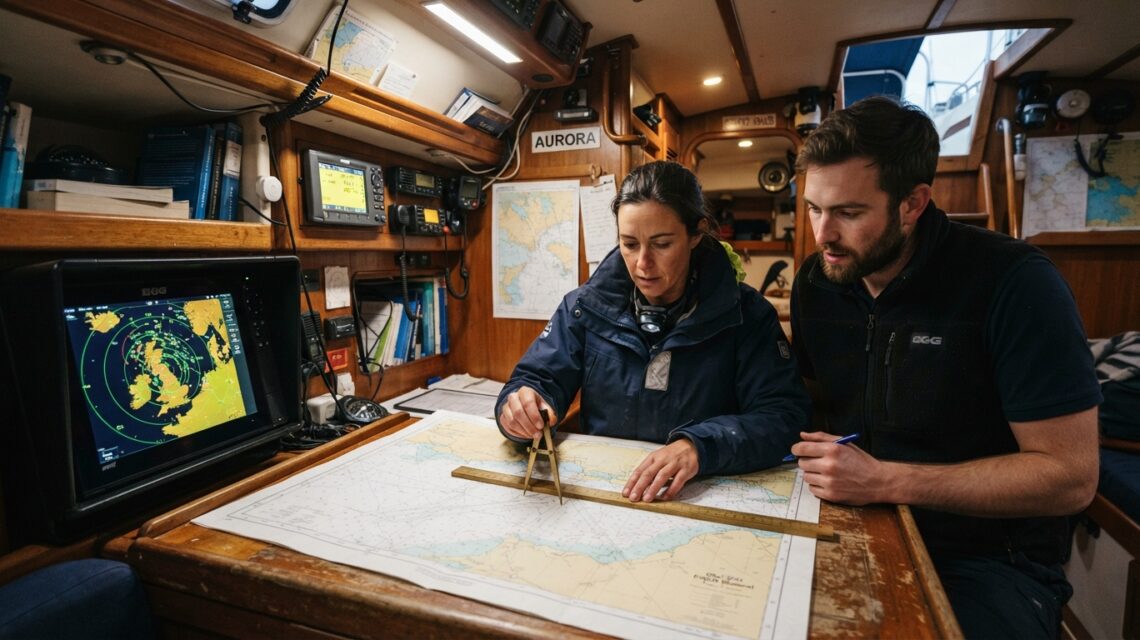
American Sailing allows students to earn their coastal navigation certification without previous sailing experience, while Advanced Coastal Cruising requires four prerequisite certifications, overnight operations and practical seamanship.
By Marcio Tamer
Updated November 19, 2026
A sailor can earn the American Sailing Association’s ASA 105 Coastal Navigation certification for $419 without stepping aboard a sailboat or completing any previous sailing courses. The next advanced cruising certification, ASA 106, requires at least 48 hours underway and proficiency in nighttime navigation, emergency procedures and challenging sailing conditions.
Although sailing schools frequently advertise these certifications together, separating them can offer financial and educational advantages. At California’s Modern Sailing School & Club, non-members pay $3,115 for the two standalone courses, compared with $3,800 for a seven-day combination program.
The $685 difference illustrates why sailors should examine the curriculum, prerequisites and actual time aboard before booking an advanced coastal sailing expedition.
ASA 105 vs. ASA 106: What is the difference?
ASA 105 teaches sailors how to determine their position, calculate safe routes and account for environmental conditions affecting navigation. ASA 106 requires them to apply that knowledge while operating a cruising sailboat during extended coastal passages.
The certifications complement each other, but their learning environments and assessment requirements differ substantially.
| Feature | ASA 105 Coastal Navigation | ASA 106 Advanced Coastal Cruising |
|---|---|---|
| Prerequisites | None | ASA 101, 103, 104 and 105 |
| Learning environment | Classroom or online | Practical liveaboard training |
| Duration examples | 40–60 hours online | 3–7 days, depending on school |
| Training vessel | Not required | Approximately 30–50 feet |
| Main competencies | Navigation, tides, currents and chart plotting | Advanced seamanship, passage planning and night operations |
| Underway requirement | None | At least 48 hours |
| Assessment | Navigation knowledge and plotting exercises | Written and practical assessments |
| Published tuition examples | $399–$790 | $995–$2,575 |
The tuition figures are examples from individual American sailing schools, not national averages. Longer expeditions, private cabins and international destinations can increase the cost considerably.
What you learn in ASA 105 before going to sea
American Sailing’s online ASA 105 course, delivered through Starpath, costs $419 and includes one year of access, instructional support and course materials. Students should expect approximately 40 to 60 hours of study, depending on their pace and the optional material they complete.
The curriculum develops navigation skills that remain useful whether a boat carries sophisticated electronic equipment or relatively basic instruments. It combines traditional chart plotting with modern electronic navigation rather than exclusively relying on paper charts.
Students learn to convert compass bearings, estimate their position from speed and elapsed time, correct their intended course for wind and current, and establish their location using identifiable landmarks.
The practical importance becomes apparent when crossing tidal waters. A boat traveling at six knots for two hours covers 12 nautical miles through the water, but a perpendicular current of two knots could displace it four nautical miles from its intended track if no correction is made.
American Sailing’s certification standard includes plotting a route of at least 20 miles with three changes of course. Students must demonstrate that they can plan a journey while accounting for the conditions that affect the vessel’s actual movement.
These skills are valuable even for sailors who have not completed ASA 104 Bareboat Cruising. Nevertheless, some previous experience aboard a sailboat may make the theoretical material easier to understand.
What the 48-hour ASA 106 requirement actually means
One frequently misunderstood aspect of ASA 106 concerns the minimum duration of its practical training.
American Sailing’s published certification standard requires a liveaboard coastal cruise involving at least 48 hours underway, including one uninterrupted period of at least 24 hours. It does not require 48 consecutive hours of sailing without stopping.
The standard also requires students to undertake a navigation watch covering at least 20 miles. This distance requirement should not be confused with a separate mandatory nighttime sailing distance.
During the course, students prepare the crew and vessel for an extended voyage, organize watch rotations, evaluate marine weather forecasts and determine fuel and freshwater requirements for a 72-hour passage.
Other practical competencies include reducing sail area, heaving-to, using safety tethers and performing a nighttime crew-overboard recovery maneuver.
Electronic navigation also forms part of the curriculum. Students demonstrate proficiency with radar, GPS chartplotters and AIS when those systems are installed aboard the training vessel.
Heavy-weather training does not mean instructors must deliberately sail into dangerous storms. The emphasis is on preparing sailors to manage challenging conditions, recognize risks and make appropriate decisions about whether to continue or modify a passage.
Is taking ASA 105 and 106 separately cheaper than a combination course?
Published school prices reveal substantial differences in how advanced coastal training is packaged.
Modern Sailing offers a six-evening ASA 105 classroom course, a four-day ASA 106 expedition and a seven-day combined program along the California coast.
| Modern Sailing program | Members | Non-members |
|---|---|---|
| ASA 105 classroom course | $560 | $750 |
| ASA 106 four-day expedition | $1,850 | $2,365 |
| Both standalone courses | $2,410 | $3,115 |
| Seven-day ASA 105/106 combination | $2,985 | $3,800 |
| Savings from separate courses | $575 | $685 |
For non-members, replacing the classroom program with Starpath’s $419 online certification could reduce the combined listed tuition to $2,784, assuming the student meets the school’s other enrollment requirements.
That is $1,016 below the seven-day combination course. However, the comparison involves different training experiences: the standalone ASA 106 program lasts four days, while the combination provides seven days aboard.
Other schools demonstrate that bundled courses are not always more expensive. Narragansett Sailing School advertises an ASA 105 and 106 package for $2,691, compared with $2,990 when purchased separately, a saving of $299.
The correct comparison therefore involves the total number of training days, course materials, accommodation arrangements and travel expenses, rather than assuming that either booking format is universally cheaper.
Can you take ASA 106 before finishing ASA 105?
American Sailing lists ASA 101, 103, 104 and 105 as prerequisites for ASA 106 certification. However, the timing of course attendance can be more flexible than the certification requirements initially suggest.
Modern Sailing’s standalone ASA 106 course allows students to complete ASA 105 within one year after finishing their practical training before receiving the advanced certification. Its combination program also accepts students who arrive with ASA 104 and complete both advanced courses during the expedition.
This distinction means that enrolling in advanced training and qualifying for the final certification are not necessarily simultaneous events.
Finishing ASA 105 beforehand remains a sensible strategy for sailors who want to concentrate on practical seamanship aboard the boat. Those enrolling in a combination program should obtain their study materials early and arrive comfortable with basic navigation calculations.
Recent sailing experience matters as well. Modern Sailing applies additional experience-review requirements to students who completed ASA 104 more than three years earlier, illustrating why possessing the necessary certificates does not always guarantee immediate enrollment.
How to plan your progression from ASA 101 to ASA 106
Sailors can integrate navigation study into their practical training without waiting until they complete every preceding certification.
An effective progression is:
- ASA 101, Keelboat Sailing 1: Develop fundamental sailing and boat-handling skills.
- ASA 103, Coastal Cruising: Gain experience aboard larger cruising sailboats.
- ASA 104, Bareboat Cruising: Learn to manage multiday recreational cruising.
- ASA 105, Coastal Navigation: Complete this at any suitable stage, preferably before advanced liveaboard training.
- ASA 106, Advanced Coastal Cruising: Apply navigation and seamanship skills during extended coastal passages.
For sailors ultimately planning an ocean crossing, ASA 106 is not the final certification in the pathway. American Sailing offers ASA 108 Offshore Passagemaking, which also requires celestial navigation training through ASA 107 or the ASA 117 endorsement.
Before booking an advanced expedition, ask the school how much time students spend underway, how navigation watches are assigned and what previous experience instructors expect. These details are particularly important when transitioning from daytime bareboat cruising to overnight passages in unfamiliar waters.
+ Siga o Giro no Facebook
+ Siga o Giro no Instagram
Leia Mais: