

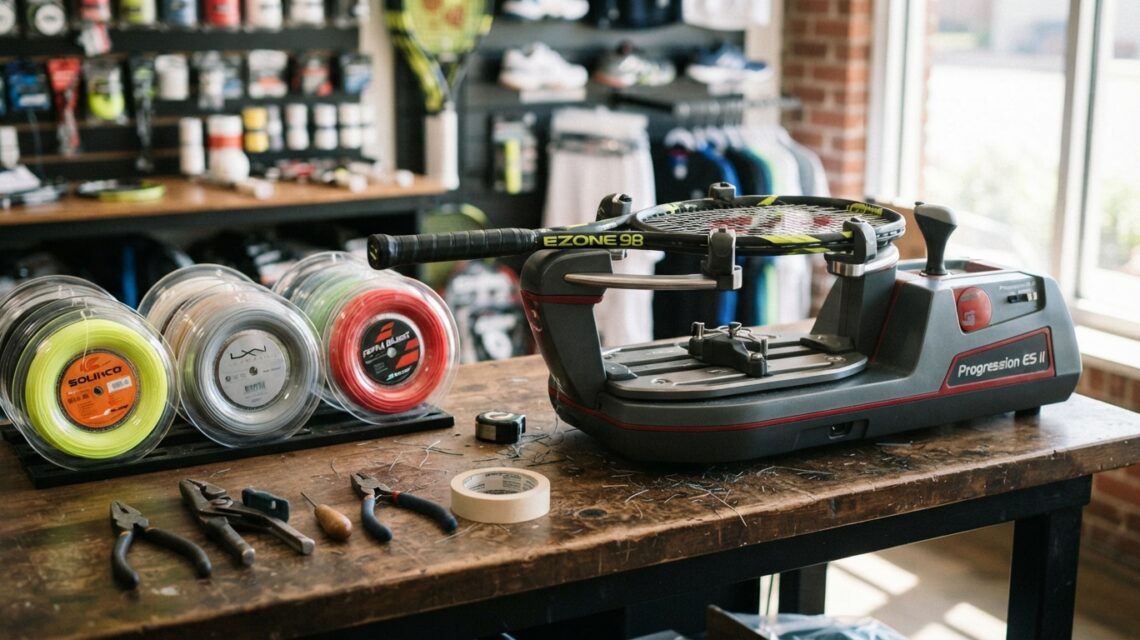
Tennis Warehouse lists the Tourna 175-CS at less than half the price of the electronic Tourna 550-ES. Both offer a route to consistent racket stringing, but their tensioning systems, workflow and long-term ownership costs differ.
By Marcio Tamer
Updated November 21, 2026
A home stringer can buy a Tourna 175-CS for $779 and get six-point racket mounting, fixed swivel clamps and a gravity-powered constant-pull tensioner. Moving to the electronic Tourna 550-ES costs $1,695, an additional $916.
That price difference raises a more useful question than whether electronic machines are inherently better: how many rackets must a stringer process before the faster motorized workflow justifies the investment?
The answer depends on workload, experience and equipment quality. Both gravity-operated and electronic constant-pull machines can produce consistent string jobs. But an electronic tension head reduces repetitive manual work, while mounting and clamp quality determine how securely the racket and strings are held throughout the process.
For occasional home stringers, the savings from buying a mechanical machine can be substantial. For a club handling several rackets every day, reduced operator effort and more predictable workflow may justify the higher price.
Drop-weight vs. electronic stringing machines
| Feature | Drop-weight | Electronic constant-pull |
|---|---|---|
| Tension source | Gravity acting on a weighted arm | Electric motor |
| Constant-pull operation | Yes, when operated correctly | Yes, on models with constant-pull control |
| Electrical power | Not required | Required |
| Main operator task | Position and level weighted arm | Set tension and activate motor |
| Mounting options | Two-point or six-point | Varies by model |
| Clamp options | Flying or fixed | Varies by model |
| Calibration | Verify mechanical accuracy and weight position | Verify tension-head accuracy |
| Main advantage | Lower cost and mechanical simplicity | Faster, less physically repetitive workflow |
| Main limitation | Slower tensioning process | Higher cost and electronic servicing requirements |
The distinction between constant-pull and lockout tensioning is important.
A conventional crank machine stops pulling when its preset tension is reached. As the string continues to stretch, tension can decrease before the string is clamped.
A drop-weight machine continues applying force through its weighted arm, while a properly designed electronic constant-pull machine automatically adjusts to maintain the selected tension.
That does not mean the finished stringbeds will always be identical. Clamping technique, string type, pulling duration and operator consistency can influence the result.
What do tennis stringing machines actually cost in 2026?
Current US listings show that both categories cover a wider price range than many buying guides suggest.
| Machine | Tensioning | Listed US price |
|---|---|---|
| Klippermate | Drop-weight | $379 |
| Gamma Momentum 2 | Drop-weight | $469.99 |
| Tourna 175-CS | Drop-weight | $779 |
| Gamma Momentum 6 | Drop-weight | $969.99 |
| Gamma Momentum 6 Plus | Drop-weight | $1,199.99 |
| Tourna 550-ES | Electronic | $1,695 |
| Gamma Momentum ELS | Electronic | $2,999.99 |
| Tourna 650-ES | Electronic | $2,999 |
| Tourna 700-ES | Electronic | $4,395 |
These are advertised US prices, not international landed costs. Promotions, availability, shipping and taxes may change the amount paid.
The Klippermate illustrates how inexpensive ownership can be. Its $379 machine uses two-point mounting and a gravity tensioner, making it attractive to players stringing their own rackets.
The Tourna 175-CS occupies a different position. Its $779 price includes six-point mounting, a linear string gripper and fixed swivel clamps, features that can make repetitive stringing more convenient.
The Gamma Momentum 6 Plus offers another mechanical option at $1,199.99, with six-point mounting, quick-action clamp bases and a five-year limited warranty.
On the electronic side, the Tourna 550-ES creates a lower entry point than the approximately $3,000 machines commonly associated with professional stringing setups.
Why mounting and clamps matter as much as the tension head
A racket frame changes shape under stringing loads. The mounting system supports the frame while the main strings and cross strings are installed.
Six-point mounting distributes support across additional contact locations, potentially reducing localized movement and distortion. However, it does not automatically make a machine safe if the supports are adjusted incorrectly.
Two-point machines can also string rackets successfully when used according to their instructions. Klippermate, for example, explicitly designs its two-point mounting system for tennis, squash and racquetball frames.
Clamp quality is equally important.
Flying clamps hold adjacent strings together, while fixed clamps are attached to the machine’s turntable. Well-adjusted fixed clamps can reduce movement and simplify handling, but worn or poorly adjusted clamps may still slip or damage strings.
For a buyer comparing two machines at similar prices, clamp construction, adjustment and mounting stability may matter more than small differences in advertised tension precision.
Does electronic stringing really save 20 to 30 minutes per racket?
Electronic machines generally make tensioning faster because the operator does not need to reposition a weighted arm for every pull.
However, the total time required to string a racket also includes mounting, weaving crosses, moving clamps, tying knots and checking the finished job. An electronic motor does not eliminate those tasks.
A beginner may spend an hour or more on an early string job regardless of machine type. An experienced stringer may complete a racket much faster, particularly with efficient clamps and a familiar string pattern.
There is insufficient evidence to establish a universal 20-to-30-minute saving for every racket.
A more useful calculation starts with the buyer’s own measured time.
Suppose an electronic machine saves 10 minutes per racket compared with a particular drop-weight setup. At five rackets per week, that represents 50 minutes saved weekly, or approximately 43 hours over 52 weeks.
At 15 rackets per week, the same saving rises to approximately 130 hours annually.
These are illustrative calculations, not independently measured performance benchmarks. Their purpose is to show why even modest time savings become significant when workload increases.
When does buying a stringing machine pay for itself?
A machine’s purchase price should be compared with the amount actually saved on each restringing job.
If a player pays $35 for labor at a shop but buys strings separately, the relevant saving is the avoided labor charge, not the entire retail price of a restringing service that includes strings.
Using $35 in avoided labor per racket produces the following illustrative break-even points.
| Machine | Purchase price | Jobs needed to recover cost |
|---|---|---|
| Klippermate | $379 | 11 |
| Tourna 175-CS | $779 | 23 |
| Gamma Momentum 6 Plus | $1,199.99 | 35 |
| Tourna 550-ES | $1,695 | 49 |
| Gamma Momentum ELS | $2,999.99 | 86 |
The figures round up to the next whole racket and exclude tools, replacement parts, electricity, taxes and the value of the stringer’s time.
For a household restringing two rackets monthly, the Tourna 175-CS would theoretically recover its purchase price in approximately 12 months at that assumed labor saving.
For a small club, the economics are different. Revenue must cover strings, labor, equipment maintenance and overhead. The most profitable machine is not necessarily the cheapest or fastest, but the one that supports reliable service at a sustainable cost.
Do drop-weight machines need calibration?
Gravity itself is stable, but that does not make every drop-weight machine permanently accurate.
The position of the weight, lever geometry, mechanical wear and operator technique all affect the actual tension applied. A drop-weight machine may also require the arm to be positioned within a specified range for its calibration scale to be valid.
Electronic machines require tension verification because sensors, motors and control systems can drift or develop faults.
Gamma sells a tension calibrator for $49.99. Checking the machine against a suitable calibrator provides a more reliable indication of performance than assuming that either gravity or electronics guarantees accuracy.
The distinction between reference tension and finished stringbed stiffness also matters. A machine pulling at 55 pounds does not mean every string in the completed racket remains at 55 pounds after clamping, knot tying and relaxation.
Which machine makes sense for home stringers and small clubs?
A basic drop-weight machine is suitable for players who string occasionally, have limited space and value low operating complexity.
A midrange drop-weight model with fixed clamps and six-point mounting can be particularly attractive for serious home stringers who want better ergonomics without paying for electronics.
Electronic constant-pull machines become more compelling as weekly volume increases, especially when multiple people use the equipment or a club needs predictable turnaround times.
The five-racket-per-week threshold sometimes suggested in buying guides is not a technical rule. A hobbyist stringing eight rackets weekly may happily use a drop-weight machine, while someone with physical limitations may prefer electronic tensioning even for one racket per month.
Before purchasing, confirm the machine’s clamp type, mounting system, service support, replacement-parts availability and workspace requirements. Also check whether the machine can be upgraded with an electronic tension head, since compatibility varies and should never be assumed.
The most important investment is still the stringer’s technique. A well-maintained mechanical machine operated consistently can produce better results than an expensive electronic model used incorrectly.
+ Siga o Giro no Facebook
+ Siga o Giro no Instagram
Leia Mais: