

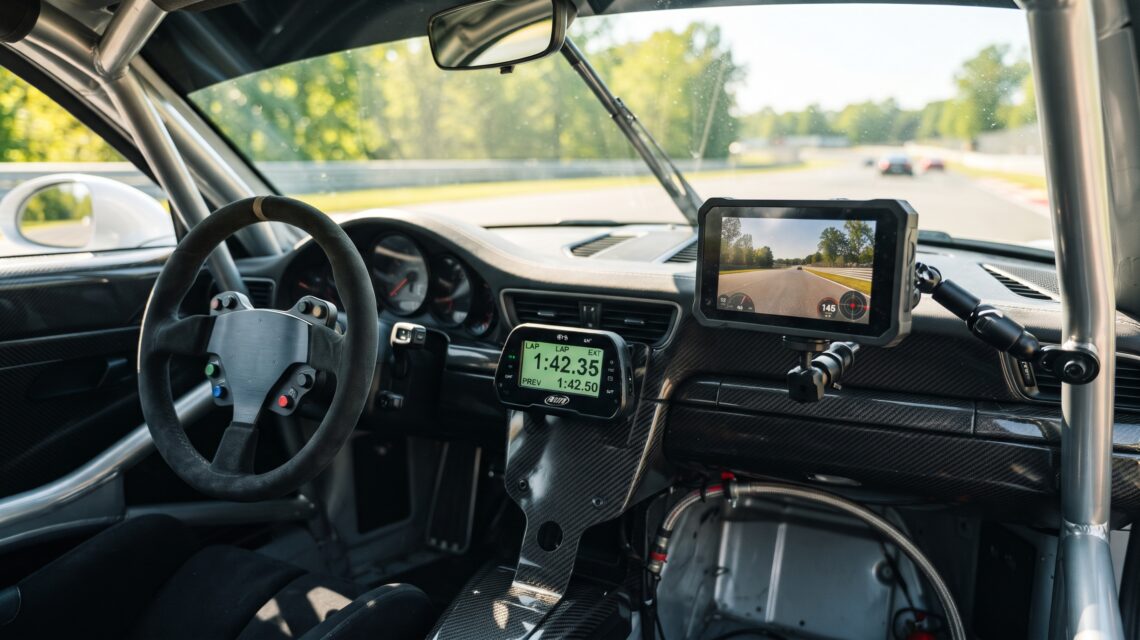
Garmin’s 2026 driving coach now matches the current AiM Solo 2 DL’s 25 Hz satellite positioning rate, but ECU connectivity, synchronized video costs and data analysis capabilities still separate the two track-day systems.
By Marcio Tamer
Updated November 18, 2026
Garmin narrowed an important hardware gap in February 2026 when it introduced the Catalyst 2, a compact track-driving performance optimizer with an integrated camera, 25 Hz satellite positioning and real-time audio coaching for $1,199.99.
The AiM Solo 2 DL costs approximately $899 and offers something Garmin’s system does not: the ability to record data directly from a compatible vehicle’s electronic control unit (ECU). However, adding a $1,599 SmartyCam 3 Corsa increases the combined hardware cost to $2,498.
That makes the AiM package more than twice as expensive as Catalyst 2, although it also provides access to a broader range of vehicle data and engineering analysis.
For recreational track-day drivers, Garmin is generally the more convenient choice for immediate driving feedback and video review. AiM becomes more compelling when the objective is to analyze actual driver inputs, investigate vehicle behavior or work with a motorsport data engineer.
Garmin Catalyst vs. AiM Solo 2 DL specifications
The introduction of Catalyst 2 makes it necessary to distinguish Garmin’s original seven-inch system from its newer, compact model. Both offer automated coaching, but their hardware and review workflows differ.
| Feature | Original Garmin Catalyst | Garmin Catalyst 2 | AiM Solo 2 DL |
|---|---|---|---|
| US price benchmark | $999.99 at launch | $1,199.99 | $899 |
| Display | 7-inch touchscreen | 3-inch touchscreen | Monochrome display |
| Satellite positioning | 10 Hz | 25 Hz | 25 Hz on current version |
| Camera | Separate 1080p camera | Integrated 1440p camera | Optional external camera |
| ECU connectivity | No | No | Yes |
| Real-time audio coaching | Yes | Yes | No automated voice coaching |
| Predictive lap timing | Yes | Yes | Yes |
| Detailed analysis | On-device | Device and mobile app | RaceStudio 3 on Windows |
| External sensor expansion | No dedicated motorsport expansion | No dedicated motorsport expansion | Compatible AiM CAN modules |
Prices represent manufacturer launch prices or published US retailer listings. Earlier AiM Solo 2 DL hardware may have different satellite receiver specifications.
Why Garmin’s 25 Hz upgrade matters
The original Catalyst receives ten satellite position updates per second. Catalyst 2 increases that frequency to 25 updates per second, matching the current Solo 2 DL specification and reducing the interval between samples from 100 to 40 milliseconds.
At 120 mph, a car travels approximately 17.6 feet between samples at 10 Hz, compared with roughly seven feet at 25 Hz.
More frequent measurements can provide additional detail when reconstructing a racing line or analyzing changes in speed. However, sampling frequency alone does not establish positioning accuracy, and both systems use additional motion sensors and processing algorithms to interpret vehicle movement.
AiM also incorporates a 100 Hz six-axis inertial measurement platform in its current Solo 2 DL. The important distinction is that satellite positioning, acceleration measurements and ECU channels can all operate at different recording frequencies.
Why Garmin Catalyst works well for recreational track days
Garmin’s primary advantage is its ability to turn recorded driving information into immediately accessible feedback. Rather than requiring drivers to interpret several graphs after every session, Catalyst automatically identifies three areas with potential for improvement.
Its True Optimal Lap technology combines sections of the driver’s recorded laps to produce a virtual lap and composite video. Unlike a conventional theoretical best calculated simply by adding the quickest sector times, Garmin’s approach considers the lines the driver has actually followed.
That virtual lap is still an estimate, not a completed lap or a guarantee that the driver can reproduce the result. Carrying additional speed through one corner can also affect braking and positioning for the next.
The system provides adaptive audio coaching through compatible connected audio equipment, allowing drivers to receive feedback without constantly looking at a display. Instructions should always remain secondary to track conditions, flags and guidance from a human instructor.
Is Catalyst 2 better than the original Garmin Catalyst?
Garmin’s second-generation device integrates a 1440p camera and satellite receiver into a compact unit with a three-inch display. The original model uses a larger seven-inch touchscreen connected to a separate windshield camera.
The newer design reduces installation complexity and makes transferring the device between vehicles more convenient. It also expands the mobile review workflow, allowing drivers to examine performance information and video using the Garmin Catalyst app on compatible smartphones and tablets.
However, the smaller screen is not necessarily an improvement for every driver. Someone who prefers reviewing laps directly on a large display in the paddock may still appreciate the original Catalyst.
Catalyst 2 also introduces drag-racing measurements and optional online video-sharing features. Certain connected services require internet access, while some shared-video features depend on Garmin’s Vault subscription.
What AiM records that Garmin cannot
Garmin can identify where a car slows down, accelerates or follows a different line. Without a direct ECU connection, however, it cannot independently measure how much pressure the driver applies to the brake pedal or how far the throttle is opened.
The Solo 2 DL can record these inputs when the vehicle exposes the relevant data through a compatible communication protocol.
| Data channel | Garmin Catalyst series | AiM Solo 2 DL |
|---|---|---|
| Vehicle speed | Satellite-derived | Satellite or compatible ECU |
| Racing line | Yes | Yes |
| Longitudinal and lateral acceleration | Yes | Yes |
| Engine RPM | No | Compatible ECU or supported RPM input |
| Throttle position | No direct measurement | Vehicle-dependent |
| Brake pressure | No direct measurement | Vehicle or sensor-dependent |
| Steering angle | No direct measurement | Vehicle or sensor-dependent |
| Gear position | No direct measurement | Compatible ECU channel |
| Coolant and oil temperatures | No | Compatible ECU or sensor channels |
The difference becomes particularly useful when two laps have similar speeds at corner entry but substantially different exit speeds. AiM may reveal whether one driver released the brakes differently, delayed throttle application or selected a different gear.
Such comparisons help narrow down the possible reasons for lost time, although telemetry alone does not automatically establish causation.
Why an OBD-II connection does not guarantee full telemetry
The presence of an OBD-II port does not mean every internal vehicle measurement is available through that connector. Standard diagnostic communication generally provides access to basic engine information, while more advanced measurements may require manufacturer-specific CAN protocols.
AiM supports CAN, K-Line and RS232 communication, with numerous predefined ECU configurations. Its RaceStudio 3 software allows users to select the appropriate vehicle protocol and configure available recording channels.
If a car does not transmit brake pressure, steering angle or another desired measurement, the driver may need additional hardware. AiM’s ACC3 expansion, for example, accepts four analog channels that can be configured for compatible sensors such as pressure transducers and suspension-position potentiometers.
Before ordering, ask an AiM specialist to confirm the available channels for your exact vehicle, model year and ECU. Buying the correct cable is only one part of establishing compatibility.
How much does AiM cost when you add synchronized video?
The Solo 2 DL’s $899 price makes it appear approximately $301 cheaper than Garmin Catalyst 2. That advantage disappears when the buyer wants an integrated motorsport video ecosystem.
Published US retailer prices illustrate the difference.
| Hardware configuration | Listed price |
|---|---|
| AiM Solo 2 | $499 |
| AiM Solo 2 DL | $899 |
| Garmin Catalyst 2 with camera | $1,199.99 |
| Solo 2 DL + SmartyCam 3 Sport | $1,898 |
| Solo 2 DL + SmartyCam 3 Corsa | $2,498 |
| Solo 2 DL + SmartyCam 3 GP | $3,098 |
Combined prices exclude additional installation costs, sensors, taxes and accessories. Some SmartyCam 3 Sport listings were out of stock when checked.
The more expensive AiM configuration offers a different level of integration. Compatible SmartyCam systems can incorporate recorded engine and driver-input channels into synchronized video, providing information that Garmin cannot obtain directly from the car.
Drivers do not necessarily need to purchase a camera immediately. The Solo 2 DL can operate independently, allowing users to establish a telemetry workflow before investing in synchronized video.
Why RaceStudio 3 matters for competitive drivers
AiM’s free RaceStudio 3 software allows drivers and engineers to compare recorded laps using graphs, track maps and calculated data channels. Speed-versus-distance analysis is particularly useful because it aligns driver performance at the same physical location around the circuit.
Consider two hypothetical laps through the same corner. If one driver lifts off the accelerator and waits 1.5 seconds before applying the brakes, while another transitions more efficiently, recorded throttle and brake-pressure traces can help identify that difference.
Garmin may detect a corresponding opportunity through changes in speed and acceleration. AiM can provide additional context by showing the actual recorded control inputs.
The trade-off is complexity. RaceStudio 3 requires configuration and analytical knowledge, and its full desktop software runs on supported 64-bit Windows systems.
AiM specifically excludes native ARM Windows support, warning that virtualized environments on ARM-based computers may have communication problems. Apple Silicon Mac owners should therefore verify compatibility before assuming that Parallels will provide a reliable alternative.
Which system should you buy for HPDE or club racing?
For drivers deciding between Garmin Catalyst and AiM Solo 2 DL, the most useful question is what they intend to do with the information after each session.
- Choose Garmin Catalyst 2 if you prioritize integrated video, automated coaching, mobile review and portability between cars.
- Choose the original Garmin Catalyst if you value its larger display and can obtain it at an attractive price.
- Choose AiM Solo 2 DL if you need compatible ECU channels, detailed telemetry comparisons or external sensor integration.
- Consider the $499 AiM Solo 2 if you want predictive lap timing and conventional data analysis without recording ECU channels.
Before installing any device, confirm your event organizer’s mounting, power-cable and in-cabin equipment rules. A mount supplied by a manufacturer is not automatically approved for every competition or HPDE program.
For the competitive driver working with a coach who already uses RaceStudio 3, the Solo 2 DL’s $400 premium over the standard Solo 2 can be justified by its additional data-acquisition capabilities. For someone who primarily wants video and actionable feedback between recreational sessions, Garmin’s integrated approach may deliver greater practical value without a more expensive telemetry installation.
+ Siga o Giro no Facebook
+ Siga o Giro no Instagram
Leia Mais: