

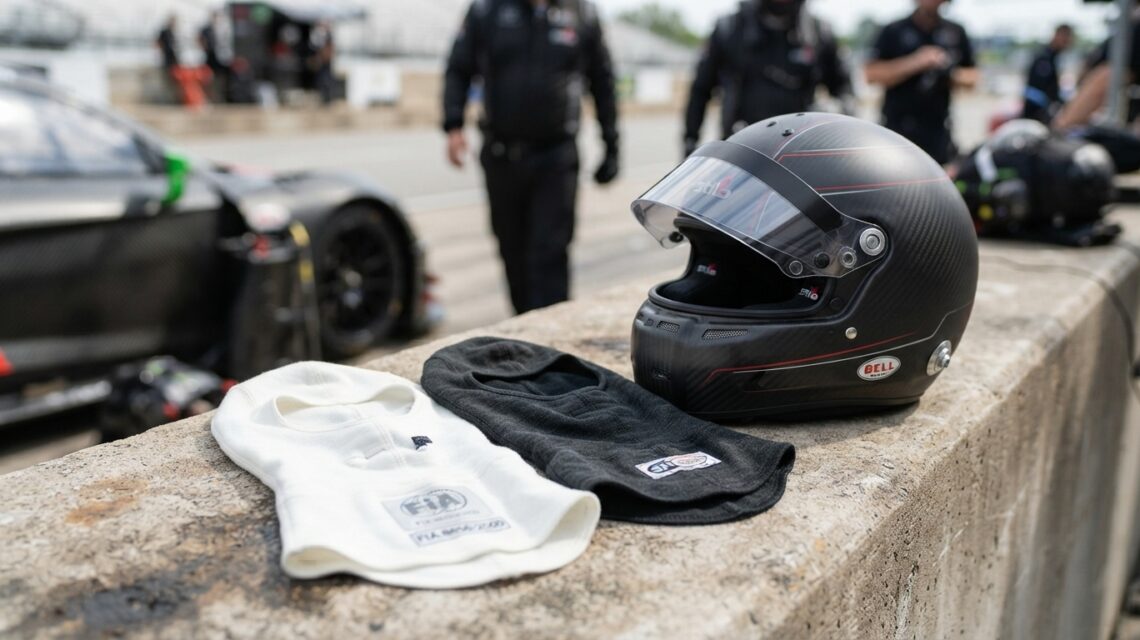
Both materials are designed to protect drivers from heat and flames, but FIA homologation, SFI certification, garment construction and racing regulations can determine which balaclava or base layer you are actually allowed to wear.
By Marcio Tamer
Updated November 23, 2026
Choosing fire-retardant underwear for racing is not simply a matter of finding the fabric that survives the hottest flame. The material underneath a racing suit must work as part of a complete protective system, covering exposed skin, reducing heat transfer, limiting flame exposure and meeting the technical requirements of the event in which the driver competes.
Nomex and CarbonX are two names frequently encountered when shopping for racing balaclavas, tops, bottoms and socks. Both are associated with flame-resistant protective clothing, but they approach thermal protection differently, and their products are not interchangeable under every motorsport rulebook.
The most important distinction is often the label. A garment made with a flame-resistant material is not automatically approved for every racing series. Drivers competing under FIA regulations may need FIA 8856-2018 homologated underwear, while many North American competitions use SFI-rated equipment. Buying the wrong certification can leave a driver with expensive clothing that fails technical inspection, regardless of its advertised thermal performance.
Nomex vs. CarbonX, the Main Differences
| Feature | Nomex and Nomex/FR blends | CarbonX |
|---|---|---|
| Material technology | Meta-aramid fibers, sometimes blended with flame-resistant viscose | Oxidized polyacrylonitrile-based fiber technology |
| Flame resistance | Inherent flame resistance, does not melt like common thermoplastic fibers | Designed to resist ignition and maintain a protective thermal barrier |
| Racing certification | Available in FIA 8856-2018 and SFI-certified garments, depending on product | Certain garments carry SFI 3.3 underclothing certification |
| Texture | Varies from traditional aramid feel to soft, stretchy technical knits | Often soft, flexible and cotton-like |
| Breathability | Depends on knit, weight, layering and ventilation zones | Depends on garment construction and fabric weight |
| Common applications | International circuit racing, rally, endurance, club racing | Drag racing, oval racing, club racing and other applications where approved |
| Main purchasing priority | Confirm FIA or SFI homologation required by the event | Confirm the exact SFI rating and series acceptance |
The table describes typical material technologies and product categories, not a guarantee that every garment made from either fiber carries the same certification or delivers identical protection.
Why FIA 8856-2018 Can Matter More Than the Brand
For drivers competing in FIA-regulated championships, homologation is often the first filter. FIA 8856-2018 covers protective clothing for automobile drivers, including racing suits, underwear, balaclavas, socks, shoes and gloves within the relevant product categories.
The standard is designed to evaluate protective clothing through controlled requirements rather than relying on a manufacturer’s description of its material. Drivers should check the homologation label, manufacturer, product identification and validity information before purchasing equipment.
The FIA’s current guidance states that clothing approved under 8856-2018 expires 10 years after its year of manufacture. This is not a reason to assume that every garment remains usable until that date, because damage, contamination, wear, repairs and event-specific requirements can affect whether equipment is accepted or safe to use.
For an international racer, this makes certified Nomex or Nomex-based FR underwear an easy starting point. The market offers balaclavas, tops, bottoms and socks designed to meet FIA requirements, making it easier to build a complete set without guessing whether individual pieces will be accepted.
CarbonX may offer excellent thermal characteristics, but the material name alone is not an FIA homologation. A driver should not substitute a CarbonX garment for an FIA-required product simply because the fabric is marketed as highly flame resistant.
How Nomex Protects the Driver
Nomex is a meta-aramid fiber known for its inherent flame resistance and thermal stability. Unlike ordinary polyester or nylon clothing, it is not designed to melt and drip onto the skin when exposed to high heat. Instead, the material resists ignition and undergoes thermal degradation and charring under severe heat exposure.
That behavior matters because racing underwear is not supposed to replace the outer suit. It adds another protective layer between the driver’s skin and the heat that may penetrate the racing suit during a fire. The entire system, including the suit, underwear, balaclava, socks, gloves, helmet and other protective equipment, must work together.
Modern race underwear is also significantly more comfortable than many drivers expect. Manufacturers use lightweight knitted fabrics, flat seams, stretch zones and different fabric densities to improve movement and reduce unnecessary bulk. Some garments combine aramid fibers with flame-resistant viscose or other materials to improve moisture handling and softness.
The result is that a modern FIA-certified base layer does not necessarily feel like a heavy industrial fire-protection garment. Lightweight construction can make a difference during endurance races, hot-weather events and long sessions in a cockpit where ventilation is limited.
What Makes CarbonX Different?
CarbonX is built around oxidized polyacrylonitrile, commonly abbreviated OPAN, as part of its flame-resistant fiber technology. Its manufacturer describes the material as having a high limiting oxygen index, meaning it requires a much higher oxygen concentration than normal atmospheric conditions to sustain combustion.
CarbonX’s published technical information describes an oxygen index of 55 for its OPAN-based fiber. The manufacturer also reports that the material carbonizes and expands when exposed to intense heat, contributing to a thermal barrier.
This is the central appeal of CarbonX. The fabric is engineered to retain protective properties under high-temperature exposure while remaining soft and flexible enough for wearable protective clothing. The company also describes its products as moisture-wicking, washable and resistant to losing their flame protection through ordinary washing.
However, manufacturer test claims should not be interpreted as proof that every CarbonX garment outperforms every FIA-approved Nomex garment in an actual cockpit fire. Different test methods measure different properties, and real-world protection depends on garment thickness, coverage, fit, seams, layering, exposure time and the complete protective system.
CarbonX is therefore best understood as an alternative flame-resistant textile technology, not a universal upgrade over certified racing underwear.
SFI 3.3 vs. FIA 8856-2018, What Drivers Need to Check
The certification question is where many purchasing mistakes occur.
FIA 8856-2018 and SFI 3.3 are separate standards. They should not be treated as interchangeable labels simply because both concern flame-resistant racing clothing.
| Requirement | FIA 8856-2018 | SFI 3.3 |
|---|---|---|
| Certification system | FIA homologation | SFI specification |
| Typical relevance | FIA-governed international motorsport | Many North American racing series |
| Product verification | FIA label, homologation details and validity | SFI label and exact garment rating |
| Automatic acceptance everywhere | No | No |
| Can the material name alone prove compliance? | No | No |
A driver racing internationally should begin with the FIA regulations applicable to the championship and event. A driver in an American club series, drag racing event or oval competition should consult the series’ own safety rules and technical inspection requirements.
Even within North American motorsport, the fact that a garment carries an SFI label does not mean it meets every clothing requirement at every track. The specification, garment type and rulebook matter.
The smartest purchasing decision is to confirm the required certification before comparing prices, fabric softness or color.
Which Balaclava Is Better for Hot Track Days?
Balaclavas are one of the most important pieces of racing underwear because they cover the head, neck and portions of the face that may otherwise be exposed around the helmet opening.
The best design depends on the helmet, seating position, cockpit environment, fit and the driver’s preferences. A balaclava that bunches around the forehead, compresses the ears or creates excessive material beneath the helmet can become uncomfortable during a long session.
Open-knit ventilation zones, lightweight fabric and flat seams can improve comfort, but they should never be used as substitutes for required fire-resistant coverage. The balaclava must fit correctly and maintain the protection expected by the event’s regulations.
A single-eye opening may be easier to wear and position, while a dual-eye design can suit certain drivers’ preferences. Neither design is universally superior. The driver’s helmet, face shape, eyewear and approved garment configuration determine which is more practical.
For hot-weather track days, prioritize a lightweight, certified garment with a comfortable fit and breathable construction. Avoid selecting underwear based exclusively on its thickness or the assumption that a heavier garment must provide better protection.
Can You Wear Regular Polyester or Nylon Under a Racing Suit?
This is where drivers should avoid improvisation.
Ordinary athletic compression clothing is not necessarily designed for cockpit fire exposure. Many synthetic fabrics used in sports apparel can soften, melt or behave differently when exposed to extreme heat. A garment that feels comfortable during a workout is not automatically appropriate beneath a racing suit.
The correct approach is to use the underwear required by the event’s regulations and the protective clothing manufacturer’s instructions. Where fire-resistant underwear is required, ordinary gym clothing is not a substitute.
For HPDE participants, requirements vary by organizer, vehicle, track and level of participation. Some events may permit a broader range of clothing under certain circumstances, but drivers should not interpret the absence of a mandatory underwear rule as evidence that ordinary synthetic clothing is the best safety choice.
A certified fire-resistant base layer adds a dedicated protective layer and reduces reliance on the outer suit alone.
Four Racing Balaclavas Worth Comparing
The following products represent different approaches to fit, certification and construction. Exact homologation and certification should be checked on the specific model and production version before purchase.
Alpinestars Race V3 Balaclava
Designed for drivers looking for lightweight construction and a close fit, the Race V3 is a representative option for those prioritizing modern racewear ergonomics, breathable fabric and helmet compatibility. Verify the exact FIA homologation label before using it in an FIA-regulated event.
Alpinestars ZX Evo V3 Balaclava
The ZX Evo V3 targets drivers who want additional construction features and specialized ventilation. Depending on the specific model, features such as hydration-tube compatibility, face-panel construction and fabric zones can make it more suitable for longer stints.
Sparco RW-11 Evo Balaclava
The Sparco RW-11 Evo is aimed at drivers who want a technical racing balaclava with a close fit and seam construction designed to reduce pressure points beneath the helmet. Certification and homologation should be confirmed for the exact model being purchased.
Simpson CarbonX Balaclava
The CarbonX option is an alternative for drivers interested in OPAN-based flame-resistant textiles and the soft feel associated with the CarbonX material family. It can be a strong candidate for SFI-oriented racing, but the product’s actual certification must match the series requirements.
The important comparison is not which brand has the most impressive flame demonstration. It is which certified garment fits correctly, covers the required areas, works with your helmet and remains comfortable throughout a race.
How to Build a Complete Fire-Resistant Base-Layer Kit
A proper racing base-layer kit should be selected as a system. Buying an approved balaclava while wearing noncompliant underwear or socks may leave the driver with an incomplete setup.
Before purchasing, check the following:
- Rulebook: Confirm the exact FIA or SFI requirements for the event.
- Balaclava: Verify certification, eye opening, neck coverage and helmet fit.
- Top: Choose a certified long-sleeve garment with appropriate coverage and comfortable seams.
- Bottoms: Confirm that the garment is approved and compatible with the racing suit.
- Socks: Select the correct fire-resistant product and required length.
- Fit: Avoid bunching, excessive compression or exposed skin between garments.
- Condition: Replace damaged, heavily worn or compromised clothing.
- Care: Follow the manufacturer’s cleaning and storage instructions.
A balaclava should overlap appropriately with the other approved garments so the neck area remains protected. The exact configuration should follow the clothing manufacturer’s instructions and applicable racing regulations rather than improvised layering rules.
Nomex or CarbonX, Which Should You Buy?
Choose FIA-homologated Nomex or an approved FR blend when FIA 8856-2018 compliance is required, when you race internationally or when you want a straightforward path to equipment inspection in FIA-regulated competition. Modern lightweight constructions can offer excellent comfort without forcing you to choose between protection and breathability.
Choose CarbonX when the exact garment carries the SFI certification required by your racing series, when its fit and comfort suit your cockpit and when you value its particular textile characteristics. Its soft feel and flame-resistant material technology make it an appealing alternative, but certification must be verified at the garment level.
For most drivers, the best purchase is not the fabric with the most dramatic laboratory claim. It is the correctly certified, undamaged garment that fits properly, covers the required areas and works with the rest of the racing safety equipment. In motorsport, the label is the starting point, not an afterthought.
+ Siga o Giro no Facebook
+ Siga o Giro no Instagram
Leia Mais: