

By Marke Tamer
Updated November 27, 2026
When opponents lob a padel team away from the net, the next overhead can determine who controls the rally. The bandeja and víbora are two of the most important responses, but they serve different tactical purposes. The bandeja prioritizes control, depth and recovery toward the net, while the víbora uses more aggressive sidespin and pace to pressure defenders.
For adult players choosing between specialized clinics, learning the bandeja first is usually the more reliable progression. It develops the positioning, contact control and recovery habits needed to handle difficult lobs. The víbora becomes a valuable next step when players can recognize shorter attacking opportunities and execute overheads without sacrificing balance.
Bandeja vs. Víbora: What Actually Changes?
Both shots are overheads played before the ball bounces, and both commonly use a continental grip. The main difference is how the racket contacts the ball, how much lateral spin the player generates, and what the shot is intended to accomplish.
| Technical factor | Bandeja | Víbora |
|---|---|---|
| Primary objective | Control the rally and maintain net position | Apply pressure and create difficult defensive rebounds |
| Typical situation | Deep or difficult lob | Shorter lob with time to prepare |
| Contact | In front of the body, at a controlled overhead height | More around the side of the ball |
| Spin | Slice or backspin | More pronounced sidespin combined with slice |
| Swing character | Compact and controlled | More rotational and aggressive |
| Typical target | Deep corners or middle | Side-wall and back-corner areas |
| Main risk | Short or predictable ball | Excessive pace, poor placement or loss of balance |
| Learning priority | Foundational overhead | More advanced attacking variation |
The distinction is tactical rather than simply a matter of power. A bandeja that lands deep and gives the pair time to recover can be more valuable than a fast víbora that allows the defenders to attack immediately.
Why the Bandeja Should Usually Come First
The bandeja is designed to solve a recurring problem in padel: how to respond to a lob without surrendering the net. Unlike a conventional tennis smash, it is not necessarily intended to finish the point. Its purpose is to send the ball deep enough, with enough slice, to make the opponents defend while the attacking pair re-establishes its position.
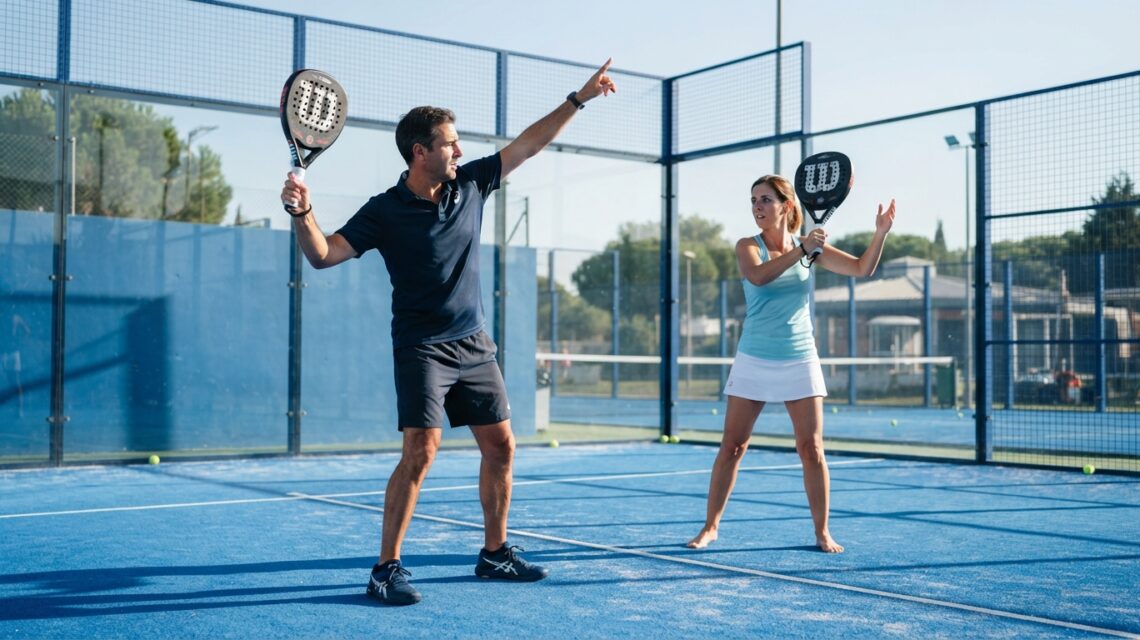
A bandeja clinic should begin with early preparation. As soon as the player recognizes the lob, the body turns sideways, the racket rises, and the non-dominant arm helps track the ball. Small adjustment steps are preferable to retreating with the body facing the net, which makes it harder to judge the contact point.
The swing should remain controlled. Players learn to contact the ball in front of the body, brush across and down its surface, and direct it toward a deep corner or the middle. The goal is not to hit as hard as possible. It is to make the opponents play another difficult ball while the pair moves forward together.
One of the most important clinic drills combines the overhead with recovery. The player receives a lob, executes a bandeja, and immediately moves forward with their partner before the next feed. Coaches evaluate not only whether the shot lands deep, but also whether the pair is ready for the next volley.
When the Víbora Becomes the Better Attacking Option
The víbora is more appropriate when the player has enough time to position under a shorter lob and can make contact from a balanced stance. Instead of prioritizing a controlled downward slice, the player brushes more around the side of the ball, producing a stronger sidespin effect.
That spin can make the rebound more difficult to read and control, particularly when the ball reaches the side glass or the junction between the side and back walls. The shot can force defenders to adjust their positioning or produce a weaker return that the attacking pair can finish.
However, the víbora is not automatically the right choice whenever the ball is above the player’s head. A short lob may create an opportunity for a more direct smash, while a deep lob may leave insufficient time to execute an aggressive sidespin shot safely.
Players also need to resist the temptation to generate spin through an isolated wrist snap. The movement should involve coordinated preparation, body rotation, arm acceleration and controlled contact. Trying to manufacture sidespin with excessive wrist action can disrupt accuracy and make the shot harder to repeat.
What Coaches Should Drill in a Bandeja Clinic
A good bandeja program develops three connected abilities: reading the lob, controlling the overhead and recovering toward the net.
First, coaches should feed balls with different depths and trajectories. Players need to recognize when they can stay near the net, when they must retreat, and when the lob is so deep that defending off the glass is the better decision.
Second, the clinic should emphasize contact quality. Players can begin with controlled feeds, aiming toward the deep middle and corners before attempting more difficult angles. The coach should check whether the racket face and contact point produce a low, controlled rebound rather than an easy ball for the defenders.
Finally, recovery should be included in every repetition. A successful bandeja is not simply a ball that lands near the back glass. It is a shot that helps the pair maintain or regain attacking court position.
What Coaches Should Drill in a Víbora Clinic
A víbora clinic should begin with positioning rather than power. Players must learn to recognize a suitable lob, turn early, create space between the body and the ball, and establish balance before accelerating the racket.
Once the contact point becomes consistent, coaches can introduce more pronounced sidespin and progressively more demanding targets. The side-wall and back-corner areas are useful training objectives because they test both directional control and the ability to create an awkward rebound.
A common mistake is attempting the víbora while moving backward or reaching behind the body. This usually compromises contact quality and can produce a weak ball that the opponents attack. The coach should reduce feed difficulty until the player can execute the movement with control.
The final progression should include tactical decisions. Players receive a mixture of deep and short lobs and must choose between bandeja, víbora, and a more direct smash when the opportunity genuinely exists.
What the Research and Coaching Standards Actually Say
The French Tennis Federation’s padel instructor guide provides a useful framework for understanding how these shots fit into player development. Its technical progression expects players to develop control of aerial shots, improve body positioning and coordination, introduce spin, and eventually make better decisions between bandeja and víbora.
This is more useful than assigning a universal rating threshold. Playtomic levels are not a standardized technical certification for these shots, and a player rated 3.5 is not automatically ready for a consistent attacking víbora. Individual footwork, timing, contact quality and tactical judgment matter more than a single app rating.
The scientific evidence also requires some caution. Padel biomechanics research has historically concentrated more heavily on other strokes than on detailed laboratory comparisons of the bandeja and víbora. Coaching descriptions of their spin and tactical differences are well established, but precise claims about wrist torque, injury rates, or guaranteed match-winning percentages should not be treated as proven scientific results.
Which Overhead Clinic Should You Book?
| Your current problem | Better starting point |
|---|---|
| You lose the net whenever opponents lob | Bandeja |
| Your overheads rebound too high off the back glass | Bandeja |
| You struggle to position under deep lobs | Bandeja |
| You can control deep overheads but lack attacking variation | Víbora |
| You reach the ball balanced and want to pressure the side wall | Víbora |
| You attempt aggressive overheads while falling backward | Return to bandeja fundamentals |
For most adult recreational players, the bandeja clinic is the better first investment. It develops the tactical foundation for handling lobs, controlling depth and recovering as a pair. A useful personal benchmark is to execute eight out of ten controlled bandejas toward a defined target during practice, although this is a coaching goal rather than an official qualification standard.
The víbora clinic becomes more valuable when those fundamentals are reliable and the player can distinguish a defensive lob from an attacking opportunity. The objective is not to replace every bandeja with a more aggressive shot. It is to add another option without losing the tactical discipline that makes overhead play effective in padel.
The most effective players do not simply hit the harder overhead. They recognize which shot gives their pair the best chance of controlling the next ball.
+ Siga o Giro no Facebook
+ Siga o Giro no Instagram
Leia Mais: