

Graham Hill and Jochen Rindt crashed their Lotus cars at almost the same corner during the 1969 Spanish Grand Prix. The failures exposed a dangerous flaw in Formula 1’s aerodynamic revolution and led officials to ban the towering wings before the next race in Monaco.
By Marcio Tamer
Updated October 27, 2026
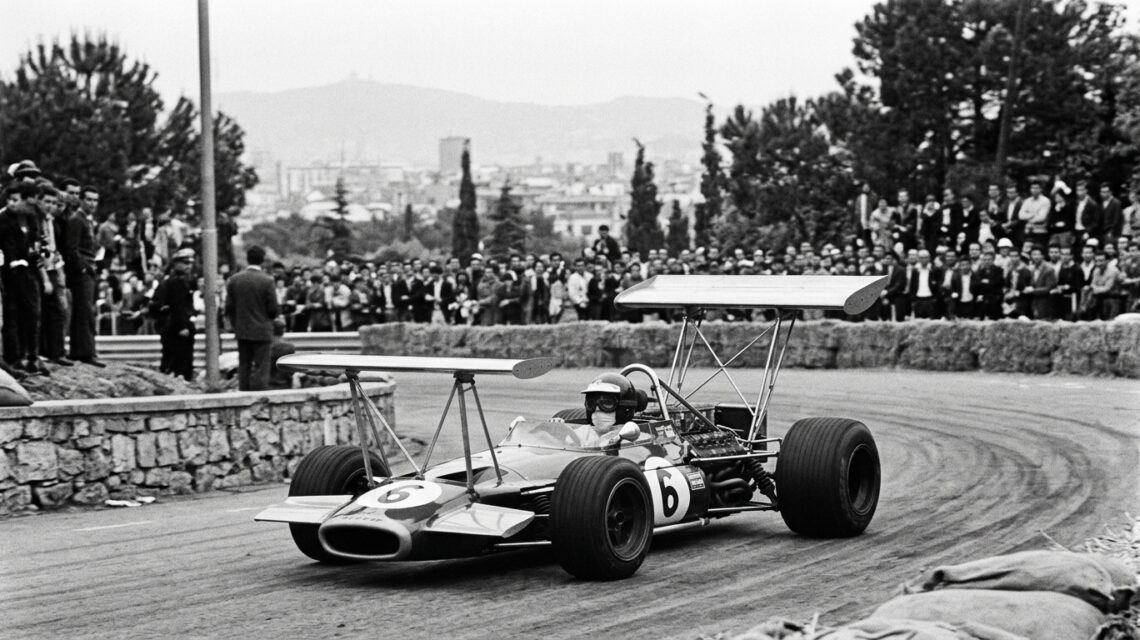
On May 4, 1969, two Formula 1 drivers crashed at almost exactly the same location during the Spanish Grand Prix in Barcelona. Both were driving Lotus 49B cars fitted with enormous aerodynamic wings mounted high above the rear wheels on slender metal supports.
Graham Hill crashed first, escaping without serious injury. Eleven laps later, his teammate Jochen Rindt suffered an even more violent accident after his rear wing collapsed while he was traveling at approximately 140 mph (225 km/h).
Rindt’s car struck the barriers, collided with the wreckage of Hill’s abandoned Lotus and overturned. He survived, but suffered facial injuries, including a broken nose.
The crashes exposed a dangerous weakness in one of Formula 1’s newest technological developments.
Engineers had discovered that aerodynamic wings could generate downforce, pushing cars toward the road and allowing them to corner at much higher speeds. But some teams had mounted these increasingly powerful devices on tall, lightly built supports connected to suspension components.
The wings produced enormous aerodynamic loads. Their mountings were not always strong enough to withstand them.
The consequences became unmistakable at the Montjuïc circuit.
Before the next Grand Prix in Monaco, Formula 1’s governing authorities intervened, banning the unrestricted high-wing designs that had helped transform the cars’ appearance and performance.
The decision did not end aerodynamic development. It forced engineers to rethink how wings should be mounted, supported and regulated.
Formula 1 discovered that wings could make cars faster without increasing engine power
By the late 1960s, Formula 1 engineers were searching for new ways to improve cornering performance.
Traditional approaches focused on engine output, suspension geometry, tires and vehicle weight.
Aerodynamics offered another possibility.
An aircraft wing is normally designed to generate lift. A racing car wing can be arranged to produce the opposite effect: downforce.
Instead of pushing a vehicle upward, the airflow pushes it toward the track.
That additional vertical load increases the force available between the tires and the road, allowing the car to generate greater cornering and braking forces.
The attraction was enormous.
A car could travel faster through corners without requiring a more powerful engine.
The principle had already been explored in sports-car racing.
American designer Jim Hall’s Chaparral cars were especially influential in demonstrating the potential of aerodynamic devices.
Formula 1 teams began adopting similar ideas during the 1968 season.
Ferrari, Lotus and other constructors experimented with wings as they searched for greater grip.
At first, the devices were relatively modest.
But once their performance benefits became clear, development accelerated.
Within months, Formula 1 cars began appearing with increasingly large wings positioned high above the bodywork.
The aerodynamic revolution had begun.
Why engineers mounted the wings so high above the cars
The placement of the early wings was not accidental.
Engineers wanted the aerodynamic surfaces to operate in relatively undisturbed airflow.
Air passing over the car’s bodywork could become turbulent, reducing the effectiveness of a wing mounted close to the chassis.
Raising the wing allowed it to interact with cleaner airflow.
That could increase the downforce generated for a given wing design.
Teams also experimented with mounting wings directly to suspension components rather than to the main body of the car.
The idea was technically attractive.
A wing attached to the suspension could transmit its aerodynamic load more directly toward the wheels.
In theory, that reduced some of the complications associated with loading the sprung mass of the car.
But the arrangement introduced new structural risks.
The aerodynamic force was being carried through mounting supports and suspension components that also had to withstand the demands of racing.
As wings became larger and more powerful, the loads increased.
The slender supports that initially appeared sufficient could become vulnerable to bending, vibration and structural failure.
That weakness would have catastrophic consequences if a wing collapsed during a high-speed corner.
The danger was not downforce itself, but the way it was being produced
Downforce is a fundamental part of modern Formula 1.
The problem in 1969 was not that engineers had discovered an inherently unsafe aerodynamic principle.
It was that the technology was developing faster than the rules governing its construction.
Some teams used tall metal struts to support wings positioned well above the car.
These structures were relatively light, but they had to resist substantial aerodynamic forces.
The loads increased rapidly with speed.
Under otherwise similar conditions, aerodynamic force rises approximately with the square of velocity.
That means doubling a car’s speed can produce roughly four times the aerodynamic force.
A support that survives moderate-speed testing may therefore experience much greater stress at racing speed.
The consequences of failure were especially dangerous because the wing was not merely a decorative component.
It was actively helping the tires maintain grip.
If the wing suddenly collapsed, the car could lose a large amount of downforce almost instantly.
At high speed, that abrupt change could destabilize the vehicle before the driver had time to react.
The combination of large aerodynamic loads, slender supports and sudden loss of grip made the high-wing era particularly hazardous.
How the 1969 wing designs created a dangerous chain of failures
The failure mechanism involved several interconnected problems.
First, the wings generated substantial downforce at high speed.
Second, their elevated mounting positions placed significant bending loads on the supports.
Third, the supports and their attachment points had to endure vibration, changes in aerodynamic loading and the mechanical stresses of racing.
Finally, a structural failure could remove the downforce that was helping the car remain stable.
The resulting loss of grip could be immediate.
A driver might enter a corner expecting the car to behave normally, only to discover that a major aerodynamic component had stopped functioning.
There was little opportunity to recover.
The design also created additional risks for other competitors and spectators.
A detached wing could become debris.
A car that suddenly lost control could strike barriers or leave the circuit.
At Montjuïc, those dangers became reality.
The Spanish Grand Prix took place on one of Formula 1’s most demanding street circuits
The 1969 Spanish Grand Prix was held at the Montjuïc circuit in Barcelona.
The course ran through public roads in the Montjuïc Park area.
It featured elevation changes, fast corners and sections where the cars approached barriers at high speed.
Unlike a modern permanent racing facility, the circuit offered limited space for drivers to recover from serious mechanical failures.
The race took place on May 4 as the second round of the 1969 Formula 1 World Championship.
Lotus arrived with two leading drivers.
Graham Hill was the reigning world champion, having won the 1968 title.
Jochen Rindt was one of the fastest drivers in the field and had qualified on pole position.
Their Lotus 49B cars were fitted with high-mounted rear wings.
The devices had become a defining feature of Formula 1’s rapid aerodynamic development.
But the Spanish Grand Prix would demonstrate how vulnerable those designs could be under extreme conditions.
Graham Hill crashed first after his Lotus wing failed
Hill’s accident occurred early in the race.
As he approached the fast section near the beginning of the lap, his Lotus suddenly became unstable.
The car left the racing line and struck the barriers.
Contemporary race reports initially described uncertainty about the precise cause.
Subsequent accounts identified a failure involving the car’s high-mounted rear wing.
The sudden aerodynamic change left Hill unable to control the Lotus.
The car was badly damaged.
Fortunately, Hill escaped without serious injury.
The wreckage remained near the circuit.
At that moment, the accident was alarming but not yet recognized as the beginning of a wider crisis.
The race continued.
Rindt remained in contention at the front.
But the same structural weakness would soon produce an even more violent crash.
Jochen Rindt’s wing collapsed at approximately 140 mph
On lap 20, Rindt approached almost the same location where Hill had crashed.
He was leading the race.
Then his rear wing collapsed.
The Lotus became unstable at approximately 140 mph, or 225 km/h.
Rindt lost control and struck the barriers.
The impact was severe.
His car then collided with the wreckage of Hill’s abandoned Lotus before overturning.
The Austrian driver was trapped inside the damaged vehicle.
Marshals and medical personnel rushed to the scene.
Rindt survived, but suffered facial injuries, including a broken nose.
The accident was particularly disturbing because it closely resembled Hill’s earlier crash.
Two cars from the same team had suffered catastrophic incidents at nearly the same point on the circuit.
The common factor was the failure of their high-mounted aerodynamic equipment.
The danger was no longer theoretical.
The technology had produced a sequence of accidents that could easily have been fatal.
The two Lotus crashes were not the only wing-related problems that day
The Spanish Grand Prix produced further evidence that the aerodynamic designs were placing dangerous demands on the cars.
Jacky Ickx suffered problems with the rear wing on his Brabham.
Contemporary reporting described the wing structure breaking apart during the race.
He returned to the pits for repairs.
Later, he retired with suspension failure.
The sequence reinforced concerns about the interaction between aerodynamic loads and suspension components.
The race itself was eventually won by Jackie Stewart in a Matra.
But the sporting result was overshadowed by the wing failures.
The accidents raised an urgent question for Formula 1’s governing authorities.
Could the cars continue racing with large wings mounted on structures that might collapse without warning?
The events in Barcelona made the answer increasingly difficult to ignore.
Jochen Rindt warned Lotus that its cars needed stronger components
Rindt’s concerns extended beyond the immediate injuries he suffered.
After the Spanish Grand Prix, he wrote to Lotus founder Colin Chapman about the safety of the team’s cars.
The letter, dated May 9, 1969, reflected his growing frustration with mechanical failures.
Rindt argued that the Lotus cars were already fast enough to remain competitive even if additional weight was required to strengthen vulnerable components.
His warning was significant because it came from a driver who had experienced the consequences firsthand.
He was not criticizing aerodynamic development from a distance.
He had survived a high-speed crash caused by a structural failure.
The letter also revealed a broader tension within Formula 1.
Engineers were pursuing lighter and faster cars.
Drivers were increasingly concerned that the pursuit of performance was reducing safety margins.
Rindt’s experience became one of the clearest examples of that conflict.
The issue was not whether innovation should continue.
It was whether teams were adequately accounting for the risks created by their designs.
Formula 1 banned the high wings before the Monaco Grand Prix
The Spanish Grand Prix took place on May 4, 1969.
The next World Championship race was scheduled for Monaco on May 18.
During the Monaco Grand Prix weekend, the sport’s governing authorities intervened.
The Commission Sportive Internationale, the FIA’s sporting authority at the time, imposed an emergency restriction on the use of wings.
The unrestricted high-mounted designs were no longer permitted.
The intervention was dramatic because teams had already developed cars around the aerodynamic devices.
Removing the wings changed the vehicles’ handling characteristics and required rapid adjustments.
Some constructors argued that the decision was too abrupt.
But the authorities considered the safety risks unacceptable.
The measure was not a permanent prohibition on all aerodynamic wings.
It was an emergency response to the dangerous designs that had emerged during the previous year.
Formula 1 subsequently introduced more specific restrictions governing wing dimensions, mounting positions and movement.
The central principle was that aerodynamic devices had to be securely attached to the car’s sprung structure rather than mounted on suspension components.
The rules also restricted movable aerodynamic devices.
The sport had accepted that downforce was valuable.
It now had to establish limits on how that downforce could be generated.
What changed in Formula 1’s aerodynamic regulations
The post-Barcelona rules represented an important turning point.
Before the intervention, teams had considerable freedom to experiment with wing placement and mounting systems.
That freedom encouraged rapid innovation but also allowed potentially dangerous designs to reach the track.
After the emergency restrictions, aerodynamic devices were subject to clearer requirements.
Wings had to be mounted more securely.
Their dimensions and positions became regulated.
And movable systems that could alter aerodynamic behavior during a lap faced restrictions.
The changes did not eliminate aerodynamic experimentation.
Instead, they redirected it.
Engineers continued developing wings, spoilers and bodywork designed to improve performance.
But the extreme high-mounted configurations of early 1969 disappeared.
The lesson was that aerodynamic performance could not be considered independently of structural safety.
A wing capable of producing enormous downforce was useful only if the car could withstand the resulting loads.
Why the 1969 crisis mattered beyond the two Lotus crashes
The events at Montjuïc exposed a broader problem in Formula 1’s development.
The sport had entered an era in which new technologies could produce dramatic performance gains in a very short period.
But the regulations had not evolved at the same pace.
The high-wing designs were an example of innovation moving ahead of established safety standards.
Teams had discovered a powerful aerodynamic advantage.
They then pushed the concept toward increasingly extreme configurations.
The consequences became visible only when components failed under racing conditions.
The emergency ban demonstrated that Formula 1’s governing authorities were willing to intervene when technical freedom created unacceptable risks.
That principle would become increasingly important as the sport developed.
Later decades brought further debates over ground-effect aerodynamics, active suspension, electronic systems and other technologies.
The details differed, but the underlying question remained similar.
How much engineering freedom should be permitted when performance gains can also introduce new dangers?
The 1969 wing crisis became an early example of that debate.
The numbers behind the 1969 Spanish Grand Prix wing failures
| Detail | Historical record |
|---|---|
| Date | May 4, 1969 |
| Race | Spanish Grand Prix |
| Circuit | Montjuïc, Barcelona |
| Car involved in both major crashes | Lotus 49B |
| Graham Hill’s accident | Early in the race, after completing eight laps |
| Jochen Rindt’s accident | Lap 20 |
| Approximate speed of Rindt’s crash | 140 mph (225 km/h) |
| Rindt’s injuries | Facial injuries, including a broken nose |
| Race winner | Jackie Stewart |
| Next Grand Prix | Monaco, May 18, 1969 |
| Regulatory response | Emergency restrictions on high-mounted wings |
| Longer-term change | More restrictive rules on wing mounting, dimensions and movement |
The figures illustrate how quickly the crisis developed.
Formula 1’s high-wing designs had become widespread during the previous season.
By the second race of 1969, their structural weaknesses had produced two major accidents in the same event.
The governing authorities responded before the next race.
The entire sequence unfolded in less than two weeks.
The aerodynamic revolution continued after the ban
The emergency restrictions did not reverse Formula 1’s aerodynamic progress.
Engineers continued searching for ways to generate downforce.
Over the following years, wings became more integrated into the overall design of racing cars.
Their shapes, positions and interactions with the bodywork were studied with increasing sophistication.
The development of ground-effect aerodynamics in the 1970s would eventually transform Formula 1 again.
Cars began using the airflow beneath their bodies to generate substantial downforce.
That technology introduced new performance possibilities and additional safety challenges.
The history of Formula 1 aerodynamics therefore did not end with the removal of towering wings.
The 1969 crisis helped establish the principle that aerodynamic devices had to be treated as critical structural and safety components.
A wing was not simply an accessory attached to a racing car.
It was a system capable of dramatically changing the forces acting on the vehicle.
If it failed, the consequences could be immediate and severe.
Jochen Rindt’s later death gave the warning an even darker meaning
The story acquired a tragic dimension the following year.
In September 1970, Rindt was killed during practice for the Italian Grand Prix at Monza.
He was driving a Lotus 72.
The accident was not caused by the same high-mounted wing failure that had injured him in Barcelona.
It occurred under different circumstances and should not be treated as a direct continuation of the 1969 technical problem.
Nevertheless, Rindt’s death intensified the historical significance of his earlier safety warnings.
He had already expressed concern about the structural reliability of racing cars.
His fatal accident reinforced the broader dangers faced by Formula 1 drivers during that era.
Rindt became the sport’s only posthumous world champion when his points total remained sufficient to secure the 1970 title.
His career therefore connects two important aspects of Formula 1 history.
He was one of the fastest drivers of his generation.
And he was among those who recognized that engineering progress could become dangerous when safety margins were neglected.
Why Formula 1’s giant wings disappeared but their legacy remained
The towering wings of 1969 were visually spectacular.
They made Formula 1 cars look unlike anything that had raced before.
But their appearance reflected a period when aerodynamic understanding was advancing faster than structural regulation.
Engineers had discovered that downforce could transform cornering performance.
They had not yet established sufficiently robust standards for mounting the devices that produced it.
The crashes of Hill and Rindt exposed that weakness in the most dramatic way.
Both drivers survived.
But their accidents demonstrated how easily a technical failure could turn a high-speed racing car into an uncontrollable object.
The emergency restrictions introduced before Monaco marked the end of Formula 1’s brief high-wing era.
They did not end the pursuit of aerodynamic performance.
Instead, they forced the sport to develop that performance within clearer technical limits.
The lasting significance of the 1969 Spanish Grand Prix is therefore not that Formula 1 abandoned wings.
It is that the sport learned, through two violent crashes, that aerodynamic innovation could not be separated from the structural integrity of the car.
+ Siga o Giro no Facebook
+ Siga o Giro no Instagram
Leia Mais: