

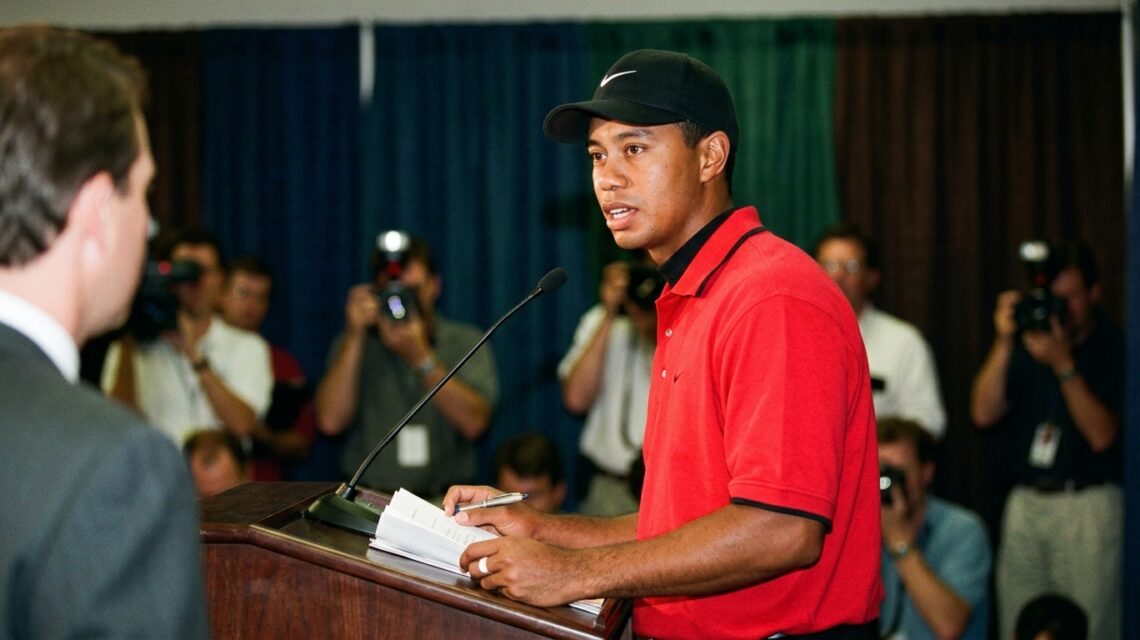
Woods was just 20 when Nike signed him to a five-year endorsement deal. His rise helped turn a small golf apparel operation into a major brand, but Nike’s eventual retreat from equipment reveals the difference between selling a superstar’s image and making money from the products he uses.
By Marcio Tamer
Updated November 5, 2026
In August 1996, Nike agreed to pay a 20-year-old golfer a reported $40 million over five years, even though the company did not yet manufacture the clubs or balls he would use in professional competition.
The golfer was Tiger Woods.
He had just won his third consecutive U.S. Amateur Championship and was preparing to make his professional debut.
Nike already sold golf shoes, clothing and accessories. But it lacked a complete equipment business capable of competing with established manufacturers such as Titleist, Callaway and TaylorMade.
That made the deal unusual.
Nike was not paying Woods primarily to demonstrate its golf clubs. It was investing in his image, his future victories and his ability to bring new consumers into the sport.
The gamble appeared to work almost immediately.
Nike’s golf apparel and footwear sales reportedly doubled to $120 million in the fiscal year ending May 1997.
The company expanded into golf balls in 1998 and launched retail golf clubs in 2002.
By fiscal 2015, Nike Golf was generating approximately $769 million in annual revenue.
But the story took an unexpected turn.
In August 2016, Nike announced that it would stop manufacturing golf clubs, balls and bags.
Woods continued representing Nike until January 2024, ending a partnership that had lasted more than 27 years.
The company had helped transform golf marketing, built a major equipment operation and then concluded that its strongest business opportunity lay elsewhere.
Why Nike offered $40 million to a golfer who had never played professionally
Tiger Woods entered professional golf with an extraordinary amateur record.
He had won three consecutive U.S. Junior Amateur Championships from 1991 through 1993.
He followed those victories with three consecutive U.S. Amateur titles from 1994 through 1996.
No previous player had achieved that combination.
His final amateur victory came at Pumpkin Ridge Golf Club in Oregon in August 1996.
Nike co-founder Phil Knight had followed Woods for years.
In a 2017 interview, Knight said the company had been cultivating a relationship with Woods for approximately three years before he turned professional.
Nike recognized that Woods offered something beyond sporting potential.
He was young, charismatic and capable of attracting attention from audiences that had rarely followed professional golf.
The company had already built its marketing identity around athletes such as Michael Jordan.
Its advertising emphasized individual achievement, personality and cultural influence.
Woods fit that strategy.
The reported five-year, $40 million contract was extraordinary for an athlete who had yet to compete professionally.
At approximately $8 million annually, it represented a major commitment to an unproven commercial asset.
But Nike was betting on the career Woods might have, not the professional record he already possessed.
The “Hello, World” campaign turned a debut into a global advertisement
Woods announced his professional career in August 1996 with the words Hello, world.
Nike used the phrase in a major advertising campaign.
The message introduced Woods as a new figure in professional golf.
It also challenged the sport’s established image.
Golf had long been associated with exclusive clubs, expensive equipment and a predominantly white professional establishment.
Woods’ arrival generated interest among audiences that had not traditionally followed the sport.
Nike’s campaign emphasized his youth and the barriers he had encountered.
The advertisements helped turn his professional debut into a cultural event.
Woods played his first PGA Tour event as a professional at the Greater Milwaukee Open.
He finished tied for 60th.
The result was modest compared with the expectations surrounding him.
But his commercial impact was already evident.
Nike had secured a highly visible athlete at the beginning of what could become a historic career.
The company did not need Woods to win immediately for the marketing investment to attract attention.
His presence alone created publicity.
Nike already had a golf business before Woods arrived
The claim that Woods forced Nike to create golf operations entirely from scratch is inaccurate.
Nike had been involved in golf for more than a decade.
The company introduced golf shoes in 1984.
It signed Spanish golfer Seve Ballesteros in 1985.
It also sponsored college golf teams and professional players.
In 1989, Nike introduced its first golf glove.
By the early 1990s, it was selling additional golf accessories.
The company also sponsored the PGA Tour’s developmental circuit, which became known as the Nike Tour.
Those activities established a presence in the sport.
But golf remained a relatively small part of Nike’s business.
The company did not yet offer a complete line of high-performance clubs and balls.
That was the opportunity Woods helped accelerate.
Nike already understood footwear, apparel and athlete marketing.
What it lacked was the technical infrastructure to compete across the full golf-equipment market.
Woods’ success gave the company a compelling reason to build that infrastructure.
Nike’s golf sales doubled after the signing
The commercial response to Woods was rapid.
In August 1997, the Los Angeles Times reported that Nike’s golf apparel and footwear sales had increased 100% to $120 million in the fiscal year ending May 31.
That implied sales of approximately $60 million in the preceding fiscal year.
Nike expected the category to exceed $200 million in the following year.
The growth occurred as Woods became the most talked-about player in golf.
In April 1997, he won the Masters Tournament by 12 strokes.
At 21, he became the youngest Masters champion at the time.
His victory attracted enormous attention.
It also gave Nike one of the most recognizable images in sports: Woods wearing the company’s logo while dominating one of golf’s most prestigious events.
But the sales increase should not be interpreted as a precise measure of Woods’ individual contribution.
Nike’s golf business was already expanding.
The company also benefited from broader distribution, product development and marketing.
Woods was an important driver of attention.
The available financial records do not isolate exactly how much revenue he personally generated.
Titleist supplied the equipment while Nike sold the image
During the early years of the partnership, Woods wore Nike apparel and footwear while playing equipment from other manufacturers.
He used Titleist golf balls.
His clubs included equipment from Titleist and Mizuno.
That arrangement reflected Nike’s limited equipment capabilities.
Woods also had a separate endorsement agreement with Titleist.
Contemporary reporting described the initial deal as approximately $3 million over three years.
That was far smaller than Nike’s $40 million commitment.
The distinction reveals how differently the companies valued Woods.
Titleist wanted a talented player using its equipment.
Nike wanted a global sports personality who could attract consumers across multiple product categories.
The arrangement eventually created tension.
In 1999, Titleist sued Nike over advertisements that it argued improperly suggested Woods was endorsing Nike golf balls.
The dispute demonstrated the commercial importance of equipment visibility.
A golfer’s ball and clubs are central to competitive performance.
Manufacturers pay substantial sums to associate their products with elite players.
Nike’s long-term ambition was to move beyond clothing and footwear.
It wanted Woods to compete using Nike equipment as well.
Nike began manufacturing golf balls in 1998
Nike introduced its first golf balls in 1998.
The initial range included several models under the Precision name.
The company was entering a technically demanding market.
Golf-ball performance depends on materials, construction, aerodynamics and manufacturing consistency.
Established brands had decades of experience.
Nike needed to develop products that could compete at the highest level.
The company also needed professional players willing to use them.
In 1999, Glen Day became the first player to win a PGA Tour event using a Nike golf ball.
The victory provided evidence that the company’s equipment could succeed in professional competition.
But the most important endorsement remained Woods.
In May 2000, he announced that he would switch from Titleist to a Nike golf ball.
The move was a major commercial milestone.
Nike could now connect Woods’ performances directly to one of its own technical products.
The company had moved from selling his image to supplying equipment he trusted in competition.
The Nike ball became part of the Tiger Slam
Woods began using Nike’s Tour Accuracy golf ball in 2000.
That summer, he won the U.S. Open at Pebble Beach by 15 strokes.
He then won The Open Championship at St Andrews.
In August, he captured the PGA Championship.
The following April, he won the 2001 Masters.
Those victories gave Woods possession of all four major championship titles simultaneously.
The achievement became known as the Tiger Slam.
It was not a calendar-year Grand Slam because the victories occurred across two seasons.
But it was an unprecedented achievement in modern men’s professional golf.
For Nike, the timing was extraordinary.
Woods completed the feat using the company’s golf ball.
The success strengthened Nike’s credibility as an equipment manufacturer.
It also increased the commercial value of the partnership.
Woods was no longer merely a promising young player.
He had become the dominant figure in professional golf.
Nike agreed to a reported $100 million renewal in 2000
Nike did not wait until the original contract expired to secure Woods’ future.
In September 2000, the company agreed to a new five-year endorsement arrangement.
Contemporary reports valued the agreement at approximately $100 million.
That represented a major increase from the original $40 million contract.
The new agreement was widely described as one of the richest athlete endorsement deals in sports history.
Woods had already won multiple major championships.
His television appeal had grown.
His commercial value had increased dramatically.
The renewal demonstrated how Nike’s original gamble had changed.
In 1996, the company had paid for potential.
By 2000, it was paying to retain one of the world’s most valuable sports personalities.
The relationship also supported Nike’s expanding equipment ambitions.
The company was developing clubs and building a dedicated golf operation.
Woods provided the brand recognition needed to enter a market dominated by established competitors.
Nike Golf became a dedicated business in 2001
Nike’s golf operations expanded significantly after Woods’ early success.
In 2001, Nike Golf became a distinct division within the company.
The business employed more than 200 people.
Nike also hired equipment designer Tom Stites and acquired his company, Impact Golf Technologies.
Stites became director of product creation for golf equipment.
The move strengthened Nike’s technical capabilities.
The company was preparing to compete directly with established club manufacturers.
Its development work included drivers, irons, wedges and putters.
Nike also invested in research and testing facilities.
The company opened a development center known as The Oven in Fort Worth, Texas.
The facility became associated with advanced club design and professional-player testing.
The business was no longer simply an apparel operation built around a celebrity endorsement.
Nike was attempting to become a complete golf-equipment manufacturer.
That required engineering expertise, manufacturing relationships and distribution.
The investment went far beyond the original endorsement contract.
Nike clubs reached retail stores in 2002
Nike introduced its first golf clubs for retail sale in February 2002.
The launch marked another stage in the company’s expansion.
Woods began using Nike clubs during the same year.
The transition was gradual.
Elite golfers are highly sensitive to changes in equipment.
Even small differences in feel, launch characteristics and performance can affect results.
Nike needed to produce clubs that met Woods’ standards.
The company also had to persuade ordinary consumers that its products could compete with established brands.
Woods’ endorsement gave Nike immediate visibility.
But brand recognition alone could not guarantee equipment sales.
Golfers compare clubs based on performance, price, fitting and personal preference.
Nike had to develop a credible product range.
Its equipment business eventually included drivers, irons, wedges, putters and golf balls.
The company also continued selling footwear and apparel.
By the mid-2000s, Nike Golf had become a significant participant in the industry.
Tiger Woods helped expand golf’s television audience
Woods’ influence extended beyond Nike’s product sales.
His performances attracted viewers who might not otherwise have watched professional golf.
The 1997 Masters became a landmark television event.
CBS reported an average rating of 14.1 for the final round.
That was the highest final-round rating in Masters history at the time.
The tournament demonstrated Woods’ ability to attract a mass audience.
His presence also increased the commercial value of major golf events.
Sponsors and broadcasters recognized that tournaments featuring Woods could generate exceptional attention.
The PGA Tour benefited from the broader growth of golf’s television business.
Prize money also increased substantially during Woods’ career.
But it would be inaccurate to attribute every increase in purses and broadcasting revenue solely to Woods.
Television contracts, sponsorship markets, economic conditions and the Tour’s own commercial strategy also influenced growth.
Woods was a major catalyst.
He was not the only cause.
The distinction matters because the phrase Tiger Effect describes a broad commercial phenomenon rather than a precisely measurable financial contribution.
Nike Golf reached hundreds of millions in annual revenue
Nike Golf continued expanding during the 2000s.
The company developed new equipment lines.
It introduced innovative club designs.
It signed additional professional golfers.
Its apparel and footwear products became widely recognizable.
The business benefited from Woods’ continued success.
He won 14 major championships between 1997 and 2008.
His red Sunday shirt became one of the most recognizable images in golf.
Nike built an extensive product identity around him.
The company also expanded its international distribution.
By fiscal 2015, Nike Golf generated approximately $769 million in revenue.
That was a substantial increase from the $120 million in golf apparel and footwear sales reported in fiscal 1997.
But the comparison requires caution.
The earlier figure covered apparel and footwear.
The later figure covered the broader Nike Golf business, including equipment.
The categories were not identical.
The figures nevertheless show the scale of Nike’s expansion into golf.
What had been a relatively small business became a major global product category.
Nike Golf’s revenue fell to $706 million in 2016
The company’s financial performance eventually weakened.
Nike’s fiscal 2016 annual report showed that Nike Golf revenue declined to $706 million.
That represented an 8.2% decrease from approximately $769 million in fiscal 2015.
The decline made golf one of Nike’s weaker major categories.
The company faced intense competition in equipment.
Established manufacturers retained strong positions.
Golf participation trends also created challenges in some markets.
Nike had invested heavily in developing clubs and balls.
But the business did not achieve the scale or profitability the company wanted.
The problem was not Woods’ popularity.
He remained one of the most recognizable athletes in the world.
The issue was whether Nike could earn an attractive return from manufacturing and selling golf equipment.
Those are different commercial questions.
A superstar endorsement can generate attention.
It cannot guarantee that every product category will be profitable.
Phil Knight said Nike lost money on golf equipment for 20 years
In 2017, Phil Knight offered a revealing explanation for Nike’s decision to leave the equipment business.
He said the company had lost money on golf equipment and balls for approximately 20 years.
Knight’s comments provided rare insight into the economics behind Nike Golf.
The company had generated substantial revenue.
It had developed sophisticated products.
It had sponsored elite athletes.
But its equipment operation had not delivered the financial results Nike wanted.
That distinction is crucial.
Revenue measures sales.
Profitability measures what remains after costs.
A business can generate hundreds of millions of dollars in annual revenue while failing to produce an acceptable return.
Nike’s experience demonstrated the difficulty of competing in a specialized equipment market.
The company had global brand recognition.
It had access to one of the greatest golfers in history.
It had invested in research and development.
Yet those advantages were not enough to make its equipment operation commercially attractive over the long term.
Nike abandoned golf equipment in 2016
On August 3, 2016, Nike announced that it would stop manufacturing golf clubs, balls and bags.
The company said it would concentrate on golf footwear and apparel.
The decision marked a major strategic reversal.
Nike had spent years developing a complete equipment business.
It had invested in technology, manufacturing and professional endorsements.
But it concluded that its strongest opportunities lay in categories where it already possessed greater competitive advantages.
The company continued selling golf clothing and shoes.
It also maintained its relationship with Woods.
The equipment exit did not mean Nike had abandoned golf entirely.
It meant the company had separated its profitable brand and apparel opportunities from a more difficult manufacturing business.
Woods subsequently began using TaylorMade clubs and Bridgestone golf balls.
He remained associated with Nike apparel.
The arrangement resembled the early years of his professional career.
Nike continued selling his image and clothing.
Other companies supplied the technical equipment he used.
Woods and Nike ended their partnership in January 2024
On January 8, 2024, Woods announced that his relationship with Nike had ended.
The partnership had lasted more than 27 years.
During that period, Woods won 15 major championships and 82 PGA Tour events.
He became one of the most commercially influential athletes in sports history.
Nike’s association with him survived personal controversy, injuries and major changes in the golf industry.
It also continued for nearly eight years after the company stopped manufacturing golf equipment.
That longevity demonstrated the value of the relationship beyond clubs and balls.
Woods had become closely associated with Nike’s brand identity.
His red Sunday shirt and the company’s logo were recognizable worldwide.
The partnership helped shape the way golf athletes were marketed.
But by 2024, both sides were ready to pursue different commercial strategies.
Woods subsequently launched the Sun Day Red apparel brand in partnership with TaylorMade.
Nike continued operating in golf footwear and apparel without him.
The Tiger Woods-Nike partnership in numbers
| Milestone | Figure |
|---|---|
| Woods turns professional | August 1996 |
| Woods’ age | 20 |
| Original Nike contract | Reported $40m over five years |
| Approximate annual value | $8m |
| Initial Titleist contract | Reported $3m over three years |
| Nike golf apparel and footwear sales, fiscal 1997 | $120m |
| Growth in fiscal 1997 | 100% |
| Woods wins first Masters | 1997 |
| Nike introduces golf balls | 1998 |
| Woods switches to Nike ball | 2000 |
| Nike renewal agreed | 2000 |
| Reported renewal value | $100m over five years |
| Nike Golf becomes dedicated division | 2001 |
| Nike clubs reach retail stores | 2002 |
| Nike Golf revenue, fiscal 2015 | Approximately $769m |
| Nike Golf revenue, fiscal 2016 | $706m |
| Nike exits clubs, balls and bags | August 2016 |
| Woods and Nike partnership ends | January 2024 |
| Partnership duration | More than 27 years |
| Woods’ major championships | 15 |
| Woods’ PGA Tour victories | 82 |
The figures reveal two different business stories.
The first is the success of athlete marketing.
Nike identified Woods before he became a professional star.
It invested heavily in his image.
His victories helped expand the company’s golf business and strengthen its global brand.
The second is the challenge of equipment manufacturing.
Nike built a substantial operation.
It generated hundreds of millions of dollars in annual revenue.
But the company ultimately decided that the equipment business did not justify continued investment.
Both outcomes are part of the same partnership.
The real Tiger Effect was bigger than golf clubs
The most important lesson from Nike’s relationship with Woods is not that a $40 million endorsement created a permanently successful equipment business.
It did not.
Nike eventually abandoned that market.
The more significant achievement was the transformation of Woods into a global commercial figure.
Nike recognized his potential before he had won a professional tournament.
It helped introduce him to audiences beyond traditional golf fans.
It developed apparel, footwear and equipment around his identity.
And it maintained the relationship for more than a quarter-century.
Woods’ sporting success made the investment extraordinarily visible.
His victories gave Nike repeated opportunities to associate its products with excellence.
But the company’s eventual retreat from equipment demonstrated that marketing success and manufacturing profitability are not the same thing.
Nike could sell Woods’ image effectively.
It could not necessarily manufacture golf clubs and balls more profitably than specialized competitors.
That distinction explains the full arc of the partnership.
The $40 million deal helped Nike become a major force in golf.
The $706 million business it eventually built showed the scale of that expansion.
And the 2016 equipment exit revealed the limits of even the most powerful athlete endorsement.
Tiger Woods changed the commercial landscape of golf.
Nike’s experience showed that a superstar can transform a brand without guaranteeing the success of every business built around him.
+ Siga o Giro no Facebook
+ Siga o Giro no Instagram
Leia Mais: