

Otto Rehhagel’s outsiders arrived in Portugal without a single victory in a major tournament. Twenty-three days later, they had eliminated defending champions France, stopped the Czech Republic and silenced Lisbon with one of football’s most improbable titles.
By Marcio Tamer
Updated October 26, 2026
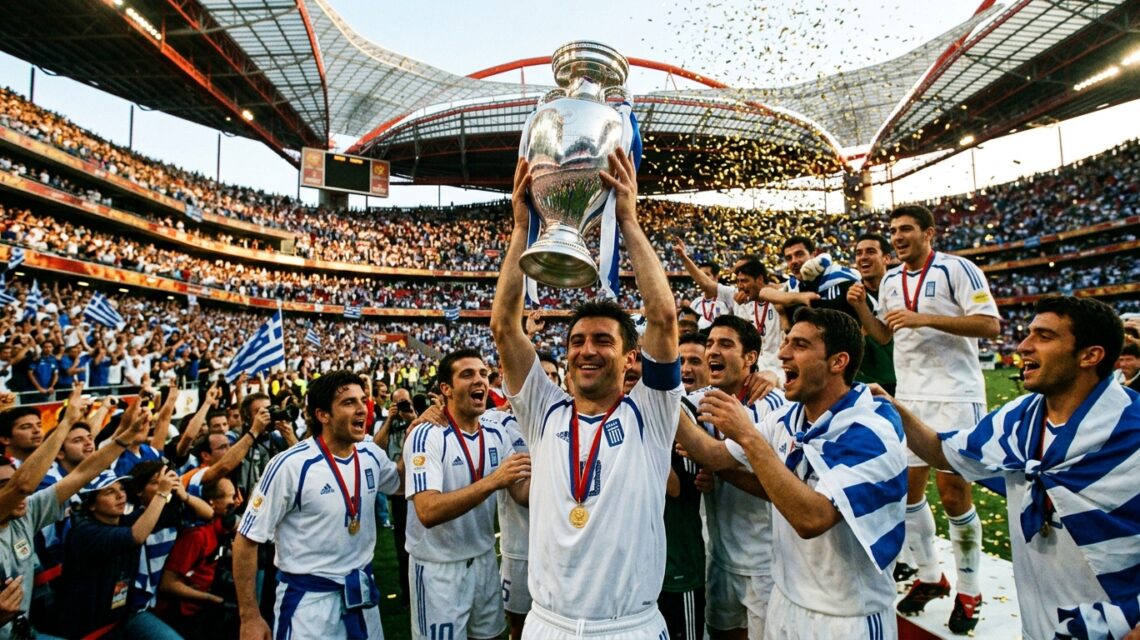
On July 4, 2004, Greece defeated Portugal 1-0 at the Estádio da Luz in Lisbon to win the UEFA European Championship for the first time.
Angelos Charisteas scored the only goal in the 57th minute, heading in a corner delivered by Angelos Basinas. Portugal, playing a major international final on home soil for the first time, could not find an equalizer.
The result completed one of the most remarkable championship campaigns in international football history.
Before the tournament, Greece had been available at odds commonly reported as 150 to 1 to win Euro 2004. The team had never won a match at a major international tournament and had qualified for only two previous major finals: Euro 1980 and the 1994 World Cup.
Yet Greece finished the tournament as European champions after defeating Portugal twice, eliminating reigning champions France and overcoming a Czech Republic team that had won all its previous matches.
Even more striking was the way Greece won.
In three consecutive knockout games, the team scored exactly one goal and conceded none.
Against France, the Czech Republic and Portugal, the combined score was 3-0.
The victory was not built on overwhelming attacking talent or expensive superstars. It came from a carefully organized defensive system, extraordinary concentration and an ability to exploit a small number of decisive opportunities.
Greece had never won a major tournament match before Euro 2004
When Greece qualified for the European Championship in Portugal, its history in major international tournaments offered little reason to expect a title challenge.
The national team had appeared at Euro 1980 in Italy, where it failed to win a match.
Its only previous World Cup appearance had come in the United States in 1994.
That tournament ended disastrously.
Greece lost all three group games, conceded ten goals and failed to score.
The results reinforced the perception that Greek football was far behind Europe’s traditional international powers.
The national team possessed experienced professionals, including players competing in Greece’s domestic league and other European competitions, but it lacked the international reputation of France, Italy, Germany, Spain or Portugal.
Qualification for Euro 2004 was therefore regarded as an achievement in itself.
Winning a match at the finals would already have represented progress.
Winning the championship appeared almost unimaginable.
The betting market reflected those expectations.
Greece was widely quoted at 150-to-1 odds before the tournament, placing it among the least-favored participants.
In fractional terms, a successful £10 wager at those odds would have generated £1,500 in profit, plus the original stake.
That price represented an implied probability of approximately 0.66%, before accounting for bookmaker margins.
It was not a precise scientific measure of Greece’s chances, but it demonstrated how unlikely the championship appeared before the first match.
Otto Rehhagel inherited a struggling team and changed its identity
The transformation began well before Euro 2004.
German coach Otto Rehhagel took charge of Greece in 2001.
His appointment followed a difficult period for the national team, which had struggled to establish consistency in international competition.
Rehhagel arrived with extensive experience in German football.
He had won Bundesliga titles with Werder Bremen and Kaiserslautern, including a remarkable championship with newly promoted Kaiserslautern in 1997-98.
That achievement demonstrated his ability to build competitive teams without relying exclusively on the biggest financial resources.
But international football presented a different challenge.
Rehhagel had limited time to work with his players, and Greece did not possess the attacking depth available to Europe’s strongest national teams.
Rather than attempting to imitate those opponents, he developed a system suited to the qualities of his squad.
His priorities were defensive organization, discipline, physical strength and collective responsibility.
The team became difficult to break down and increasingly dangerous from set pieces.
Rehhagel also emphasized consistency in selection, allowing players to develop an understanding of their responsibilities.
By Euro 2004, Greece had become a highly coordinated unit.
The team did not need to dominate possession to control the risks within a match.
It needed to prevent opponents from creating clear chances, remain competitive and take advantage of the opportunities that appeared.
Greece’s defensive system was more complex than simply parking the bus
The Greek approach was frequently described as defensive or negative.
But the system involved more tactical sophistication than merely placing players behind the ball.
Rehhagel organized his team around a strong central defensive structure, disciplined midfield coverage and carefully managed transitions.
Traianos Dellas played a central role in defense, using his positioning and aerial ability to protect the penalty area.
Michalis Kapsis provided physical strength and close marking.
Fullbacks including Giourkas Seitaridis and Takis Fyssas were expected to defend aggressively while supporting attacks when appropriate.
Captain Theodoros Zagorakis became the team’s central organizing figure in midfield.
His positioning, work rate and decision-making helped Greece maintain its defensive shape.
Kostas Katsouranis and Angelos Basinas contributed further protection and ball distribution.
Up front, Charisteas provided a physical target and a major threat in the air.
Greece often defended with a compact structure, limiting space between the defensive and midfield lines.
Against certain opponents, Rehhagel used specific marking assignments to restrict influential attacking players.
The system blended elements of zonal defending with man-oriented responsibilities.
Its effectiveness came from the players’ understanding of when to press, when to retreat and how to protect dangerous areas.
The team also placed enormous emphasis on set pieces.
Corners and free kicks became valuable opportunities because Greece could threaten the opposition goal without committing large numbers of players forward during open play.
This combination of defensive discipline and set-piece efficiency would decide the tournament.
Greece shocked Portugal 2-1 in the opening match
Euro 2004 began on June 12 at the Estádio do Dragão in Porto.
Portugal entered the tournament as host nation and one of the favorites.
Its squad included Luís Figo, Deco, Rui Costa, Pauleta and a young Cristiano Ronaldo.
The Portuguese were expected to begin their campaign with a victory over Greece.
Instead, the visitors stunned the home crowd.
Giorgos Karagounis opened the scoring in the seventh minute with a powerful shot from outside the penalty area.
Greece doubled its lead early in the second half when Basinas converted a penalty.
Portugal eventually pulled a goal back through Ronaldo in stoppage time, but the comeback came too late.
Greece won 2-1.
The result immediately changed perceptions of Rehhagel’s team.
The Greeks had not simply survived against a major opponent.
They had taken an early lead, defended with discipline and exploited Portugal’s mistakes.
But one surprising victory did not make Greece a championship favorite.
The team still needed to navigate a difficult group containing Spain and Russia.
A draw with Spain and a defeat to Russia nearly ended the campaign
Greece’s second group match came against Spain on June 16.
Spain took the lead through Fernando Morientes, but Charisteas equalized in the second half.
The match finished 1-1.
The result gave Greece four points from its opening two games and placed the team in a strong position to qualify for the knockout stage.
But the final group match against Russia exposed the narrow margins of the campaign.
Russia scored twice in the first 17 minutes, threatening to eliminate Greece.
Zisis Vryzas pulled one goal back before halftime, and the match ended in a 2-1 defeat.
Greece finished the group with four points, level with Spain.
Both teams had identical goal differences, but Greece advanced because it had scored more goals across the group stage.
Portugal finished first with six points, while Greece took second place.
The qualification was dramatic.
A single additional Russian goal, without a Greek response, would have changed the goal-difference calculation and eliminated Rehhagel’s team.
Instead, Greece advanced to face France in the quarterfinals.
The tournament’s greatest surprise was still alive.
France arrived as defending champion, but Greece stopped its attacking stars
France entered the quarterfinal as one of the strongest teams in the tournament.
The French had won the 1998 World Cup and Euro 2000, establishing themselves as a dominant international side.
Their squad included Zinedine Zidane, Thierry Henry, Patrick Vieira, Claude Makélélé and other established stars.
Although France had shown vulnerabilities during the group stage, it remained heavily favored against Greece.
The quarterfinal took place on June 25 at the Estádio José Alvalade in Lisbon.
Rehhagel’s team executed its defensive plan with remarkable discipline.
Greece restricted space in central areas and prevented France from establishing a consistent attacking rhythm.
The decisive moment arrived in the 65th minute.
Zagorakis advanced down the right flank and delivered a cross into the penalty area.
Charisteas rose above the defense and headed the ball into the net.
Greece led 1-0.
France attempted to respond, but the Greek defense held firm.
The final whistle confirmed an extraordinary result.
Greece had eliminated the reigning European champions without conceding a goal.
The victory demonstrated that the opening win against Portugal had not been an isolated accident.
Rehhagel’s system could withstand pressure from teams possessing some of the world’s most accomplished attacking players.
The Czech Republic were unbeaten until Greece ended their run
Greece’s semifinal opponent was the Czech Republic, arguably the most impressive attacking team of Euro 2004.
The Czechs had won all three group matches before eliminating Denmark 3-0 in the quarterfinals.
Their squad included Pavel Nedvěd, Tomáš Rosický, Milan Baroš, Jan Koller and Petr Čech.
Baroš was the tournament’s leading scorer and would finish with five goals.
The Czech Republic had demonstrated an ability to attack quickly, create chances and recover from difficult positions.
Against Greece, however, its momentum was disrupted.
The semifinal took place on July 1 at the Estádio do Dragão.
The Czechs created several opportunities, but Greece remained organized.
A major turning point came when Nedvěd was forced off with an injury before halftime.
The match remained goalless through 90 minutes.
Extra time followed under the silver-goal rule, a short-lived UEFA regulation that could end a match at the conclusion of an extra-time period if one team was leading.
Near the end of the first 15-minute extra-time period, Greece won a corner.
Basinas delivered the ball into the penalty area.
Dellas rose and headed it into the net.
The goal came in first-half stoppage time of extra time, effectively ending the match under the silver-goal rule.
Greece won 1-0 and reached the European Championship final.
It was the last silver goal scored in a major UEFA international tournament before the rule was abolished.
The result also completed another remarkable defensive performance.
For the second consecutive knockout match, Greece had defeated one of Europe’s strongest teams without conceding.
Portugal had a second chance to beat Greece in the final
The final on July 4 brought the tournament back to its opening matchup.
Portugal had recovered from its initial defeat to Greece and advanced through the knockout rounds.
The hosts defeated England on penalties in the quarterfinals and overcame the Netherlands 2-1 in the semifinals.
The Portuguese squad possessed exceptional attacking talent.
Figo remained one of Europe’s most accomplished players.
Deco had recently helped Porto win the UEFA Champions League under José Mourinho.
Ronaldo, still a teenager, was emerging as one of football’s most exciting young players.
Portugal also had the advantage of playing in front of a passionate home crowd at the Estádio da Luz in Lisbon.
The setting appeared ideal for a national celebration.
But Greece had already demonstrated that it could defeat Portugal.
Rehhagel’s players entered the final knowing their defensive structure could frustrate the hosts.
The challenge was to repeat that performance under even greater pressure.
Charisteas scored the goal that silenced Lisbon
The final began with Portugal attempting to control possession and create attacking opportunities.
Greece defended compactly, limiting space and forcing the hosts to work for chances.
The decisive moment came in the 57th minute.
Greece won a corner on the right side.
Basinas delivered an accurate cross into the penalty area.
Charisteas rose and headed the ball past Portuguese goalkeeper Ricardo.
Greece led 1-0.
The goal reflected the team’s tournament identity.
A disciplined defensive performance had kept the match level, and a set piece provided the opportunity to take the lead.
Portugal responded with increasing urgency.
The hosts pushed forward, seeking an equalizer that would keep their championship hopes alive.
Figo, Ronaldo and their teammates attempted to break through the Greek defense.
But Rehhagel’s players maintained their shape.
Dellas, Kapsis and the rest of the defensive unit protected dangerous areas and resisted Portugal’s pressure.
As the minutes passed, the home crowd grew increasingly anxious.
When the final whistle sounded, Greece had completed the impossible.
The team that had never previously won a major tournament match was now European champion.
The numbers behind Greece’s Euro 2004 miracle
| Statistic | Greece at Euro 2004 |
|---|---|
| Pre-tournament title odds | Commonly reported at 150 to 1 |
| Matches played | 6 |
| Wins | 4 |
| Draws | 1 |
| Defeats | 1 |
| Goals scored | 7 |
| Goals conceded | 4 |
| Knockout-stage results | Three consecutive 1-0 victories |
| Goals conceded in knockout stage | 0 |
| Final opponent | Portugal |
| Final score | Greece 1-0 Portugal |
| Winning goal | Angelos Charisteas, 57th minute |
| Head coach | Otto Rehhagel |
The statistics reveal how unusual Greece’s championship was.
The team scored only seven goals in six matches, averaging approximately 1.17 goals per game.
It did not overwhelm opponents with attacking volume.
Instead, Greece maximized the value of individual goals.
In the knockout stage, every goal the team scored was decisive.
Charisteas’s header eliminated France.
Dellas’s silver goal eliminated the Czech Republic.
Charisteas’s second knockout-stage header defeated Portugal in the final.
Three goals produced three victories against some of Europe’s strongest teams.
The defensive record was equally remarkable.
Greece did not concede a single goal during the knockout rounds.
That consistency allowed the team to win matches without needing multiple scoring opportunities.
The victory was not only about defense
Greece’s championship is often remembered as a triumph of defensive football.
That description is accurate but incomplete.
The team also demonstrated exceptional efficiency in attacking situations.
Its set-piece routines were carefully prepared.
Players understood their movement patterns and responsibilities during corners and free kicks.
Charisteas’s aerial ability made him particularly dangerous.
Zagorakis provided leadership and tactical intelligence in midfield.
Basinas delivered important passes and set pieces.
Dellas contributed both defensive stability and the decisive semifinal goal.
The team’s attacking opportunities were limited, but they were not accidental.
Rehhagel built a system designed to create specific chances while minimizing defensive risk.
The approach was especially effective in knockout football, where one goal can decide a match.
Greece did not need to dominate possession or produce spectacular attacking performances.
It needed to remain organized, avoid mistakes and convert the moments that mattered.
The championship changed the careers of Rehhagel and his players
Rehhagel became a national hero in Greece.
His achievement was particularly significant because he was a foreign coach leading a country with limited success in major international tournaments.
He had transformed a team that struggled to qualify for major competitions into European champion.
Captain Zagorakis was named UEFA’s Player of the Tournament.
His performances reflected the qualities that defined Greece’s success: leadership, discipline, work rate and tactical awareness.
Charisteas became one of the most celebrated players in Greek football history.
His goals against France and Portugal were central to the championship.
Dellas also secured a permanent place in the tournament’s history through his silver goal against the Czech Republic.
The victory produced enormous celebrations across Greece.
Supporters filled streets and public squares as the national team returned home with the trophy.
The achievement became a defining moment in modern Greek sporting history.
Why Greece could not repeat the miracle in later tournaments
The Euro 2004 championship did not immediately establish Greece as a permanent European powerhouse.
The national team failed to qualify for the 2006 World Cup.
It returned to the European Championship in 2008 but lost all three group matches.
Greece later qualified for the 2010 and 2014 World Cups and reached the quarterfinals of Euro 2012.
Those appearances demonstrated that the national team remained competitive internationally.
But the extraordinary combination of circumstances that produced the 2004 championship proved difficult to reproduce.
Several factors had aligned during the tournament.
Rehhagel had developed a cohesive tactical system.
The players executed it with exceptional discipline.
Key opponents struggled to break down the Greek defense.
And Greece converted a remarkably high proportion of its decisive opportunities.
The achievement therefore represented a peak rather than the beginning of a sustained period of European dominance.
That does not diminish its significance.
Winning one major international championship against such expectations was itself extraordinary.
Why Greece’s 2004 title remains one of football’s greatest upsets
International football has produced many surprising results.
Underdogs have defeated traditional powers in individual matches, and smaller nations have occasionally reached the later stages of major tournaments.
But Greece’s achievement required something more difficult.
The team had to survive the group stage, eliminate the defending champions, defeat an unbeaten Czech side and overcome the host nation in the final.
It did so without conceding a goal in any knockout match.
The 150-to-1 odds reflected how unlikely that sequence appeared before the tournament.
The victory also challenged assumptions about what a successful international team needed.
Greece did not possess the attacking stars available to France, Portugal or the Czech Republic.
It relied instead on collective organization, tactical discipline and efficiency.
Rehhagel’s system did not make Greece the most entertaining team in the tournament.
It made Greece the hardest team to defeat when the stakes were highest.
The championship was not proof that technical talent or attacking creativity were unimportant.
It demonstrated that a well-organized team could compensate for individual disadvantages through preparation and execution.
On July 4, 2004, Portugal entered the final hoping to celebrate its first major international trophy.
Instead, Greece scored from a corner, defended its lead and became European champion.
The final score was 1-0.
The wider achievement was even more extraordinary: a team that had never won a match at a major tournament before Euro 2004 defeated Portugal twice and won three consecutive knockout games without conceding.
For Greece, it was the first major international football championship in the nation’s history.
For European football, it remains one of the clearest examples of how tactical discipline and collective belief can overturn even the most overwhelming expectations.
+ Siga o Giro no Facebook
+ Siga o Giro no Instagram
Leia Mais: