

New England arrived in Arizona undefeated, favored by 12 points and chasing the NFL’s first perfect season since 1972. Instead, five sacks of Tom Brady, a 32-yard catch against Rodney Harrison and a touchdown with 35 seconds left produced one of football’s greatest upsets.
By Marcio Tamer
Updated October 26, 2026
On February 3, 2008, the New England Patriots were 35 seconds away from losing the perfect season they had spent five months building.
At University of Phoenix Stadium in Glendale, Arizona, New York Giants quarterback Eli Manning found Plaxico Burress in the end zone for a 13-yard touchdown. The Giants took a 17-14 lead, leaving Tom Brady and the Patriots almost no time to respond.
New England had entered Super Bowl XLII with an 18-0 record. The Patriots had completed the NFL’s first 16-0 regular season, won two playoff games and arrived as 12-point favorites against a Giants team that had lost six regular-season games.
A victory would have made the Patriots the first NFL team since the 1972 Miami Dolphins to finish an entire season undefeated.
Instead, New York won 17-14.
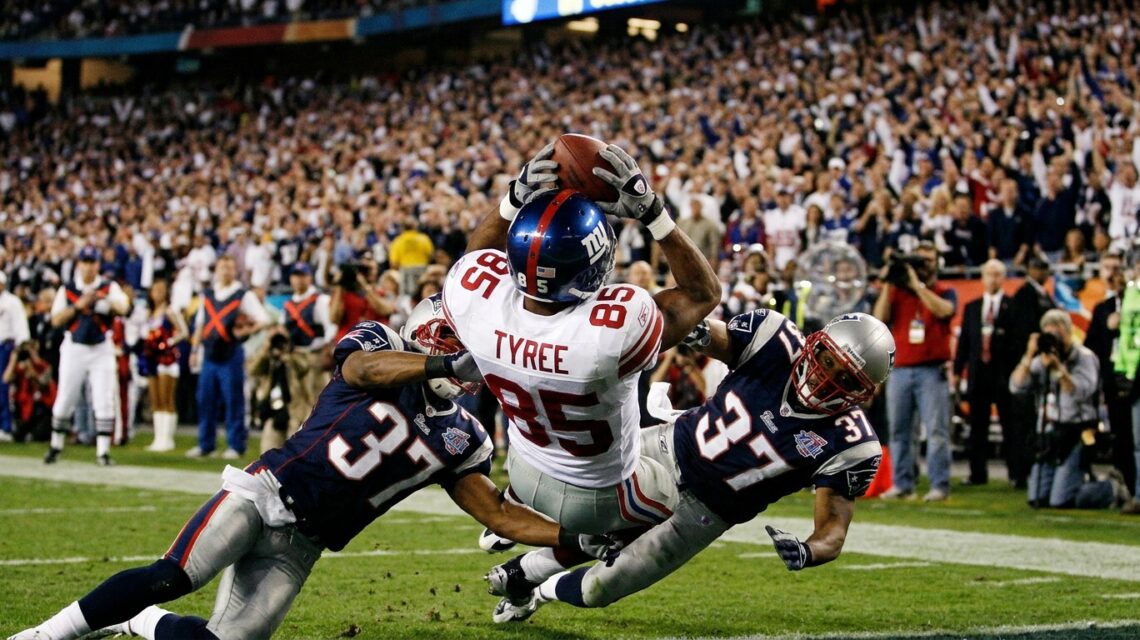
The defining play was a 32-yard reception by Giants receiver David Tyree, who secured Manning’s pass against his helmet while being defended by Patriots safety Rodney Harrison.
But the Helmet Catch was only one part of the upset.
The Giants’ defensive front had spent the entire evening disrupting Brady, sacking him five times and holding a historically productive offense to just 14 points.
The final result turned New England’s pursuit of perfection into one of the most painful defeats in NFL history.
The Patriots had won 18 consecutive games and rewritten the NFL record book
The 2007 Patriots were not merely another strong Super Bowl contender.
They had produced one of the most dominant regular seasons in league history.
Under head coach Bill Belichick, New England finished 16-0, becoming the first team to complete an undefeated regular season under the NFL’s 16-game schedule.
The Patriots then defeated the Jacksonville Jaguars in the divisional playoffs and the San Diego Chargers in the AFC Championship Game.
Their record entering the Super Bowl was 18-0.
The offense, led by Brady, had set a new NFL single-season scoring record with 589 points.
Brady threw 50 touchdown passes during the regular season, surpassing Peyton Manning’s previous record of 49.
Wide receiver Randy Moss caught 23 touchdown passes, breaking Jerry Rice’s previous single-season record of 22.
Those two records demonstrated how difficult New England’s passing attack had become to defend.
Brady could exploit coverage with precise throws, while Moss stretched defenses vertically and threatened to score from almost anywhere on the field.
Wes Welker provided another major receiving option, operating effectively on shorter routes and creating opportunities after the catch.
The Patriots also had an experienced defense and a coaching staff accustomed to championship pressure.
New England had already won Super Bowls following the 2001, 2003 and 2004 seasons.
Another victory would have delivered the franchise’s fourth championship in seven seasons.
But the greater historical prize was an undefeated season.
Why the 1972 Miami Dolphins mattered to New England’s pursuit of perfection
Before the 2007 Patriots, the 1972 Miami Dolphins were the only team in NFL history to complete both the regular season and postseason without losing.
Miami finished that campaign 17-0, including its Super Bowl VII victory over Washington.
The Dolphins achieved their perfect season under a shorter regular-season schedule.
In 1972, NFL teams played 14 regular-season games.
By 2007, the schedule had expanded to 16 games, meaning New England had already completed more consecutive victories than Miami before reaching the Super Bowl.
A Patriots victory would have produced a 19-0 final record.
That would not simply have matched Miami’s undefeated achievement. It would have established a new benchmark for the number of wins in a perfect NFL season.
The distinction mattered because New England had survived a longer schedule and additional opportunities for injuries, fatigue and unexpected defeats.
But history records perfection differently from ordinary win totals.
An 18-1 season, however extraordinary, is not undefeated.
That difference became the central consequence of the Giants’ victory.
The Giants entered the playoffs with six losses and almost no margin for error
New York’s route to Super Bowl XLII looked very different.
The Giants finished the 2007 regular season with a 10-6 record.
They qualified for the playoffs as the NFC’s fifth seed, meaning they had to begin the postseason away from home.
Their path required victories against three opponents in hostile stadiums.
First, the Giants defeated the Tampa Bay Buccaneers 24-14.
They then traveled to Dallas and beat the Cowboys 21-17.
The NFC Championship Game took place at Lambeau Field in Green Bay, where New York faced Brett Favre and the Packers in freezing conditions.
The Giants won 23-20 in overtime after kicker Lawrence Tynes made a 47-yard field goal.
That victory sent New York to its first Super Bowl since the 2000 season.
The team had overcome three road playoff games, but New England remained a formidable opponent.
The Patriots had already defeated the Giants during the regular season.
On December 29, 2007, New England won 38-35 at Giants Stadium to complete its 16-0 campaign.
Although the Giants lost that game, their ability to challenge the Patriots became an important source of confidence.
New York had demonstrated that it could compete with New England’s record-setting offense.
The Super Bowl would test whether the Giants could go one step further.
The Giants were 12-point underdogs, but their defense offered a realistic path to victory
The betting market strongly favored New England.
The Patriots entered Super Bowl XLII as 12-point favorites.
That meant oddsmakers expected New England to win by a substantial margin.
The point spread was not a prediction that the Patriots would necessarily win by exactly 12 points. It was a betting line designed to balance wagers and reflect market expectations.
The Giants’ challenge was obvious.
Trying to defeat New England in a high-scoring contest would require matching an offense that had averaged nearly 37 points per game during the regular season.
New York needed a different approach.
Head coach Tom Coughlin and defensive coordinator Steve Spagnuolo emphasized pressure on Brady.
The Giants possessed one of the NFL’s most dangerous defensive fronts.
Michael Strahan, Osi Umenyiora, Justin Tuck and other defenders gave New York the ability to attack the quarterback without relying exclusively on heavy blitz packages.
That distinction was crucial.
Sending too many defenders after Brady could leave receivers open downfield.
But generating pressure with four defensive linemen allowed the Giants to keep more players in coverage.
The strategy reduced Brady’s time to throw while limiting the passing lanes available to Moss, Welker and New England’s other receivers.
It was the tactical foundation of the upset.
Five sacks of Tom Brady changed the game before the Helmet Catch
The Giants’ defense delivered one of its most important performances of the season.
Brady was sacked five times, losing 37 yards on those plays.
The pressure disrupted New England’s timing and prevented the Patriots from consistently creating explosive passing opportunities.
Justin Tuck was particularly influential.
He recorded two sacks and forced a fumble, helping New York keep the game close.
Strahan and Umenyiora also contributed to the pressure that repeatedly forced Brady to move or release the ball earlier than he wanted.
The Patriots’ offensive line struggled to protect the quarterback against New York’s aggressive defensive front.
Brady completed 29 of 48 passes for 266 yards and one touchdown.
Those numbers were respectable in isolation.
But they were far below the production expected from an offense that had dominated the league throughout the season.
New England scored only 14 points.
That was 22.8 points below its regular-season scoring average of approximately 36.8 points per game.
The Giants did not need to shut out the Patriots.
They needed to keep the score close enough for Manning and the offense to have a chance in the final minutes.
Their defense accomplished exactly that.
The first three quarters produced only ten combined points
The opening stages of Super Bowl XLII were dominated by defense.
New York took a 3-0 lead in the first quarter when Lawrence Tynes made a 32-yard field goal.
The Patriots responded early in the second quarter.
Running back Laurence Maroney scored on a 1-yard touchdown run, giving New England a 7-3 lead.
That score remained unchanged through halftime and the entire third quarter.
The lack of scoring was extraordinary given New England’s offensive reputation.
The Patriots had entered the game with one of the most productive passing attacks in NFL history.
But the Giants’ defensive pressure, combined with disciplined coverage, prevented Brady from establishing a consistent rhythm.
New York’s offense also struggled to score.
Manning faced pressure from the Patriots’ defense, and the Giants were unable to convert several opportunities into points.
The game became a contest of field position, defensive execution and patience.
That favored New York’s chances.
Every scoreless minute increased the possibility that the underdogs could reach the final quarter within striking distance.
David Tyree scored New York’s first touchdown before making the famous catch
The fourth quarter finally produced the offensive drama that would define the game.
With 11:05 remaining, Manning connected with Tyree for a 5-yard touchdown pass.
The score gave the Giants a 10-7 lead.
Tyree was not one of New York’s primary receiving stars.
He had been used mainly on special teams and as a reserve receiver.
During the 2007 regular season, he caught only four passes.
Yet in the Super Bowl, he became an unexpected offensive contributor.
His first touchdown of the game was already significant.
It put the Giants ahead against an undefeated opponent with little more than 11 minutes remaining.
But New England still had Brady.
The Patriots responded with a methodical drive that appeared to restore control.
Brady found Randy Moss and put the Patriots ahead with 2:42 remaining
New England took possession at its own 20-yard line with 7:54 left in the game.
Brady led an 80-yard touchdown drive, completing eight of 11 passes.
The Patriots moved steadily downfield, relying on shorter completions rather than the explosive deep passes that had characterized much of their season.
With 2:42 remaining, Brady connected with Moss for a 6-yard touchdown.
New England regained the lead, 14-10.
The situation was now extremely difficult for the Giants.
They needed a touchdown, not merely a field goal.
Manning had less than three minutes to move the ball downfield against an experienced Patriots defense.
A failed drive would almost certainly end the game.
The Patriots were within minutes of completing a perfect 19-0 season.
But the Giants had one final possession.
The final drive began at New York’s 17-yard line
The Giants took over at their own 17-yard line with 2:39 remaining.
Manning began moving the offense downfield.
He completed an 11-yard pass to Amani Toomer, then continued advancing the ball through a combination of short passes and rushing plays.
One of the most important moments came on fourth-and-1.
Running back Brandon Jacobs gained two yards to keep the drive alive.
The conversion was essential.
If New York had failed, the Patriots would have taken possession with the lead and little time remaining.
Instead, the Giants continued.
A few plays later, they faced another critical situation.
With 1:15 left, New York had third-and-5 at its own 44-yard line.
The Giants needed five yards to extend the drive.
The Patriots needed one defensive stop to move closer to an undefeated championship.
What happened next became one of the most famous plays in NFL history.
Eli Manning escaped a near-sack and launched the Helmet Catch
On third-and-5, Manning dropped back to pass.
The Patriots’ defensive line immediately applied pressure.
Richard Seymour and Jarvis Green closed in, and Manning appeared certain to be sacked.
But the Giants quarterback somehow escaped.
He pulled free from defenders who had grabbed him and moved away from the collapsing pocket.
Then he launched a pass downfield.
The ball traveled toward Tyree, who was tightly covered by Patriots safety Rodney Harrison.
Tyree jumped for the ball.
Harrison challenged the catch, making the reception extraordinarily difficult.
But Tyree secured the football against the top of his helmet while falling backward.
He maintained control as he hit the ground.
The officials ruled it a completed pass.
The play gained 32 yards, moving the Giants from their own 44-yard line to the New England 24.
It converted third-and-5 and kept the championship drive alive.
The catch was remarkable for several reasons.
Manning had escaped what appeared to be a certain sack.
Tyree had caught a contested pass despite close coverage.
And the ball remained secure against his helmet as he fell.
The play became known simply as the Helmet Catch.
The NFL later ranked it among the greatest plays in league history. <Cite refs={[“turn702029search1″,”turn702029search2”]}/>
The Helmet Catch was extraordinary, but it did not score the winning touchdown
The Helmet Catch is sometimes remembered as the play that directly won the Super Bowl.
It was the decisive conversion, but it was not the winning score.
The Giants still had to finish the drive.
After Tyree’s reception, Manning continued directing the offense.
With 35 seconds remaining, he found Burress for a 13-yard touchdown.
Burress had beaten Patriots cornerback Ellis Hobbs and was open in the end zone.
Manning delivered the pass, and Burress completed the catch.
The Giants took a 17-14 lead.
The touchdown transformed the Helmet Catch from an extraordinary highlight into a championship-defining play.
Without Tyree’s reception, the Giants might not have extended the drive.
Without Burress’s touchdown, the catch would not have been enough to win the game.
The two plays formed the decisive sequence.
New York had gone from facing a potential season-ending third down to taking the lead against an undefeated opponent.
The Patriots had 35 seconds to save their perfect season
New England still had time for one final possession.
Brady attempted to move the Patriots into position for a potential tying field goal or winning touchdown.
But the Giants’ defense refused to allow a comeback.
New York pressured Brady and prevented the Patriots from completing the passes needed to advance downfield.
The final New England possession ended without a score.
When the clock expired, the Giants had won 17-14.
The Patriots’ record fell from 18-0 to 18-1.
New York finished the season as Super Bowl champion.
The result denied New England a perfect season and preserved the 1972 Dolphins’ unique place in NFL history.
For the Giants, it completed one of the most remarkable postseason runs the league had seen.
They had won three road playoff games before defeating the undefeated Patriots on a neutral field.
The numbers behind Super Bowl XLII
| Statistic | New York Giants | New England Patriots |
|---|---|---|
| Final score | 17 | 14 |
| Regular-season record | 10-6 | 16-0 |
| Record entering Super Bowl | 13-6 | 18-0 |
| Passing yards | 255 | 266 |
| Quarterback sacks allowed | 3 | 5 |
| Turnovers | 1 | 1 |
| Fourth-quarter points | 14 | 7 |
| Betting position | 12-point underdog | 12-point favorite |
| Final season record | 14-6 | 18-1 |
The statistics show how closely contested the game became.
New England had dominated opponents throughout the regular season, but the Giants limited its offense to 14 points.
Brady threw for 266 yards, only 11 more than Manning.
The difference was not overwhelming offensive production.
It was New York’s ability to generate pressure, prevent explosive plays and execute during the final possession.
The Giants scored 14 of their 17 points in the fourth quarter.
That late offensive surge turned a defensive struggle into one of the most dramatic Super Bowl finishes ever.
Eli Manning won Super Bowl MVP, but the Giants’ defense made the upset possible
Manning was named Super Bowl XLII Most Valuable Player.
He completed 19 of 34 passes for 255 yards, two touchdowns and one interception.
His final drive became the defining performance of his career to that point.
The escape from pressure before the Helmet Catch demonstrated his ability to remain composed in a critical situation.
The touchdown pass to Burress completed the comeback.
But the Giants’ defensive performance was equally important.
Without five sacks of Brady and sustained pressure throughout the game, New York might never have reached the final minutes with a realistic chance to win.
The Patriots had scored 589 points during the regular season.
Holding that offense to 14 points required exceptional execution.
The Giants’ defensive line prevented Brady from controlling the game in the way he had against most opponents.
The offense then capitalized on the opportunity.
The championship was therefore the product of both defensive disruption and late offensive execution.
Why the Giants’ victory was bigger than a single miraculous catch
The Helmet Catch became the defining image of Super Bowl XLII because it combined athletic skill, extraordinary improvisation and enormous stakes.
But the upset had been developing throughout the game.
The Giants’ defensive front had repeatedly disrupted Brady.
New England’s offense had struggled to produce points.
Manning had remained composed despite pressure.
And New York had kept the score close enough for one final drive to decide the championship.
The result was not simply a lucky reception against an otherwise dominant Patriots team.
It was a complete performance built around a clear tactical objective.
The Giants understood that New England’s greatest strength was its passing offense.
They attacked that strength directly.
By generating pressure without sacrificing coverage, New York reduced the effectiveness of Brady’s passing game.
The Helmet Catch then provided the extraordinary moment required to complete the upset.
The Patriots eventually built a greater dynasty, but the perfect season was gone
The defeat did not end New England’s long-term success.
Belichick and Brady continued leading the Patriots for more than a decade.
The franchise eventually won six Super Bowls during their partnership.
Brady later added a seventh championship with the Tampa Bay Buccaneers.
New England’s dynasty therefore extended far beyond the 2007 season.
But the perfect-season opportunity never returned.
The Patriots reached another Super Bowl against the Giants following the 2011 season.
New York won again, defeating New England 21-17 in Super Bowl XLVI.
Manning earned another Super Bowl MVP award.
Those two victories established the Giants as one of the few teams capable of repeatedly defeating Brady’s Patriots on football’s biggest stage.
Yet the 2008 result remained unique.
New England had never been closer to completing an undefeated championship season.
The Giants stopped it with 35 seconds remaining.
Why Super Bowl XLII remains one of the NFL’s greatest upsets
The magnitude of the result came from the contrast between the teams.
The Patriots were undefeated, had set major offensive records and were favored by 12 points.
The Giants had lost six regular-season games and needed three road playoff victories just to reach the Super Bowl.
New England was chasing a historic 19-0 season.
New York was trying to win its first championship since Super Bowl XXV.
The Giants’ defensive line turned the game into a low-scoring contest, giving Manning an opportunity to win it late.
Then came the Helmet Catch.
A reserve receiver with only four regular-season receptions secured a 32-yard pass against one of the NFL’s most experienced defensive backs.
Four plays later, Burress scored the winning touchdown.
The Patriots finished 18-1.
The Giants finished as champions.
That difference of one game changed the historical meaning of New England’s entire season.
Instead of becoming the first NFL team to finish 19-0, the Patriots became the team that came closest to perfection and lost at the final hurdle.
For the Giants, the victory demonstrated how a team with an imperfect regular-season record could become extraordinary when the postseason began.
And for David Tyree, one reception transformed a relatively modest receiving career into a permanent place in NFL history.
+ Siga o Giro no Facebook
+ Siga o Giro no Instagram
Leia Mais: