

Brazil had scored 13 goals in its previous two matches and was preparing to celebrate its first world title. Then Juan Alberto Schiaffino and Alcides Ghiggia overturned a 1-0 deficit, giving Uruguay the trophy and creating football’s most enduring national heartbreak.
By Marcio Tamer
Updated October 26, 2026
On July 16, 1950, Brazil entered the Maracanã in Rio de Janeiro needing only a draw against Uruguay to become world champion for the first time.
The hosts had demolished Sweden 7-1 and Spain 6-1 in their previous two matches. Their attacking stars were scoring freely, the country was anticipating a historic celebration, and the newly built stadium was packed with one of the largest crowds ever assembled for a football match.
FIFA records an official attendance of 173,850, although estimates of the total number of people inside the Maracanã have approached or exceeded 200,000.
Brazil appeared to be following the expected script when Friaça scored two minutes into the second half.
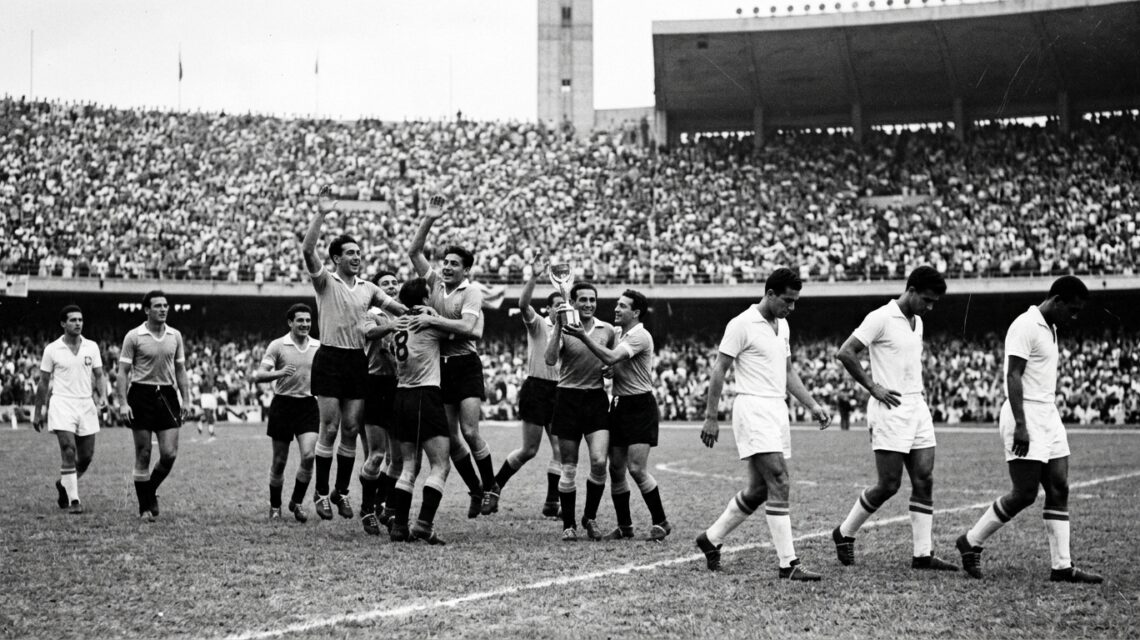
But Uruguay equalized through Juan Alberto Schiaffino in the 66th minute. Then, in the 79th, Alcides Ghiggia beat Brazilian goalkeeper Moacir Barbosa to complete a 2-1 comeback.
The result gave Uruguay its second World Cup title and denied Brazil what had seemed an almost certain triumph.
The defeat became known as the Maracanazo, a name that came to symbolize far more than an unexpected football result.
It became a national trauma, changed the image of Brazil’s football team and placed an extraordinary burden on players who had come within minutes of becoming champions.
Yet one of the most revealing details is often overlooked: the 1950 World Cup did not have a traditional knockout final. Brazil and Uruguay met in the last match of a four-team championship group, and the hosts held the advantage because of their earlier results.
Uruguay had to win. Brazil only had to avoid defeat.
Why Brazil needed only a draw to become world champion
The 1950 World Cup used a format unlike the knockout system familiar to modern audiences.
After the opening group stage, four teams advanced to a final round-robin group: Brazil, Uruguay, Spain and Sweden.
Each team played the other three once.
The team finishing with the most points would become world champion.
Under the scoring rules of the time, a victory was worth two points and a draw was worth one.
Brazil entered the last round with four points after beating Sweden and Spain.
Uruguay had three points, having drawn 2-2 with Spain and beaten Sweden 3-2.
That produced a simple championship calculation.
If Brazil won, it would finish with six points and claim the title.
If the match ended in a draw, Brazil would finish with five points, one ahead of Uruguay.
But if Uruguay won, it would finish with five points while Brazil remained on four.
In other words, the hosts did not need to defeat Uruguay to become champions.
They needed only to avoid losing.
The advantage was substantial, especially given Brazil’s extraordinary scoring form.
But it also created a psychological complication: a team accustomed to attacking could now win the world’s biggest trophy without scoring another goal.
Brazil had scored 13 goals in two matches before facing Uruguay
The expectations surrounding Brazil were not based entirely on patriotic enthusiasm.
The hosts had produced devastating attacking performances in the final group.
On July 9, Brazil defeated Sweden 7-1 at the Maracanã.
Four days later, it overwhelmed Spain 6-1 at the same stadium.
That meant Brazil had scored 13 goals and conceded only two across its first two matches in the championship group.
Uruguay’s route had been far less convincing.
The Uruguayans drew 2-2 with Spain and then needed a comeback to beat Sweden 3-2.
Brazil’s superior results created a widespread impression that the title was already within reach.
The contrast was striking.
Brazil had scored 13 goals in two games, while Uruguay had conceded four.
The hosts also possessed one of the most feared attacks in international football.
Ademir de Menezes was the tournament’s leading scorer, finishing with nine goals.
Zizinho supplied creativity and technical quality.
Jair Rosa Pinto, Chico and Friaça provided further attacking options.
Brazil had reason to feel confident.
But Uruguay was not an inexperienced outsider.
The country had won the inaugural World Cup in 1930 and possessed players with considerable international experience.
The mistake was not believing Brazil could win.
It was treating victory as inevitable.
The Maracanã was built to showcase Brazil’s place in world football
The stadium itself was central to the story.
Construction of the Maracanã began as Brazil prepared to host the first World Cup since 1938.
The tournament had been suspended during the Second World War, making the 1950 edition a symbolic return for international football.
Brazil wanted a venue capable of staging the world’s biggest matches and demonstrating its growing importance in the sport.
The Maracanã opened on June 16, 1950, exactly one month before the decisive match against Uruguay.
Its enormous capacity made it one of the most ambitious stadium projects of its era.
The venue became a physical expression of Brazil’s expectations.
It was designed for mass gatherings, major sporting events and the possibility of a home World Cup triumph.
By July 16, the stadium had become the center of national attention.
Supporters filled its stands, while millions more followed the match through radio broadcasts and newspaper coverage.
The enormous crowd was not simply a backdrop.
It became part of the pressure surrounding the Brazilian players and the challenge confronting Uruguay.
How many people actually watched the Maracanazo?
The crowd figure is one of the most frequently exaggerated details of the 1950 World Cup.
The number of 200,000 spectators is widely associated with the match.
However, FIFA’s official attendance figure is 173,850.
That remains the recognized record for attendance at a FIFA World Cup match.
The higher estimates are not necessarily invented.
Contemporary accounts and later historical research have suggested that the total number inside the stadium may have been considerably greater than the official count.
Some estimates place the crowd at 199,854, while others suggest more than 200,000 people may have been present.
The difference comes from the distinction between officially recorded attendance and estimates of everyone who entered the stadium, including people who may not have been counted through conventional ticket records.
For historical accuracy, the figures should not be treated as interchangeable.
The confirmed official attendance was 173,850.
The frequently cited figure of approximately 200,000 is an estimate of the larger crowd.
Even using the official number, the scale of the occasion was extraordinary.
More than 170,000 people had gathered to watch Brazil attempt to win its first World Cup.
Newspapers and public celebrations helped create an atmosphere of certainty
The mood before kickoff reflected the country’s belief that the title was already secured.
Brazilian newspapers published celebratory coverage of the national team.
One of the most famous examples came from O Mundo, which presented the Brazilian players as world champions before the decisive match had been played.
The episode became a lasting symbol of the confidence surrounding the team.
Reports from the period also describe preparations for victory celebrations and the expectation that Brazil would lift the trophy at home.
Such accounts should be understood within the atmosphere of the time.
They demonstrate widespread optimism, but they do not prove that every Brazilian player believed the match was already won.
The national team still had to face an opponent capable of competing at the highest level.
The danger was that the public celebration could make anything short of victory feel like a catastrophe.
For Uruguay, the situation was different.
The visitors had little reason to expect support from the crowd and knew that a draw would not be enough.
Their task was clear.
They had to defeat Brazil in front of the largest World Cup audience ever officially recorded.
Obdulio Varela refused to let Uruguay surrender before kickoff
Uruguay captain Obdulio Varela became one of the central figures in the Maracanazo.
A commanding midfielder, Varela was known for his leadership, physical presence and determination.
He understood that Uruguay could not afford to be intimidated by Brazil’s reputation or the crowd.
Historical accounts describe tensions over how Uruguay should approach the match.
Coach Juan López was concerned about Brazil’s attacking strength and considered a cautious strategy.
Varela, however, believed excessive defensiveness would allow Brazil to control the contest.
FIFA’s retrospective account describes the captain challenging the idea that Uruguay should simply retreat and absorb pressure.
The argument was tactical as well as psychological.
Brazil had scored seven goals against Sweden and six against Spain.
Allowing the hosts to attack continuously could produce another heavy defeat.
Uruguay needed to defend intelligently, but it also had to create opportunities.
Varela encouraged his teammates to compete rather than merely survive.
The decision helped establish Uruguay’s approach.
The visitors would respect Brazil’s attacking quality without surrendering the initiative entirely.
Brazil dominated the early stages but could not score before halftime
The opening period unfolded amid extraordinary noise from the crowd.
Brazil attacked with confidence, attempting to exploit its technical superiority and the pace of its forwards.
Uruguay goalkeeper Roque Máspoli faced pressure, while defenders Eusebio Tejera and Matías González worked to contain Brazil’s attacks.
Varela helped organize the midfield and disrupt the hosts’ passing rhythm.
Brazil created opportunities, but Uruguay remained competitive.
The first half ended 0-0.
That score still favored Brazil.
Under the tournament rules, a draw would be enough to secure the championship.
But the goalless first half also showed that Uruguay was capable of resisting the Brazilian attack.
The visitors had survived 45 minutes without conceding.
They remained one goal away from changing the championship standings.
Friaça scored in the 47th minute and brought Brazil within reach of the title
Brazil finally broke through shortly after halftime.
In the 47th minute, Friaça scored to give the hosts a 1-0 lead.
The goal transformed the atmosphere inside the Maracanã.
Brazil was now ahead in a match it only needed to draw.
Uruguay would have to score twice to become champion.
Given the hosts’ attacking record, the task appeared extremely difficult.
The crowd erupted.
For many supporters, the goal seemed to confirm that Brazil was about to win its first World Cup.
But the match was far from over.
Uruguay had already demonstrated resilience during the tournament, recovering from difficult situations against Spain and Sweden.
The visitors now faced their greatest challenge.
They needed to overturn a deficit against the host nation in front of an enormous and overwhelmingly Brazilian crowd.
Varela’s response to Brazil’s goal became part of the Maracanazo legend
After Friaça scored, Varela took the ball and disputed the goal with the referee.
FIFA’s historical account states that the Uruguay captain knew the goal was legitimate but deliberately argued about a possible offside.
The purpose, according to the retrospective, was to slow the restart and allow the emotional intensity inside the stadium to subside.
The incident became one of the most famous examples of psychological leadership in World Cup history.
By interrupting the immediate restart, Varela gave his teammates time to regain their concentration.
The crowd’s celebrations gradually diminished.
Uruguay could reorganize and prepare for the remaining minutes.
The precise words spoken during the exchange have been retold in different versions over the decades.
Those reconstructed conversations should not be treated as verbatim transcripts.
But the broader point remains central to the story.
Uruguay did not respond to Brazil’s goal by collapsing.
Its captain worked to restore composure, and the team continued searching for a way back into the match.
Schiaffino equalized in the 66th minute, but Brazil was still on course to win
Uruguay’s first breakthrough came in the 66th minute.
Ghiggia advanced down the right flank and helped create the opportunity for Juan Alberto Schiaffino.
Schiaffino finished the move to make the score 1-1.
The goal changed the emotional atmosphere inside the Maracanã.
Brazil’s lead had disappeared.
But the hosts were still in position to become world champions.
A draw remained enough.
That detail is essential to understanding the final stages.
At 1-1, Uruguay was still behind Brazil in the championship standings.
The visitors needed another goal.
Brazil, meanwhile, could secure the title simply by preventing Uruguay from scoring again.
The match had become a contest between two opposing objectives.
Uruguay needed to attack.
Brazil needed to preserve a result that would deliver the trophy.
The next 13 minutes would decide the World Cup.
Ghiggia’s 79th-minute goal changed the championship
The decisive moment arrived in the 79th minute.
Ghiggia received the ball on Uruguay’s right wing and attacked the space behind Brazilian defender Bigode.
He advanced toward the penalty area, creating a dangerous situation for goalkeeper Moacir Barbosa.
The Brazilian goalkeeper had to anticipate whether Ghiggia would shoot or deliver a cross.
Ghiggia chose to shoot.
The ball beat Barbosa at the near post and entered the net.
Uruguay led 2-1.
For the first time in the match, Brazil was no longer in a position to win the World Cup.
The hosts needed an equalizer.
The stadium’s atmosphere changed dramatically.
The crowd that had been celebrating Brazil’s apparent triumph was confronted with the possibility of an unimaginable defeat.
Ghiggia’s goal became one of the most famous in World Cup history.
It did not merely win a football match.
It reversed the championship standings with little time remaining.
The final minutes turned the Maracanã from celebration to disbelief
After Uruguay took the lead, Brazil attempted to recover.
The hosts still had time to score, and a 2-2 draw would have been enough to secure the title.
But the pressure was enormous.
Brazil had spent much of the tournament attacking freely and scoring in large numbers.
Now it needed one goal against an opponent defending the most important lead in its history.
Uruguay held firm.
Goalkeeper Máspoli and the defenders resisted Brazil’s attempts to equalize.
The final whistle came with the score still 2-1.
English referee George Reader ended the match.
Uruguay was world champion.
Brazil had lost the title at home.
Accounts of the aftermath describe an extraordinary change in the stadium’s atmosphere, from overwhelming noise to stunned silence and grief.
The phrase the silence of the Maracanã became central to the memory of the event.
It should not be interpreted as a literal measurement of absolute silence from every spectator.
It expresses the emotional shock of a crowd that had arrived expecting celebration and instead witnessed defeat.
The numbers behind the 1950 Maracanazo
| Statistic | Brazil | Uruguay |
|---|---|---|
| Final score | 1 | 2 |
| Points before the match | 4 | 3 |
| Result needed to win the title | Win or draw | Win only |
| Goals in previous two final-round matches | 13 | 5 |
| Goals conceded in previous two final-round matches | 2 | 4 |
| Goals in the decisive match | Friaça, 47th minute | Schiaffino, 66th; Ghiggia, 79th |
| Final-round points | 4 | 5 |
| Final position | Runner-up | World champion |
Official attendance: 173,850 spectators.
Estimated total crowd: Often reported at approximately 200,000, with some historical accounts suggesting a higher number.
Venue: Maracanã Stadium, Rio de Janeiro.
Date: July 16, 1950.
Referee: George Reader of England.
The numbers illustrate how dramatically the championship changed.
Brazil entered the match with a superior record and needed only one point.
Uruguay had to win.
After Friaça’s goal, the visitors needed two unanswered goals.
They scored both within 13 minutes of each other.
The final result reversed the standings and gave Uruguay its second World Cup title.
Why Barbosa became the most unfairly punished figure of the defeat
The Maracanazo had consequences that extended far beyond the final whistle.
One of the most painful involved Brazilian goalkeeper Moacir Barbosa.
Barbosa had been a leading goalkeeper of his era and an important member of Brazil’s national team.
But Ghiggia’s winning goal became permanently associated with his name.
For decades, Barbosa faced criticism and public blame for the defeat.
The reaction reflected more than a sporting assessment of one goal.
It revealed the pressure placed on individuals when a national team suffers a result of enormous symbolic importance.
The goalkeeper became a convenient figure onto whom supporters could project the disappointment of an entire country.
That treatment has since been widely criticized as unjust.
Brazil’s defeat was not caused by a single player.
The team had conceded two goals, failed to respond after falling behind and faced an opponent that executed its opportunities effectively.
Blaming Barbosa alone ignored the collective nature of football.
It also obscured the quality of Ghiggia’s attacking move.
The goal was the product of Uruguay’s persistence and the forward’s ability to exploit space.
Barbosa’s treatment remains one of the most troubling legacies of the Maracanazo.
The defeat helped change Brazil’s national-team identity
The 1950 World Cup also became associated with a visible change in Brazilian football.
At the time, Brazil played in white shirts with blue trim.
After the defeat, the white uniform became linked in popular memory with the humiliation at the Maracanã.
A new design was eventually selected, featuring the yellow shirt with green trim that would become internationally recognizable.
Brazil adopted the new colors in the years following the tournament.
The yellow shirt later became one of the most famous symbols in world football.
It accompanied Brazil’s rise to unprecedented international success.
The national team won its first World Cup in 1958, followed by further titles in 1962, 1970, 1994 and 2002.
The change in uniform did not itself produce those victories.
But it became part of the symbolic transformation that followed the 1950 defeat.
The team that had suffered at the Maracanã eventually became the most successful national side in World Cup history.
Uruguay’s victory was not its first World Cup title
The Maracanazo is sometimes described as the moment Uruguay unexpectedly became a football power.
That interpretation overlooks the country’s earlier achievements.
Uruguay had already won the inaugural FIFA World Cup in 1930.
It had also won Olympic football gold medals in 1924 and 1928, competitions that carried enormous international prestige before the World Cup was established.
The 1950 team therefore belonged to a country with a strong football tradition.
Its players were not unknown amateurs confronting a nation with no comparable history.
Uruguay had experience, tactical quality and a culture of international competition.
What made the 1950 victory extraordinary was the specific situation.
Brazil was hosting the tournament.
The hosts had scored 13 goals in their previous two matches.
They needed only a draw.
And Uruguay had to win in front of a crowd overwhelmingly expecting a Brazilian celebration.
The result was an upset because of those circumstances, not because Uruguay lacked footballing pedigree.
Why the Maracanazo still matters more than seven decades later
The 1950 defeat became one of the defining moments in Brazilian sporting culture.
It demonstrated how national expectations can transform a football match into an event with consequences far beyond the field.
Brazil had prepared for its first World Cup triumph.
Instead, Uruguay won the title.
The emotional impact was intensified by the setting.
The Maracanã had been built as a monument to Brazilian football’s ambitions.
The enormous crowd had gathered expecting to witness history.
And Brazil had held the advantage both before the match and after Friaça’s opening goal.
The reversal was therefore especially painful.
The Maracanazo also created a lasting contrast between two national football narratives.
For Uruguay, the victory became a symbol of courage, composure and the ability to overcome overwhelming pressure.
For Brazil, the defeat became a reminder that talent, home advantage and public expectation do not guarantee success.
The event has been revisited repeatedly in football literature, documentaries and World Cup retrospectives.
Its influence extends beyond the statistics of a single match.
It shaped how generations of supporters understood victory, failure and the emotional stakes of international football.
What the 1950 result reveals about football’s most famous upsets
The Maracanazo is often remembered through three images: a packed stadium, Ghiggia’s winning goal and the stunned reaction of Brazilian supporters.
But the deeper story lies in the contrast between expectation and outcome.
Brazil had scored freely throughout the tournament.
Uruguay had struggled to produce equally convincing results.
The hosts needed only a draw.
And after 47 minutes, Brazil was leading.
The championship appeared to be moving toward the result most observers expected.
Then Uruguay scored twice.
Schiaffino’s equalizer reopened the contest.
Ghiggia’s winner transformed it.
The final whistle confirmed that Brazil’s apparent advantage had disappeared.
The match did not prove that Uruguay was the stronger team across the entire tournament.
It proved that Uruguay had produced the result required under the competition’s rules.
That distinction is what makes the story so powerful.
Brazil had done almost everything necessary to become champion.
But on July 16, 1950, the final result belonged to Uruguay.
The official crowd of 173,850 remains a World Cup record, and the name Maracanazo remains inseparable from one of football’s most dramatic reversals.
More than seven decades later, the match still stands as a reminder that even the strongest favorite must finish the job.
+ Siga o Giro no Facebook
+ Siga o Giro no Instagram
Leia Mais: