


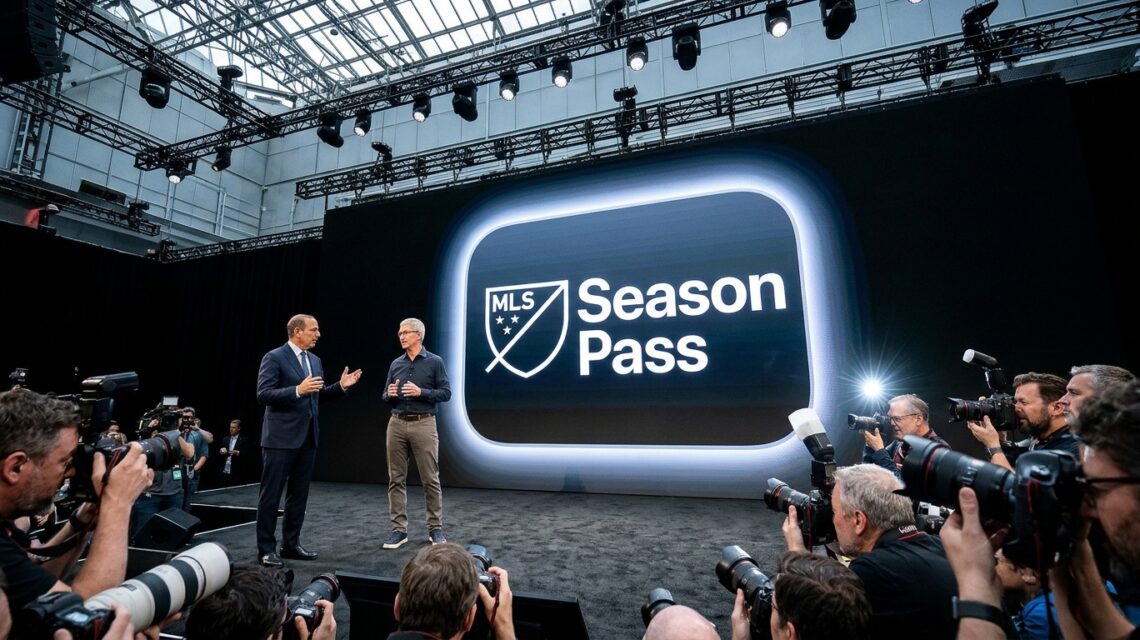
The 10-year partnership centralized soccer broadcasting across more than 100 countries, removed local blackouts and introduced a new way to compensate Lionel Messi. But after three seasons, Apple changed its strategy: every MLS match is now included in a standard Apple TV subscription.
By Marcio Tamer
Updated November 5, 2026
On June 14, 2022, Apple and Major League Soccer announced a broadcasting partnership that would change how American professional soccer was distributed.
The agreement covered ten seasons, from 2023 through 2032.
Its reported minimum value was $2.5 billion, equivalent to approximately $250 million annually.
But the most significant part of the deal was not the money.
For the first time, a major American professional sports league was making every match available through one worldwide streaming service, without the local television blackouts that had long complicated sports broadcasting.
The strategy was ambitious.
Instead of selling local rights separately to regional broadcasters, MLS consolidated its media inventory.
Apple gained a global soccer product.
MLS received a long-term financial guarantee and the possibility of additional subscription-related revenue.
Then Lionel Messi arrived in 2023.
His move to Inter Miami created a new commercial opportunity, including a reported arrangement linking part of his compensation to international streaming subscriptions.
But the experiment did not remain unchanged.
In November 2025, Apple and MLS announced that the standalone MLS Season Pass would disappear after the season.
Beginning in 2026, every MLS match would be included in a standard Apple TV subscription at no additional charge.
The original ten-year partnership continued, but the consumer business model changed after just three seasons.
That decision revealed the central challenge of sports streaming: owning valuable rights is not the same as persuading viewers to purchase a separate subscription for one competition.
Why the traditional American sports television model was fragmented
For decades, major American sports leagues relied on a combination of national television agreements and local broadcasting contracts.
National networks paid to show selected games.
Regional sports networks carried many regular-season matches involving local teams.
Fans often needed different subscriptions to watch different competitions.
Geographic blackout restrictions created additional complications.
A supporter could live close to a team but be unable to watch its matches through a particular streaming service because a regional broadcaster held exclusive local rights.
The system protected the value of local television contracts.
But it also frustrated viewers.
Major League Soccer faced the same problem.
Its clubs negotiated regional broadcasting arrangements.
National matches appeared on networks including ESPN, Fox and Univision.
International rights were distributed through separate agreements.
The result was a fragmented product.
A fan following one team might need several services to watch an entire season.
MLS commissioner Don Garber believed the league could offer something simpler.
The expiration of its existing media agreements created an opportunity to restructure the system.
MLS consolidated its local rights before signing with Apple
The Apple agreement required a significant change in how MLS controlled its broadcasting inventory.
The league needed to bring together rights that had previously been distributed among clubs and regional broadcasters.
That meant coordinating the expiration or restructuring of local agreements.
The process was essential to the new model.
Apple could not offer every match worldwide if individual clubs continued granting exclusive rights to regional networks.
MLS therefore moved toward a centralized broadcasting structure.
The league became responsible for creating a unified media product.
It could then negotiate with a technology company capable of distributing that product globally.
The arrangement differed from the traditional American sports model.
The NFL, NBA, MLB and NHL maintained combinations of national, regional and local broadcasting agreements.
MLS was willing to concentrate its core live-match inventory in one digital ecosystem.
That made the league an attractive partner for Apple.
It also created a major commercial risk.
The competition would become heavily dependent on one distribution platform.
The $2.5 billion figure was a reported minimum guarantee
The financial structure was one of the deal’s most unusual features.
Contemporary reporting by Sports Business Journal described Apple’s commitment as a minimum guarantee worth approximately $250 million per year.
Across ten seasons, that produced a reported minimum value of $2.5 billion.
The agreement also included a revenue-sharing mechanism.
MLS could receive additional money if subscription sales exceeded a specified threshold.
But the exact threshold was not publicly disclosed.
Neither was the percentage of additional subscription revenue allocated to the league.
That limits what can be calculated from the deal.
The reported $250 million annual guarantee is not Apple’s annual profit.
It is not the total amount paid by consumers.
And it is not necessarily the final amount MLS receives in a given year.
Apple also faced costs associated with operating and marketing the service.
MLS and its clubs had responsibilities for producing the broadcasts.
The economics therefore involved more than a simple rights payment.
The agreement combined guaranteed income with a potential incentive to expand the subscriber base.
Why Apple wanted a worldwide soccer league
Apple had several reasons to enter the sports broadcasting market.
Live sports attract audiences that watch programming at specific times.
They can encourage subscribers to remain with a streaming service.
They also create opportunities for advertising, sponsorship and international expansion.
MLS offered an unusual package.
The league controlled a large schedule of matches.
Its clubs were located across the United States and Canada.
It had a growing international player base.
And it could offer a global rights package without the same fragmentation found in many other major sports properties.
Apple could distribute matches through the Apple TV app on phones, computers, smart televisions, streaming devices and game consoles.
The company did not need to build a traditional cable television network.
It could use its existing software and distribution infrastructure.
The partnership also aligned with the growth of soccer in North America.
The United States, Canada and Mexico were preparing to host the 2026 FIFA World Cup.
Apple and MLS were betting that interest in the sport would continue increasing.
The ten-year duration gave both sides time to develop the product.
But the long contract also required flexibility.
The consumer subscription model would eventually change.
MLS Season Pass launched in February 2023
Apple and MLS launched MLS Season Pass on February 1, 2023.
The service was available in more than 100 countries and regions.
Subscribers could watch every regular-season MLS match.
The package also included the MLS Cup Playoffs and Leagues Cup.
Matches were available without local blackouts.
The service offered commentary in English and Spanish.
Matches involving Canadian teams were also available in French.
That multilingual approach reflected the league’s international ambitions.
MLS wanted to reach fans beyond North America.
The service also included highlights, replays, studio programming and other original content.
The goal was to make the league available through one destination.
Fans no longer needed to identify which regional network held the rights to a particular match.
They could open the Apple TV app and find the competition.
That was a major improvement in accessibility.
But the product was not free.
Viewers generally needed to purchase a separate MLS Season Pass subscription.
The original subscription created a new financial barrier
The 2023 launch introduced a standalone subscription.
In the United States, the initial full-season price was $99.
Apple TV+ subscribers could purchase the package at a discounted price.
Monthly options were also available.
The structure created a clear commercial distinction.
Apple TV+ was the company’s broader entertainment service.
MLS Season Pass was an additional product dedicated to soccer.
A viewer could subscribe to one without necessarily receiving the other.
That gave Apple a way to measure direct demand for MLS.
It also created an additional payment decision for consumers.
A casual fan might already subscribe to Apple TV+.
But watching every MLS match required another purchase.
For committed supporters, the convenience of having all matches in one place could justify the price.
For occasional viewers, the extra fee might discourage participation.
The model therefore balanced two competing objectives.
It generated direct subscription revenue.
But it also limited the number of people who could watch the league without paying more.
That trade-off became central to the partnership’s evolution.
Lionel Messi changed the commercial value of the agreement
In June 2023, Lionel Messi announced that he would join Inter Miami.
The move was one of the most significant player transfers in MLS history.
Messi had won the 2022 FIFA World Cup with Argentina.
He was already one of the most recognizable athletes in the world.
His arrival gave MLS an international audience far larger than the league had previously commanded.
The timing was particularly important.
Apple had launched MLS Season Pass only months earlier.
Messi’s presence created an immediate opportunity to attract new subscribers.
Fans in Argentina, Europe, Asia and other markets could watch his Inter Miami matches through the same platform.
There was no need for separate regional broadcasting agreements.
The global rights structure made Messi’s commercial value easier to capture.
Apple and MLS could market his matches internationally.
The partnership had created a distribution system capable of responding to a major sporting event.
Messi’s arrival tested that system almost immediately.
Messi’s contract included a streaming revenue-sharing arrangement
Messi’s compensation package was unusual.
His agreement with Inter Miami reportedly included salary, signing bonuses and an ownership-related component.
But he also negotiated commercial arrangements involving major MLS partners.
Those included Apple and Adidas.
In July 2023, Sports Business Journal reported that Garber had confirmed Messi would receive additional compensation linked to new international MLS Season Pass subscriptions.
The arrangement reflected Messi’s value beyond Inter Miami.
His presence could attract viewers to matches involving other MLS teams.
It could increase the league’s global profile.
It could also generate new revenue for Apple.
The streaming component allowed Messi to participate in some of that commercial upside.
But the exact percentage was not publicly disclosed.
Nor was the precise calculation method.
It is therefore inaccurate to claim that Messi received a known percentage of every new subscriber worldwide.
The public evidence supports a more limited conclusion.
His compensation included an undisclosed arrangement tied to international subscription revenue.
That was still a significant innovation.
It connected a player’s earnings to the growth of a media product.
Why Messi’s deal was different from a conventional player contract
Most professional athletes receive compensation primarily from their teams.
Their salaries are negotiated within the relevant league’s rules.
They may also earn money from endorsements.
Messi’s MLS arrangement combined those traditional elements with a new source of commercial income.
Apple had a direct financial interest in his presence.
The company was paying for rights to a league whose global appeal could increase substantially with Messi playing in it.
That created an incentive for Apple to participate in the recruitment package.
The arrangement also reflected MLS’s centralized commercial structure.
The league negotiates major commercial agreements collectively.
That made it possible to coordinate a deal involving a club, the league and external partners.
Messi’s arrival was not financed solely by Inter Miami’s standard player salary.
The wider package included commercial opportunities connected to the league’s business relationships.
That helped MLS compete for a player who had attracted interest from clubs with enormous financial resources.
The agreement demonstrated how media rights could become part of player recruitment.
Messi’s arrival increased subscriptions, but the exact totals remain undisclosed
The commercial response was immediate.
Inter Miami’s social media following expanded rapidly.
Ticket demand increased.
Messi merchandise became highly sought after.
MLS Season Pass also benefited.
In August 2023, MLS said subscriptions had more than doubled since Messi joined the league.
Apple executives reported that the service was performing better than expected.
But the companies did not disclose a complete set of subscriber figures.
That creates an important limitation.
The percentage increase was significant.
But without a verified starting number, it cannot be converted into an exact number of new paying subscribers.
Nor can the increase be translated directly into revenue.
Some subscriptions were discounted.
Others were included with season-ticket packages.
Promotional offers also affected pricing.
The financial value of an additional subscription therefore depended on the type of customer and the applicable terms.
Messi clearly increased attention and demand.
The precise amount of incremental subscription revenue remains undisclosed.
The 2026 decision changed the business model
On November 13, 2025, Apple and MLS announced a major change.
Beginning with the 2026 season, every MLS match would be included in a standard Apple TV subscription.
The standalone MLS Season Pass would end after the 2025 season.
The decision removed the additional fee that had existed during the first three years of the partnership.
Fans who already subscribed to Apple TV could watch MLS without purchasing another package.
The change applied to regular-season matches, the Leagues Cup, the MLS All-Star Game, Campeones Cup and the MLS Cup Playoffs.
The worldwide distribution model remained intact.
Matches continued to be available without local blackouts.
The service remained accessible in more than 100 countries and regions.
The change therefore did not reverse the original broadcasting strategy.
It changed how consumers paid for the product.
Instead of selling MLS as a separate subscription, Apple made the league part of its broader entertainment offering.
That was a fundamental commercial shift.
Why Apple stopped selling MLS Season Pass separately
Apple and MLS presented the change as a way to make the league more accessible.
The companies emphasized the convenience of including every match in one standard subscription.
The decision also aligned MLS with Apple’s broader sports strategy.
Apple TV already carried original entertainment programming and selected live sports.
The company was expanding its sports portfolio.
Bundling MLS with the wider service increased the value of an Apple TV subscription.
It also reduced friction for potential viewers.
A subscriber interested in a single Inter Miami match no longer needed to purchase a separate soccer package.
The change could help casual fans discover the league.
It could also make MLS more useful as a retention tool for Apple’s streaming business.
But the companies did not publicly disclose all the financial reasons behind the decision.
It would therefore be speculative to claim that the standalone service failed.
The available evidence supports a narrower interpretation.
Apple and MLS decided that including the league in the broader subscription offered a better strategic approach for 2026.
The exact subscriber, revenue and profitability calculations behind that decision remain private.
What changed for viewers in 2026
The consumer experience became simpler.
Before 2026, viewers generally needed a separate MLS Season Pass subscription to watch every match.
From 2026, a standard Apple TV subscription included the complete MLS schedule.
The change eliminated the extra MLS-specific charge.
In the United States, Apple TV was advertised at $14.99 per month in 2026.
That price covered the broader streaming service, not only MLS.
The exact subscription price and availability could vary by country.
The service remained accessible through the Apple TV app on supported devices.
Fans did not need to own an Apple television device.
They could watch through compatible smart TVs, streaming hardware, computers and mobile devices.
The league also continued providing subscriptions through eligible full-season ticket packages.
The central promise remained unchanged.
Every MLS match was available through one service without local blackouts.
But the economic relationship between the viewer and the product had changed.
The Apple-MLS deal in numbers
| Indicator | Figure |
|---|---|
| Partnership announced | June 14, 2022 |
| Original contract period | 2023–2032 |
| Reported minimum value | $2.5bn |
| Reported annual minimum guarantee | $250m |
| Initial MLS Season Pass launch | February 1, 2023 |
| Original U.S. season price | $99 |
| Global availability | More than 100 countries and regions |
| Local broadcast blackouts | None for MLS matches |
| Messi joins Inter Miami | 2023 |
| Reported Messi streaming arrangement | Undisclosed share linked to international subscriptions |
| Reported subscription growth after Messi arrived | More than doubled |
| Standalone MLS Season Pass ends | After 2025 season |
| MLS included in standard Apple TV subscription | 2026 |
| Advertised U.S. Apple TV price in 2026 | $14.99 per month |
| MLS clubs in 2026 | 30 |
| Regular-season matches per club | 34 |
The figures illustrate how the agreement evolved.
The original deal created a dedicated global soccer subscription.
Messi’s arrival helped increase demand.
The 2026 change made the league available to a broader base of Apple TV subscribers.
The underlying media partnership remained in place.
But the subscription strategy changed substantially.
The financial risk shifted from local broadcasters to a global platform
The Apple agreement changed the distribution of commercial risk.
Under the traditional model, MLS clubs negotiated local broadcasting contracts.
Regional networks paid for rights in specific markets.
The league also sold national and international packages.
Revenue came from multiple broadcasters.
The Apple arrangement concentrated the core streaming product in one global partnership.
That simplified distribution.
It also reduced dependence on regional sports networks.
But it increased the importance of Apple’s commercial strategy.
MLS became closely tied to the platform’s decisions about pricing, marketing and subscriber growth.
The reported minimum guarantee provided financial stability.
The revenue-sharing structure created potential upside.
But the exact economics were not publicly disclosed.
The 2026 bundling decision demonstrated that Apple could change the consumer-facing model while maintaining the broader partnership.
That flexibility was valuable.
It also showed how much influence a single technology partner could have over the league’s media strategy.
The agreement did not eliminate traditional television entirely
The Apple partnership was frequently described as a complete break with television.
That description needs qualification.
Apple became the exclusive destination for the complete MLS match inventory.
But selected matches also appeared on traditional television networks.
Fox continued carrying a package of MLS games.
Those broadcasts were not exclusive.
The same matches remained available through Apple’s platform.
The arrangement allowed MLS to preserve some traditional television exposure while centralizing its complete streaming product.
That distinction matters.
The league did not abandon every linear broadcaster.
It changed which partner controlled the comprehensive rights package.
Apple became the central distribution platform.
Traditional television became a supplementary channel rather than the primary way to access the full season.
Why the model matters beyond soccer
The MLS agreement offered a test case for the future of sports broadcasting.
Traditional media rights are often fragmented by territory, platform and competition.
That fragmentation can generate high fees.
But it also makes the viewing experience complicated.
MLS demonstrated that a league could consolidate its rights and offer a complete global product.
The model created advantages.
Fans could find every match in one place.
The league could standardize production.
International marketing became easier.
And a global star such as Messi could attract viewers without the need to negotiate separate broadcasting arrangements in every market.
But the experiment also revealed a limitation.
A dedicated sports subscription may be attractive to committed supporters while remaining a harder sell to casual viewers.
Apple’s 2026 decision addressed that problem by making MLS part of a broader entertainment package.
The change suggested that the value of sports rights may extend beyond direct subscription revenue.
Live matches can help attract customers, retain existing subscribers and differentiate a streaming service.
Those benefits are difficult to measure publicly.
But they are central to the economics of modern sports media.
What remains unknown about the $2.5 billion partnership
Several important financial details have not been publicly disclosed.
Apple and MLS have not released the full contract.
The exact revenue-sharing threshold remains private.
The percentage of additional subscription income allocated to MLS is not public.
The companies have not published complete annual subscriber totals for the original Season Pass product.
The precise financial terms of Messi’s Apple-linked compensation are also undisclosed.
Those gaps limit any calculation of the partnership’s profitability.
The reported $2.5 billion guarantee is a significant commitment.
But it does not establish whether Apple has earned a positive return.
Nor does it reveal how much additional revenue MLS has received beyond the minimum.
The 2026 bundling decision adds another layer of uncertainty.
When MLS became part of the standard Apple TV subscription, it became harder to separate the value of soccer viewers from the wider streaming business.
A customer might subscribe primarily for MLS.
Another might watch MLS occasionally while subscribing for entertainment programming.
The financial value of each customer depends on retention, pricing, engagement and other factors.
Those data remain largely private.
The real significance of the Apple-MLS experiment
The Apple partnership transformed MLS broadcasting in three stages.
First, the league consolidated its media rights and launched a global subscription service.
Second, Messi’s arrival demonstrated how a superstar could increase the commercial value of a worldwide streaming platform.
Third, Apple and MLS changed the subscription model by including every match in the broader Apple TV service.
The sequence is more revealing than the original $2.5 billion headline.
The deal was not simply a ten-year television contract.
It was an experiment in how a sports league could become part of a technology company’s global subscription business.
The first phase emphasized direct payment for soccer.
The second used a global superstar to expand demand.
The third prioritized broader accessibility and integration with Apple’s entertainment platform.
The league retained its most important distribution advantage throughout the process.
Fans could watch every MLS match in one place without local blackouts.
But the way Apple attempted to monetize that access changed.
That is the central lesson of the partnership.
Streaming can simplify sports broadcasting.
It can create new forms of athlete compensation.
It can also make global audiences easier to reach.
But the business model must still evolve as companies learn how viewers behave.
MLS and Apple did not abandon their original vision in 2026.
They changed the price of admission.
+ Siga o Giro no Facebook
+ Siga o Giro no Instagram
Leia Mais: