


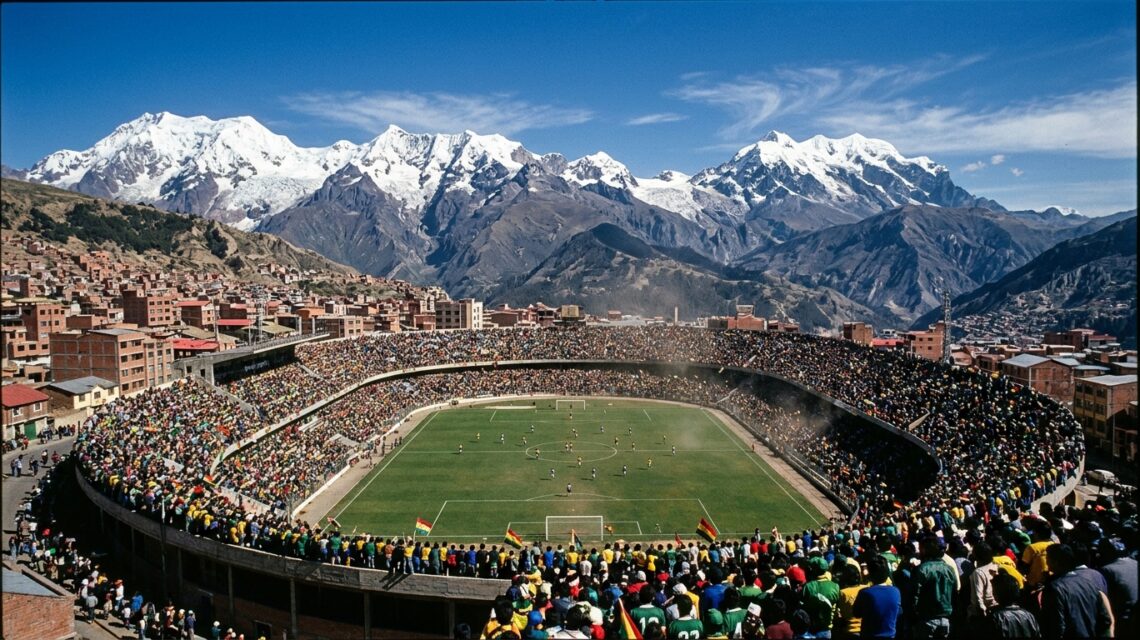
From Cerro de Pasco to El Alto, the world’s most extreme football venues expose visiting players to thinner air, reduced endurance and a different ball flight. The ranking also reveals why the highest stadium is not necessarily the most important one in international football.
By Marcio Tamer
Updated November 10, 2026
At approximately 4,378 meters above sea level, Estadio Daniel Alcides Carrión in Cerro de Pasco, Peru, stands higher than almost every inhabited football destination on Earth.
The stadium sits more than 700 meters above Bolivia’s famous Hernando Siles Stadium in La Paz, where visiting national teams have spent decades struggling with the effects of altitude.
But the most consequential recent development in high-altitude football happened elsewhere.
In September 2024, Bolivia began staging World Cup qualifiers at Estadio Municipal de El Alto, approximately 4,090 meters above sea level.
The move took the national team’s home advantage to an even more extreme elevation.
El Alto’s stadium became the highest venue used for a men’s World Cup qualifying match, according to contemporary reporting.
Brazil, Venezuela and other South American opponents faced conditions significantly different from those encountered at sea level.
The reason is not simply that breathing feels harder.
At extreme altitude, reduced atmospheric pressure limits the oxygen available to working muscles, while lower air density changes the forces acting on a moving football.
The result is a combination that can alter both physical performance and the way a match is played.
The 10 highest football stadiums in the world
The following ranking focuses on established football venues with documented use in organized competition, including professional and lower-division football. Elevations are approximate because published measurements differ between sources, and stadium-level surveys are not consistently available.
The list is based on commonly documented high-altitude grounds, particularly in South America, rather than a certified worldwide census of every football pitch.
| Rank | Stadium | City and country | Approximate altitude |
|---|---|---|---|
| 1 | Estadio Daniel Alcides Carrión | Cerro de Pasco, Peru | 4,378 m |
| 2 | Estadio Municipal de El Alto (Villa Ingenio) | El Alto, Bolivia | 4,090 m |
| 3 | Estadio Víctor Agustín Ugarte | Potosí, Bolivia | 3,967 m |
| 4 | Estadio Enrique Torres Belón | Puno, Peru | 3,829 m |
| 5 | Estadio Guillermo Briceño Rosamedina | Juliaca, Peru | 3,825 m |
| 6 | Estadio Jesús Bermúdez | Oruro, Bolivia | 3,735 m |
| 7 | Estadio Hernando Siles | La Paz, Bolivia | 3,637 m |
| 8 | Estadio Inca Garcilaso de la Vega | Cusco, Peru | 3,350 m |
| 9 | Estadio Huancayo | Huancayo, Peru | 3,250 m |
| 10 | Estadio Rodrigo Paz Delgado | Quito, Ecuador | Approximately 2,850 m |
Ranking qualification: Some international compilations include additional venues in China, Ethiopia and other high-altitude regions, while published elevations for certain stadiums vary substantially. The table should therefore be read as a ranking of widely documented high-altitude football venues, not an independently surveyed and exhaustive global top 10.
The first seven entries all stand above 3,600 meters.
That is a remarkable concentration of football infrastructure in an environment where unacclimatized athletes can experience significant physiological stress.
1. Estadio Daniel Alcides Carrión: Peru’s stadium above 4,300 meters
<AsyncImage query=”Estadio Daniel Alcides Carrion Cerro de Pasco Peru football stadium aerial” aspectRatio=”16:9″/>
Cerro de Pasco is one of the highest cities in the world.
Its Estadio Daniel Alcides Carrión is widely identified as the highest football stadium used for organized competition.
Published estimates generally place the ground between 4,338 and 4,380 meters, with 4,378 meters frequently cited in South American rankings.
The venue has been associated with Unión Minas and other local clubs.
Its extreme location presents challenges that extend beyond football.
Cerro de Pasco experiences low temperatures, difficult weather and the logistical constraints of a high-altitude mining city.
For visiting players accustomed to sea level, the difference in atmospheric pressure is substantial.
At approximately 4,378 meters, standard atmospheric calculations indicate that ambient pressure is roughly 59% of its sea-level value.
That does not mean the air contains 41% less oxygen by percentage.
Oxygen still makes up approximately 21% of dry air.
Instead, the reduced pressure means fewer oxygen molecules are available in each breath.
The distinction explains why the stadium is such an extreme sporting environment.
2. Estadio Municipal de El Alto: Bolivia’s new international fortress
<AsyncImage query=”Estadio Municipal de El Alto Villa Ingenio Bolivia Always Ready football stadium” aspectRatio=”16:9″/>
Estadio Municipal de El Alto, also known as Villa Ingenio, stands at approximately 4,090 meters.
It is the home of Always Ready, one of Bolivia’s prominent professional clubs.
The venue gained international attention when it began hosting major continental club matches.
In 2024, Bolivia’s national team also moved selected World Cup qualifiers there.
The decision created a notable contrast with Hernando Siles in La Paz.
Hernando Siles had long been regarded as one of international football’s most difficult away venues.
El Alto sits roughly 450 meters higher.
That difference may appear modest compared with the overall elevation, but atmospheric pressure continues to decrease as altitude rises.
The change means visiting players encounter an even more demanding environment.
El Alto also offers a modern stadium setting that can host significant international fixtures.
Its importance is therefore different from that of Cerro de Pasco.
Cerro de Pasco is associated with the altitude record.
El Alto has become a prominent example of extreme altitude in major international competition.
3. Estadio Víctor Agustín Ugarte: football in the historic city of Potosí
<AsyncImage query=”Estadio Victor Agustin Ugarte Potosi Bolivia football stadium” aspectRatio=”16:9″/>
Estadio Víctor Agustín Ugarte stands at approximately 3,967 meters in Potosí, Bolivia.
The stadium has been associated with Real Potosí and Nacional Potosí.
Potosí is famous for its mining history and its location high in the Andes.
The city’s elevation has also made its football teams difficult opponents for visitors from lower altitudes.
Players arriving shortly before a match can experience increased breathing rates and fatigue during sustained running.
The effects are particularly noticeable during repeated high-intensity efforts.
However, altitude alone does not determine results.
Squad quality, tactical preparation, travel, temperature and the timing of arrival all influence performance.
Potosí’s elevation creates a challenging environment, but it does not make its home teams unbeatable.
4. Estadio Enrique Torres Belón: the overlooked ground in Puno
Estadio Enrique Torres Belón is located in Puno, Peru, at approximately 3,829 meters.
The stadium has hosted football associated with Alfonso Ugarte and regional competitions.
Its inclusion matters because it is frequently absent from simplified rankings of the world’s highest football stadiums.
Puno is situated near Lake Titicaca, in a region where communities have adapted to life at considerable altitude.
That adaptation does not make local residents immune to every physiological effect of thin air.
But athletes who live and train at elevation may be better prepared for the conditions than visiting players who arrive from sea level.
The stadium also illustrates why the definition of a professional football venue matters.
Some rankings focus exclusively on grounds regularly used in top-flight competitions.
Others include established stadiums hosting lower-division or regional football.
Those different criteria can change the order of the list.
5. Estadio Guillermo Briceño Rosamedina: Juliaca’s high-altitude challenge
<AsyncImage query=”Estadio Guillermo Briceno Rosamedina Juliaca Peru Binacional football stadium” aspectRatio=”16:9″/>
Juliaca’s Estadio Guillermo Briceño Rosamedina stands at approximately 3,825 meters.
The venue gained wider attention through Deportivo Binacional’s participation in Peruvian and continental football.
The stadium hosted matches that brought opponents from substantially lower elevations into the Peruvian highlands.
At this altitude, teams face two simultaneous challenges.
The first is physiological.
Reduced oxygen availability makes sustained aerobic activity more difficult, especially for athletes who have not acclimatized.
The second is aerodynamic.
Lower air density reduces drag on the football.
That can change the distance and speed of long passes, crosses and shots.
Players may need to adjust the force and trajectory they use when striking the ball.
The effects are real, although their magnitude depends on the ball, its speed, spin and environmental conditions.
6. Estadio Jesús Bermúdez: Oruro’s historic football ground
<AsyncImage query=”Estadio Jesus Bermudez Oruro Bolivia football stadium” aspectRatio=”16:9″/>
Estadio Jesús Bermúdez is located in Oruro, Bolivia, at approximately 3,735 meters.
It has been associated with San José and other football activity in the region.
Oruro’s altitude places the stadium above Hernando Siles in La Paz.
That is an important correction to many informal rankings, which place La Paz ahead of Oruro because of its greater international prominence.
The two stadiums have different sporting profiles.
Hernando Siles is famous for national-team matches and continental club competitions.
Jesús Bermúdez sits higher geographically.
Altitude rankings must be based on elevation rather than reputation or the importance of the competitions hosted.
7. Estadio Hernando Siles: the most famous high-altitude stadium in South America
<AsyncImage query=”Estadio Hernando Siles La Paz Bolivia football stadium aerial” aspectRatio=”16:9″/>
Hernando Siles is located in La Paz at approximately 3,637 meters.
The stadium has long hosted Bolivia’s national team and major domestic clubs, including Bolívar and The Strongest.
For decades, it was the international reference point for debates about high-altitude football.
Bolivia’s national team achieved memorable results there against more highly ranked opponents.
Those performances contributed to the stadium’s reputation as a difficult destination for visiting teams.
But the venue’s significance extends beyond results.
Hernando Siles became central to a dispute over whether playing at extreme altitude created unacceptable health risks or unfair competitive conditions.
That controversy eventually involved FIFA, medical researchers and South American football authorities.
The stadium also remains a useful example of how altitude interacts with other aspects of football.
A visiting team may struggle with repeated sprints.
A goalkeeper may find that long-range shots behave differently.
And coaches may alter pressing intensity or substitution strategies to manage fatigue.
None of those effects means that every match at altitude follows the same pattern.
8. Estadio Inca Garcilaso de la Vega: football in the historic city of Cusco
<AsyncImage query=”Estadio Inca Garcilaso de la Vega Cusco Peru football stadium” aspectRatio=”16:9″/>
Estadio Inca Garcilaso de la Vega is located in Cusco, Peru, at approximately 3,350 meters.
The ground has been associated with Cienciano and other clubs from the region.
Cusco’s elevation is lower than those of Cerro de Pasco, El Alto and Potosí.
Nevertheless, it remains high enough to affect visitors who are not accustomed to playing in reduced atmospheric pressure.
The city’s history and international tourism profile make it one of the best-known high-altitude destinations in Peru.
But its football environment has a distinct identity.
Teams from Cusco have long used the stadium for domestic and continental competition.
The challenge for visiting players is not simply completing 90 minutes.
It is maintaining their usual intensity throughout the match.
9. Estadio Huancayo: a difficult away destination in central Peru
Estadio Huancayo stands at approximately 3,250 meters in central Peru.
The venue has been associated with Sport Huancayo and other regional football teams.
Its elevation is lower than that of Cusco but still well above the level at which unacclimatized athletes can experience meaningful reductions in aerobic performance.
The stadium is another example of how Peru’s geography shapes its domestic football calendar.
Clubs may travel between coastal cities and high-altitude locations within the same competition.
That creates substantial environmental variation across a season.
A team that performs comfortably in Lima may face different physical demands in Huancayo.
Those differences are one reason altitude preparation remains a recurring topic in Peruvian football.
10. Estadio Rodrigo Paz Delgado: Quito’s major continental venue
Estadio Rodrigo Paz Delgado, also known as Casa Blanca, is located in Quito, Ecuador.
Published football sources commonly place it at approximately 2,850 meters, although some geographical references use lower figures for parts of the city and surrounding area.
The stadium is the home of LDU Quito, one of Ecuador’s most successful clubs.
It has hosted major continental matches and remains one of the best-known high-altitude venues in South American football.
Quito’s elevation is significantly lower than El Alto’s.
But the city is still high enough for altitude to influence the preparation of visiting teams.
The stadium also demonstrates why a top-10 ranking requires clearly defined criteria.
Other established grounds in Ecuador, Colombia, Ethiopia and China may enter or leave the list depending on which elevation figures and competition standards are used.
The precise global order beyond the highest and most consistently documented venues remains less certain than many published rankings suggest.
Why the football travels differently at high altitude
Altitude affects football through the atmosphere.
As elevation increases, atmospheric pressure generally decreases.
Air density also falls.
A football moving through thinner air encounters less aerodynamic drag than it would at sea level, assuming similar temperature and other conditions.
That can allow some shots and long passes to travel farther or retain more speed.
Spin-related forces can also change.
A curling free kick depends partly on the interaction between the rotating ball and the surrounding air.
With lower air density, that interaction can be weaker.
But the practical result is not simply that every shot becomes faster or every free kick stops curving.
Ball speed, spin rate, surface texture and weather conditions all influence the trajectory.
Players must adapt to the combination of those variables.
That is why teams sometimes report difficulty judging long passes and shots after arriving at high-altitude venues.
What happens to the human body above 3,000 meters?
The physical challenge comes primarily from reduced oxygen pressure.
The percentage of oxygen in the atmosphere remains approximately constant, but the lower pressure reduces the amount of oxygen available to the body with each breath.
To compensate, breathing and heart rate generally increase.
For an athlete arriving from sea level, the consequences can include reduced aerobic capacity, greater fatigue and difficulty recovering between intense efforts.
Some individuals also develop symptoms of acute mountain sickness, including headaches, nausea and disturbed sleep.
The severity varies from person to person.
In a 2008 review of preparation for football at altitude, researchers reported that players exposed to approximately 3,600 meters could experience a reduction in maximal aerobic power of around 25% during the first days.
That figure should not be interpreted as a universal 25% decline in match performance.
Maximal oxygen uptake is a physiological measurement.
Football performance depends on additional factors, including tactics, technical ability, pacing and decision-making.
Nevertheless, the research demonstrates why high-altitude matches can be demanding even for elite athletes.
Does altitude guarantee a home-team advantage?
No.
Altitude can create a significant advantage for teams accustomed to playing in those conditions, but it does not guarantee victory.
A 2007 study published in the British Medical Journal examined international football results in South America and found that altitude differences were associated with changes in home-team winning probabilities.
The analysis suggested that teams based at high elevation benefited when hosting opponents from lower altitudes.
But the study also found that the relationship was more complicated when those teams traveled to sea level.
High-altitude teams could face disadvantages away from home.
That matters because acclimatization works in both directions.
Teams accustomed to thinner air do not automatically enjoy superior performance in every environment.
The advantage depends on the specific conditions and the teams involved.
Altitude is a competitive factor, not a substitute for football quality.
Why FIFA tried to restrict high-altitude matches
The most significant international controversy began in 2007.
FIFA initially moved to restrict international matches above 2,500 meters.
The decision prompted strong opposition from South American football authorities, particularly in Bolivia.
Supporters of the restrictions argued that sudden exposure to high altitude could create health risks and affect competitive fairness.
Opponents argued that countries should not be prevented from playing international football in their established home cities.
The original ban was withdrawn shortly after its announcement while further scientific evidence was considered.
FIFA subsequently examined acclimatization recommendations through medical discussions and research.
In 2008, its executive committee considered requirements involving adaptation periods for matches above certain elevations.
Those historical recommendations should not be confused with a universal, currently enforced rule requiring every visiting team to spend a fixed number of days at altitude.
The later use of El Alto for World Cup qualifiers demonstrates that major international football has continued at elevations above 4,000 meters.
The controversy ultimately helped stimulate scientific research rather than producing a permanent blanket prohibition.
How much time do players need to acclimatize?
There is no single preparation period that works equally well for every athlete or every altitude.
Acclimatization is a gradual process.
The body adjusts breathing, fluid balance and other physiological responses after exposure to lower oxygen pressure.
Longer exposure can improve tolerance to altitude, but the adaptation process depends on elevation, individual physiology and training conditions.
A 2008 scientific review suggested that preparing for approximately one to two weeks at moderate or high altitude could provide a reasonable compromise between adaptation benefits and the practical demands of football schedules.
However, the researchers also emphasized uncertainty about the optimal strategy.
Later scientific work continued to identify unresolved questions.
Some teams arrive early to acclimatize.
Others choose to arrive close to kickoff to reduce the time spent experiencing altitude-related symptoms.
Those strategies involve different trade-offs.
Medical supervision, player monitoring and individualized preparation are more useful than assuming that one timetable guarantees protection or performance.
Why the highest stadium is not the same as the highest major international venue
Cerro de Pasco and El Alto illustrate two different records.
Estadio Daniel Alcides Carrión is widely recognized as the world’s highest established football stadium.
But it has not played the same role in major international competitions as Bolivia’s Villa Ingenio stadium.
El Alto has hosted continental club football and World Cup qualifiers.
That gives it a different sporting significance.
It also explains why the Bolivian stadium receives more international attention despite being approximately 288 meters lower than Cerro de Pasco.
A third distinction concerns the highest football match ever played.
Guinness World Records recognizes a match organized by Equal Playing Field on Mount Kilimanjaro in Tanzania on June 24, 2017, at 5,714 meters.
That event took place on a specially prepared temporary pitch.
It was not held in a permanent professional stadium.
The record for the highest football match therefore should not be confused with the record for the highest established football stadium.
What the ranking reveals about football in the Andes
The geography of high-altitude football is unusually concentrated.
Peru and Bolivia account for most of the world’s best-known extreme-altitude stadiums.
Their football infrastructure reflects cities and communities that developed at elevations where many visitors experience significant physiological challenges.
For local clubs, those environments are ordinary home conditions.
For visiting teams, they can require substantial preparation.
The difference becomes particularly important in competitions where clubs travel repeatedly between coastal cities and the Andes.
It also creates a continuing debate about sporting fairness.
A team from sea level may face reduced aerobic capacity at altitude.
A team based in the Andes may face different challenges when traveling to lower elevations.
Neither circumstance eliminates the legitimacy of the match.
The central question is how teams prepare and how governing bodies manage health risks.
With Bolivia continuing to use El Alto for major international football, that debate is unlikely to disappear.
And the most extreme figure remains in Peru.
At approximately 4,378 meters, Cerro de Pasco’s Estadio Daniel Alcides Carrión stands almost 750 meters above the famous Hernando Siles in La Paz, a difference large enough to show that even football’s best-known altitude fortress is far from the top of the Andes.
+ Siga o Giro no Facebook
+ Siga o Giro no Instagram
Leia Mais: