

Defensive glass-play clinics can help recreational players stop giving away points, while volley and overhead training teaches them to exploit attacking positions. New research and Playtomic’s own rating rules show why neither clinic guarantees a faster ranking increase.
By Marcio Tamer
Updated November 22, 2026
Unforced errors accounted for 44.9% of point endings in padel research summarized by a 2023 systematic review. Winners represented another 38.4%, while forced errors accounted for 16.7%.
Those figures offer a stronger explanation for why recreational players should take defensive training seriously than the frequently repeated claim that more than 70% of amateur points are lost through back-wall mistakes. That specific 70% figure is not established by the available evidence.
But the same research presents an apparent contradiction. Studies of professional padel have found that a large majority of winning shots come from attacking positions near the net.
For players trying to improve their Playtomic ratings, the lesson is not simply to defend more or attack harder. It is to identify which part of the transition from defense to attack is costing their pair the most points.
What the research says about defense and net dominance
A systematic review published in the Journal of Human Kinetics examined research on padel performance and identified two recurring patterns.
First, unforced errors are a major factor in match outcomes. Second, successful pairs spend more time in attacking positions and produce more effective volleys and overheads.
| Research finding | Reported result | What it means |
|---|---|---|
| Point endings classified as unforced errors | 44.9% | Avoidable mistakes are an important performance target |
| Point endings classified as winners | 38.4% | Attacking ability also matters |
| Point endings classified as forced errors | 16.7% | Pressure can win points without a clean winner |
| Winning shots from attacking positions | Often above 80% in cited professional research | Net positioning is a major tactical advantage |
These percentages come from different analyses and should not be treated as measurements from one recreational-player sample.
The distinction matters because professional players possess technical abilities and tactical patterns that cannot be directly mapped onto a Playtomic 2.0 or 3.5 player.
A 2025 study comparing amateur and professional padel found meaningful differences in stroke selection, court position and error patterns. That supports tailoring training to the player’s actual level rather than applying professional statistics mechanically.
Why defensive glass-play clinics can produce immediate benefits
For players who repeatedly misjudge wall rebounds, defensive training addresses a problem that appears throughout a match.
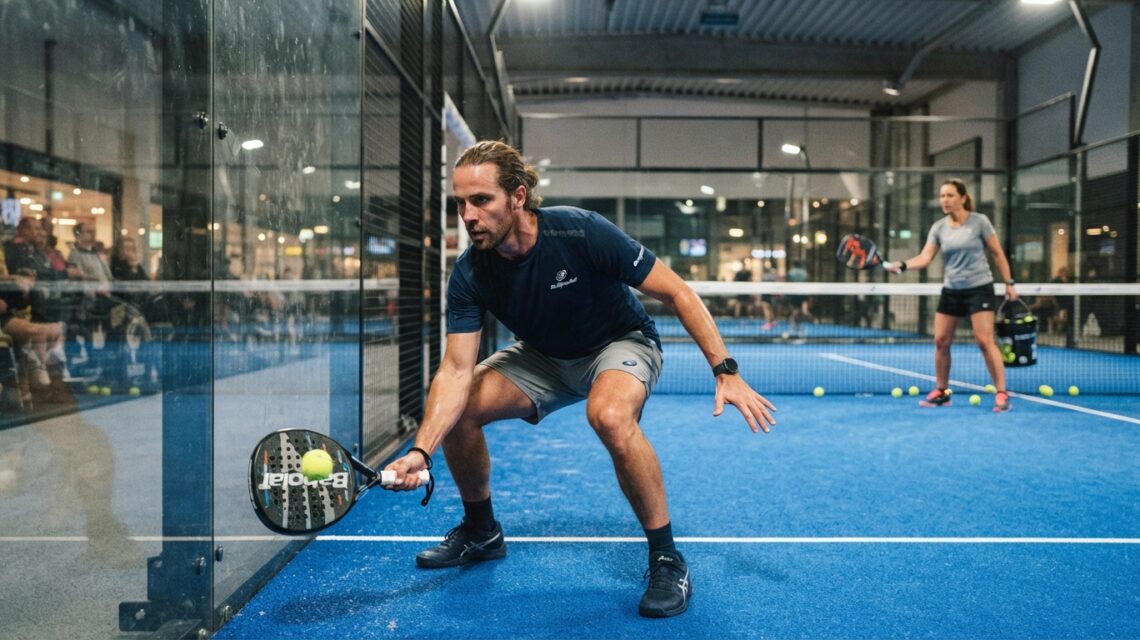
A back-wall clinic typically teaches players to recognize when the ball will rebound far enough to play comfortably, turn their body early and avoid striking the ball while moving backward.
Double-wall drills add another challenge because the rebound angle changes depending on whether the ball contacts the side glass or back glass first.
The objective is not to hit a spectacular counterattack from every defensive position. It is to return the ball with sufficient control to continue the rally and create a better opportunity.
A practical defensive session should include controlled back-wall feeds, corner rebounds, returns under pressure and lobs aimed beyond the opposing net players.
The lob is particularly important because it can change who controls the court. A sufficiently deep lob may force opponents to retreat, creating an opportunity for the defending pair to advance together.
However, not every lob should trigger an automatic rush forward. If the opponents can comfortably attack the ball overhead, advancing too early may expose the pair to an easy winner.
Why the lob is more complicated than simply hitting it high
Research published in Applied Sciences in 2024 examined the effectiveness of lobs in professional padel.
Among the observed men’s lobs, only 16.3% passed beyond the opponents without being intercepted. The corresponding figure for women’s padel was 26.1%.
That means most lobs in the studied professional matches were met with an overhead rather than passing the attacking pair completely.
This does not make the lob ineffective. An overhead played while retreating or from a difficult position can still weaken the attacking pair’s advantage.
It does show why coaches should emphasize depth, trajectory and timing instead of teaching players that any high lob automatically wins the net.
For recreational players, a useful progression begins with controlling the lob from a stationary position, then producing it after a wall rebound and finally using it during a live rally while coordinating movement with a partner.
When a net-attack clinic becomes the better investment
A player who already defends comfortably but repeatedly loses attacking positions may benefit more from a net-focused clinic.
The relevant skills include compact volleys, controlled bandejas, directional accuracy and coordinated movement between partners.
The bandeja is especially important because its purpose is often to maintain pressure and preserve net position rather than finish the point immediately.
A víbora adds a more aggressive sidespin option, while the smash becomes useful when the incoming lob allows a genuinely attacking contact.
Research published in 2024 found that proximity to the net increased the probability of winning a point. It also reported that the serving pair won 73% of short rallies in the studied men’s matches, compared with 57% of medium rallies and 47% of long rallies.
Those figures demonstrate how the initial attacking advantage can diminish as rallies continue. They do not establish a universal win rate for every recreational pair.
For players whose opponents routinely neutralize their volleys or push them backward with lobs, improving overhead placement and recovery positioning may offer a more direct benefit than spending another weekend exclusively on wall defense.
Does a Playtomic rating of 3.5 mean you should switch clinics?
Not necessarily.
Playtomic’s official coaching materials explain that its level system uses match results, player levels, team averages and a reliability measure.
Players with lower rating reliability can experience larger changes when new results are recorded. Higher reliability generally means smaller adjustments.
Consequently, two players with identical ratings may have very different weaknesses, match histories and rating stability.
| What happens in your matches | More useful clinic focus |
|---|---|
| You frequently misread back-wall rebounds | Defensive glass play |
| Your lobs regularly land short | Defensive lobs and transitions |
| You defend well but rarely gain the net | Lob placement and coordinated movement |
| You reach the net but lose it after one overhead | Bandeja and recovery positioning |
| Your volleys frequently sit up or go long | Net-attack technique |
| Both partners move independently | Tactical pair-positioning clinic |
A numerical cutoff such as Playtomic 3.5 cannot reliably determine which clinic is best.
Likewise, there is no verified evidence that a defensive clinic consistently moves players from 2.0 to 3.5 faster than an attacking clinic.
How to measure whether a clinic is improving your game
The most useful evaluation begins before the first coaching session.
Record several competitive matches and identify recurring errors. A player might discover that the majority of lost points originate from rushed wall rebounds, short defensive lobs or poor overhead decisions.
After the clinic, compare similar match situations rather than relying only on the final score.
Useful measures include the number of avoidable wall errors, the percentage of defensive lobs that create a neutral or favorable situation, and how often the pair retains the net after an overhead.
A coach can also track whether both players advance and retreat together instead of leaving large gaps between them.
The next step is to test those improvements against opponents of comparable strength.
A better Playtomic rating may follow stronger match results, but the platform’s algorithm does not award points simply because a player completed a clinic or improved a particular stroke.
Which clinic should you book first?
For a beginner or lower-intermediate player who struggles with wall rebounds, a defensive glass-play clinic is a sensible first investment. It addresses a frequent source of errors and teaches the skills needed to escape pressure.
For a player who already controls defensive rallies and produces reliable lobs, a net-attack clinic may offer greater value by improving volleys, overheads and court positioning.
The strongest long-term training plan combines both. Defensive skills help a pair regain the attacking position, while net skills help it maintain that advantage and convert opportunities into points.
When choosing a clinic, prioritize meaningful individual feedback, drills that progress into live rallies and opportunities to practice with your regular partner. A four-player group on one court can be a practical format, but coaching quality and actual repetitions matter more than an arbitrary participant limit.
The next useful step is to review where your pair loses points, not simply where your Playtomic rating sits.
+ Siga o Giro no Facebook
+ Siga o Giro no Instagram
Leia Mais: