

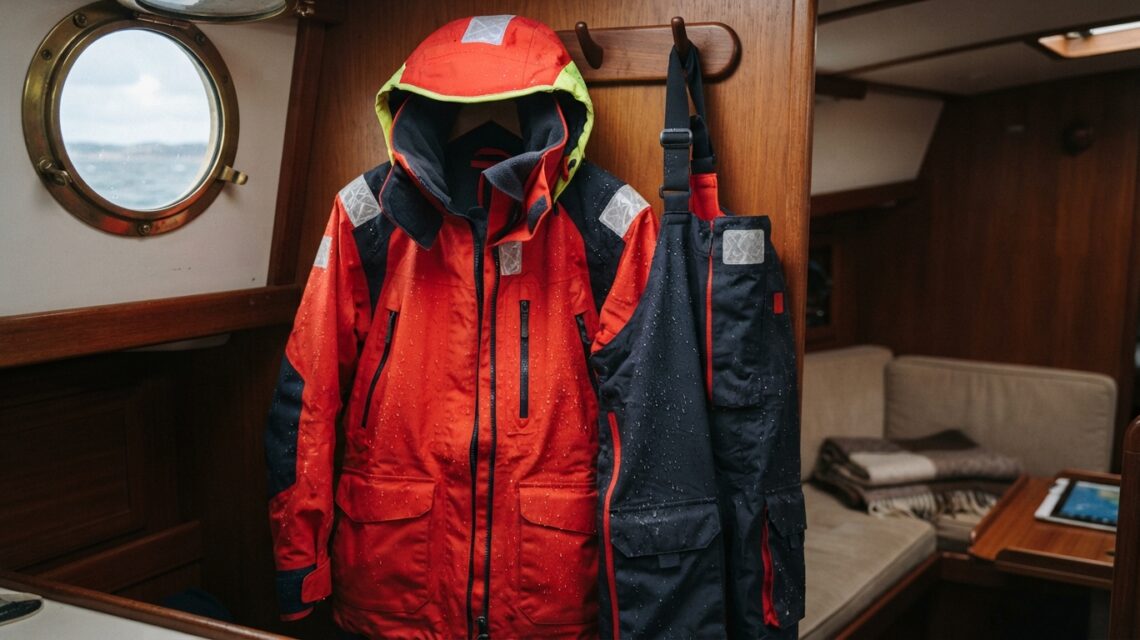
A premium 3-layer GORE-TEX Pro offshore jacket can be worth its $1,000-plus price when sailors spend days exposed to cold, breaking seas and continuous spray. But proprietary marine membranes from Gill, Musto and Helly Hansen have narrowed the performance gap, with some products reaching waterproof ratings of 30,000 mm. For coastal passages, overnight races and most recreational offshore sailing, the right construction, collar, cuffs and overall fit may matter more than the membrane’s brand name.
By Marcio Tamer
Updated November 24, 2026
An offshore foul-weather jacket is more than a waterproof layer. During a night watch in cold conditions, it must protect against wind-driven rain, waves breaking over the cockpit, repeated spray and the physical demands of working on deck. A jacket that leaks around the wrists, allows water through its front closure or restricts movement can become a serious problem even when its membrane carries an impressive technical specification.
The market is divided between premium jackets using GORE-TEX technology and models built around proprietary waterproof-breathable systems. Sailors often associate GORE-TEX with the highest level of protection, but the difference is not as simple as the price tags suggest. Modern proprietary fabrics can deliver substantial waterproof performance, while the complete garment determines how well that protection works at sea.
GORE-TEX Pro vs. proprietary membranes, what actually changes?
GORE-TEX is a membrane technology developed by W. L. Gore & Associates and licensed to manufacturers that build finished garments around it. The company now offers different membrane technologies, including next-generation ePE products, which use expanded polyethylene rather than relying exclusively on the older ePTFE construction.
The current GORE-TEX Pro range is designed for demanding environments where abrasion resistance, durable waterproofing and breathability are important. Its three-layer construction combines a protective outer textile, a waterproof membrane and an internal backer. Gore describes its newer Pro products as PFAS-free, meaning they are made without intentionally added per- and polyfluorinated substances, although trace amounts may remain.
Proprietary systems follow a similar general principle but use materials and construction methods developed or selected by each brand. HELLY TECH Professional, Gill XPLORE and Musto’s OceanTech Pro or BR2 technologies are examples of systems designed for different levels of marine exposure.
The distinction is important because proprietary does not automatically mean inferior. Musto currently lists its BR2 Offshore Jacket 2.0 with a waterproof rating of 30,000 mm, while Gill’s XPLORE technology also reaches a published 30,000 mm rating in its OS2 system information. Those figures are higher than the 28,000 mm benchmark often used to describe GORE-TEX waterproof performance.
That does not make the jackets equivalent in every respect. Waterproof ratings measure resistance to water pressure under specified testing conditions. They do not independently measure breathability, abrasion resistance, seam construction, zipper protection or long-term performance after repeated exposure to salt, sunscreen and wear.
Waterproof ratings do not tell the whole story
Hydrostatic head is one of the most familiar measurements used to compare waterproof fabrics. It indicates how much water pressure a material can withstand before water penetrates it. A higher number generally indicates greater resistance to water pressure, but it does not provide a complete picture of how a jacket performs in an offshore environment.
GORE-TEX publishes a waterproof standard above 28,000 mm for its membrane technology. Musto’s BR2 Offshore Jacket 2.0 is listed at 30,000 mm, while Gill publishes a 30,000 mm hydrostatic-head result for its XPLORE fabric technology. Helly Hansen’s HELLY TECH Professional system specifies a minimum waterproofness level of 20,000 mm.
These numbers show why a simple premium-versus-budget comparison can be misleading. Some proprietary marine jackets already offer very high waterproof ratings, and the difference between two garments may depend more on construction and design than on the membrane category.
Breathability is even harder to compare because manufacturers can use different testing methods and units. Moisture vapor transmission rate, usually expressed in grams per square meter over 24 hours, and evaporative resistance, expressed as RET, are not interchangeable measurements. A claim of 25,000 g/m²/24h cannot be directly compared with an RET figure without understanding the test method.
For sailors, the practical question is whether the jacket allows enough body moisture to escape during activity while keeping external water out. A highly waterproof garment that traps sweat during winch work can still leave its wearer cold and uncomfortable during a long watch.
Why the jacket’s construction matters as much as its membrane
The collar, hood, cuffs and front closure are critical parts of an offshore jacket. These areas are exposed to repeated water impact and movement, and they can become weak points if the design does not match the intended sailing conditions.
A high protective collar should cover the neck and lower face when required, while remaining comfortable enough to wear for several hours. A well-designed hood should accommodate a sailing helmet or cap where appropriate, maintain peripheral visibility and remain secure when the wind increases.
Wrist protection deserves equal attention. Adjustable outer cuffs help reduce water entry, while inner seals can provide another barrier depending on the design. Some jackets use laminated stretch cuffs, others use adjustable PU seals, and specialized dry-top garments may use latex seals. These constructions are not interchangeable, and a tight seal should not compromise circulation or mobility.
The front zipper is another important detail. Some garments use a conventional zipper protected by a double storm flap, while others use waterproof zipper systems designed to reduce bulk. The Sail Racing Reference GORE-TEX Pro Jacket, for example, uses a two-way YKK AquaGuard zipper, an internal storm placket and reinforced construction at high-wear areas. Mustang Survival’s EP 6.5 Ocean Jacket uses a two-way YKK AQUASEAL zipper.
A longer rear hem, articulated sleeves, reinforced elbows and reflective details also matter. The jacket must remain protective when the sailor bends, reaches overhead, moves around the cockpit or works near the mast. A membrane specification cannot compensate for a poor fit or badly designed closures.
When GORE-TEX Pro is worth the higher price
For sailors undertaking multi-day passages in cold, high-latitude waters, the premium for a top-tier offshore jacket can be justified. Extended exposure increases the importance of durable construction, reliable weather protection, abrasion resistance and a design that remains comfortable through repeated wet watches.
The Sail Racing Reference GORE-TEX Pro Jacket is a clear example of this premium category. Its official US listing has shown a price of approximately $1,400, with a three-layer construction, 80-denier nylon face fabric, reinforced lower back, corrosion-resistant zipper components and a high collar with an integrated storm cap.
Mustang Survival’s EP 6.5 Ocean Jacket is another specialist option. The manufacturer lists it at $1,549.99 in the United States and specifies Mil Spec 6.5 GORE-TEX fabric, a removable high-visibility hood, integrated face protection and a waterproof two-way zipper.
These are expensive garments, but they are designed for sailors who may spend long periods exposed to harsh conditions. In that environment, durable construction and reliable protection can justify paying more, particularly when the jacket is used frequently over several seasons.
The purchase still needs to be evaluated as part of a complete clothing system. A premium shell will not replace suitable thermal base layers, insulation, waterproof trousers, gloves and appropriate personal protective equipment.
Why proprietary membranes make sense for many cruisers
For sailors who spend weekends racing, make coastal passages or charter in warmer regions, a high-spec proprietary jacket can offer a more balanced purchase.
Musto’s BR2 Offshore Jacket 2.0 is one example. The manufacturer lists a 30,000 mm waterproof rating, articulated sleeves, adjustable cuffs, a high-visibility hood and an offshore-oriented collar and hood design. Its official European listing has shown a price of €450.
Gill’s OS2 Offshore Jacket uses XPLORE technology in a two-layer construction. The manufacturer highlights its high thermal collar, high-visibility hood, reflective details and adjustable PU inner seals. Gill also publishes a 30,000 mm hydrostatic-head rating for its XPLORE fabric system, although the precise specification should be checked against the version being purchased.
Helly Hansen’s Skagen Offshore Jacket uses HELLY TECH Performance in a two-layer construction. Its features include Cordura reinforcements, SOLAS reflective details, a high collar, double storm flap, adjustable cuffs and an articulated sleeve design. It is a useful example of why the membrane name alone does not define the jacket’s intended use.
These garments can be entirely appropriate for demanding recreational sailing. The important qualification is that a two-layer coastal or offshore jacket should not automatically be treated as equivalent to a reinforced three-layer garment designed for prolonged exposure in severe ocean conditions.
Representative offshore jackets and their differences
| Jacket | Membrane or fabric | Construction and notable features | Manufacturer-listed price |
|---|---|---|---|
| Sail Racing Reference GORE-TEX Pro | GORE-TEX Pro ePE | 3-layer, 80D nylon, reinforced lower back, storm-cap hood | About $1,400 |
| Mustang Survival EP 6.5 Ocean | Mil Spec 6.5 GORE-TEX | Marine-focused construction, removable hood, AQUASEAL zipper | $1,549.99 |
| Musto BR2 Offshore Jacket 2.0 | OceanTech Pro / BR2 | 30,000 mm waterproof rating, articulated sleeves, high-vis hood | €450 |
| Gill OS2 Offshore Jacket | XPLORE | 2-layer construction, high collar, adjustable inner seals | Varies by market |
| Helly Hansen Skagen Offshore | HELLY TECH Performance | 2-layer construction, Cordura reinforcement, SOLAS details | Varies by market |
Prices are manufacturer-listed examples from different markets, not a controlled retail comparison. Taxes, exchange rates, seasonal discounts and product revisions can change the final price.
DWR, saltwater and the maintenance most sailors overlook
Durable Water Repellent, or DWR, is the treatment applied to the outer face fabric to encourage water to bead and roll off instead of soaking into the textile. It is separate from the waterproof membrane beneath it.
When the outer fabric becomes saturated, the jacket can feel cold and clammy even if the membrane remains waterproof. This condition is commonly called wetting out. It can also reduce comfort because the saturated outer layer makes it harder for moisture to move through the complete fabric system.
GORE-TEX explains that DWR performance declines with wear, dirt, sunscreen, insect repellent and other contaminants. The company’s current care guidance recommends washing garments according to their labels, using liquid detergent, avoiding fabric softener and restoring the water-repellent treatment when necessary.
Saltwater exposure also makes regular rinsing and proper drying important. Salt deposits, dirt and sunscreen can accumulate on the face fabric, cuffs and zippers. After sailing, rinse the jacket with fresh water when appropriate, allow it to dry fully and follow the manufacturer’s instructions before storing it.
There is no universal rule that every offshore jacket needs a new DWR treatment once a year. The correct interval depends on use, contamination, washing and whether water still beads on the outer fabric after cleaning and reactivation.
How to choose the right jacket for your sailing conditions
For regular ocean passages in cold water, a premium three-layer offshore jacket with reinforced high-wear areas, a protective collar, a well-designed hood and secure closures is a sensible investment. GORE-TEX Pro models such as the Sail Racing Reference and Mustang EP 6.5 are examples of this category.
For coastal cruising, overnight racing and recreational offshore use, proprietary options such as the Musto BR2, Gill OS2 and Helly Hansen Skagen deserve serious consideration. Their technical specifications and marine-specific features can provide substantial protection without requiring a four-figure purchase.
Before buying, try the jacket with the layers you actually expect to wear. Check shoulder movement, reach above the head, cuff compatibility with sailing gloves and whether the collar interferes with your personal flotation device or harness. If possible, test the hood with the headwear you normally use at sea.
The most expensive membrane is not automatically the best choice for every sailor. A properly fitted jacket with suitable construction, effective seals and the right level of protection for the conditions will usually be a better investment than buying a premium fabric name without considering how the complete garment performs.
+ Siga o Giro no Facebook
+ Siga o Giro no Instagram
Leia Mais: