

At Camp Bonifas, American and South Korean soldiers have played a single par-three hole beside one of the world’s most heavily guarded borders. The artificial-turf course became famous in 1988, but its warning signs, military history and live minefields reveal a story far stranger than ordinary golf.
By Marcio Tamer
Updated October 28, 2026
A golf ball that misses the fairway at Camp Bonifas can become a permanent loss.
Not because it has landed in deep water, thick vegetation or an inaccessible bunker.
It may have entered a live minefield.
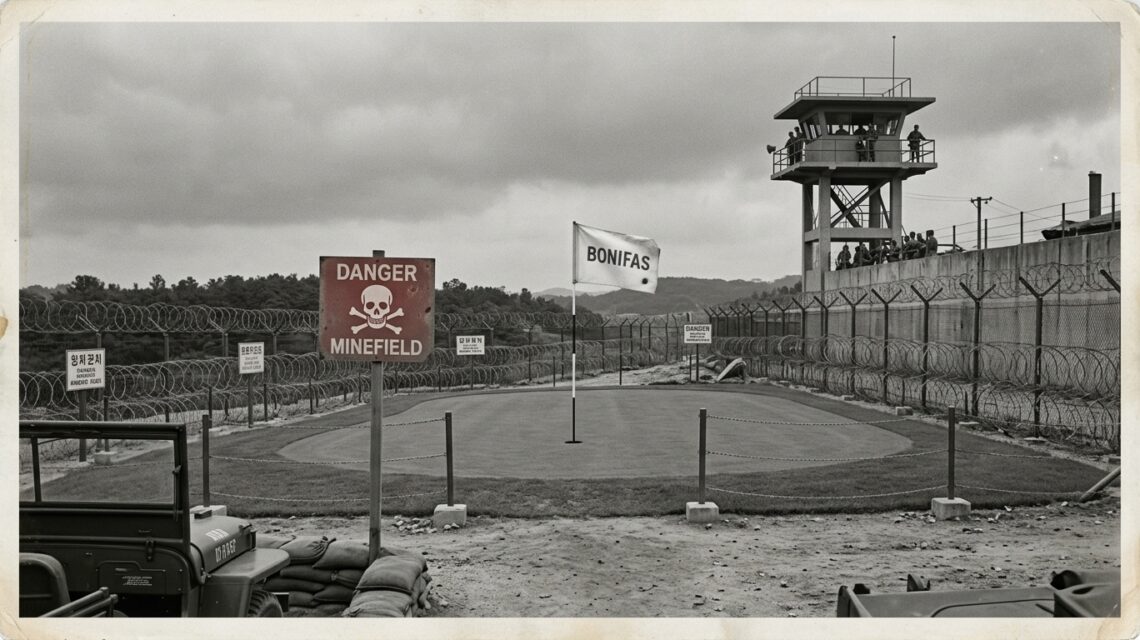
At a military post near the Demilitarized Zone separating North and South Korea, soldiers have played one of the world’s most unusual golf holes: a 192-yard, par-three layout bordered by military fortifications and areas contaminated with land mines.
There is no conventional 18-hole course.
There is no luxury clubhouse overlooking manicured fairways.
The playing surface includes artificial turf, and the surrounding landscape contains security fences, trenches, bunkers and restricted military terrain.
The hole’s reputation became internationally famous in 1988, when Sports Illustrated reporter Shelly Smith described it as the world’s most dangerous golf course.
More than two decades later, the U.S. Army confirmed that the hole was still being used.
In August 2022, an official military video showed two American soldiers playing at Camp Bonifas.
That footage provides unusually direct evidence that the strange golfing tradition survived long after its original publicity.
But the course is not merely an eccentric military attraction.
Its location, history and hazards explain why a simple recreational activity can take on a completely different meaning beside the Korean border. <Cite refs={[“turn937058search0″,”turn937058search7”]}/>
Where is Camp Bonifas, and how close is it to North Korea?
Camp Bonifas is a United Nations Command military post near Panmunjom, the location associated with the Korean Armistice Agreement and the Joint Security Area.
It lies on the South Korean side of the border region.
According to the U.S. Army, the installation is approximately 400 meters south of the southern boundary of the Korean Demilitarized Zone.
That distinction is important.
The DMZ is not simply a narrow line dividing the two countries.
It is a buffer zone approximately four kilometers wide, established under the 1953 armistice.
The Military Demarcation Line runs through its center.
Camp Bonifas is near the DMZ’s southern edge, rather than being located directly on the Military Demarcation Line itself.
Descriptions that place the golf course only 400 meters from North Korea therefore confuse the southern boundary of the buffer zone with the actual military dividing line.
The camp’s proximity to the DMZ is still extraordinary.
It is a military installation in one of the most sensitive security environments in the world.
And its small golf hole exists within that environment. <Cite ref=”turn937058search7″/>
Why a demilitarized zone is surrounded by so many weapons
The name Demilitarized Zone can be misleading.
The Korean DMZ was created after the Korean War armistice was signed on July 27, 1953.
The agreement stopped large-scale fighting but did not produce a permanent peace treaty.
North and South Korea therefore remain technically in a state of unresolved war.
The buffer zone was intended to separate opposing forces.
But the areas surrounding it became heavily fortified.
Military installations, observation posts, barriers and minefields developed along the border.
The result is one of the most heavily monitored frontiers on Earth.
The apparent contradiction is central to understanding Camp Bonifas.
The buffer zone itself was created to reduce direct military confrontation.
Yet the security systems surrounding it became exceptionally dense.
That is why a recreational golf hole at a nearby military post can sit beside terrain where entering the wrong area may be dangerous.
The course consists of just one par-three hole
The Camp Bonifas layout is not a conventional golf course.
It consists of one hole.
Its official reported distance is 192 yards, approximately 176 meters.
That makes it comparable in length to a relatively long par three at an ordinary golf club.
But almost every other feature is unusual.
The teeing area is elevated.
The playing surface includes artificial turf.
The green is harder than the grass surfaces found at most golf courses.
Military fortifications and restricted areas surround the hole.
A shot that travels too far can enter a minefield.
A badly sliced shot can head toward a military bunker.
A hook can land in a nearby ginseng field.
The U.S. Army’s 2012 account described all three possibilities.
That combination of hazards made the hole famous.
Golfers normally worry about losing strokes.
At Camp Bonifas, the boundaries of the playing area are also safety boundaries. <Cite ref=”turn937058search0″/>
The warning signs are more important than the scorecard
The course’s most distinctive feature is its warning signage.
Historical photographs show notices advising players not to retrieve balls from the rough because of live minefields.
The message is direct.
A lost golf ball is not worth the risk of entering restricted terrain.
On an ordinary golf course, a player might search for a missing ball for several minutes.
At Camp Bonifas, wandering into the wrong area could expose someone to an explosive hazard.
The warning therefore changes how the game is played.
The boundary is not simply an out-of-bounds line defined by golf rules.
It is a military safety restriction.
A player who misses badly must leave the ball behind rather than attempt a recovery.
The hole’s reputation rests on this difference.
The danger is not created by the golf shot itself.
It comes from the surrounding military environment. <Cite refs={[“turn937058search2″,”turn937058search6”]}/>
Did a golf ball really detonate a land mine?
One of the most frequently repeated stories about Camp Bonifas involves an errant golf ball setting off a mine.
The claim appears in historical reporting and later retrospectives.
A 1998 Washington Post account has been cited as describing such an incident.
Subsequent articles repeated the story.
The anecdote became central to the hole’s reputation.
But there is an important limitation.
The available public reporting does not establish the exact date, location, mine type or official military incident record for the alleged detonation.
That means the incident should be described as a reported event rather than a fully independently verified explosion.
The underlying danger, however, is not dependent on the anecdote.
The presence of minefields around the playing area is documented by military and journalistic sources.
The warnings against retrieving balls are real.
The possibility of serious injury from entering contaminated terrain is sufficient to explain why the course acquired its reputation.
The tee box is positioned above an old machine-gun emplacement
The unusual design of the hole reflects its military surroundings.
According to reporting published by GOLF.com in 2020, the tee box sits approximately 50 feet above the fairway.
The elevated position is associated with a former machine-gun emplacement.
That creates a dramatic downhill opening shot.
The elevation change affects how the ball travels.
A golfer must account for the drop between the tee and the landing area.
Wind is another challenge.
Gusts moving through the border region can influence the flight of a ball.
The artificial-turf green adds further difficulty.
Unlike natural grass, the surface may produce less predictable stopping behavior for approach shots.
A ball that lands on the green can bounce or roll farther than expected.
Even without the minefields, the hole would present unusual playing conditions.
The surrounding security environment makes every mistake more consequential. <Cite ref=”turn937058search1″/>
Why soldiers built a golf hole beside one of the world’s most tense borders
Military service near the Korean DMZ can involve prolonged periods of alertness and psychological pressure.
Personnel stationed at Camp Bonifas operate in a sensitive environment.
They must follow strict security procedures.
Their duties can include monitoring activity near the border and supporting operations associated with the Joint Security Area.
Recreation therefore serves a practical purpose.
Sports facilities provide opportunities for physical activity, social interaction and relief from routine stress.
The Camp Bonifas golf hole was developed as a small recreational outlet for soldiers stationed in the area.
Its existence reflects a common feature of military life.
Even in demanding operational environments, personnel need opportunities to rest and maintain morale.
The difference at Camp Bonifas is the setting.
The recreational facility sits beside military infrastructure and dangerous restricted terrain.
The result is a striking contrast between an ordinary leisure activity and an extraordinary security environment.
The camp’s name commemorates a deadly 1976 border incident
Camp Bonifas was named in honor of U.S. Army Captain Arthur Bonifas.
He was killed during a confrontation with North Korean soldiers in the Joint Security Area on August 18, 1976.
The incident began during an operation to trim a poplar tree that obstructed visibility between United Nations Command observation posts.
North Korean soldiers confronted the work party.
The confrontation escalated into violence.
Bonifas and First Lieutenant Mark Barrett were killed.
The event became known as the Korean axe murder incident.
It produced a major military crisis.
The United States and South Korea responded with a carefully planned operation to remove the tree.
The operation, known as Operation Paul Bunyan, involved a substantial military show of force.
The tree was cut down.
The confrontation ended without a wider war.
The incident remains one of the most serious episodes in the history of the Joint Security Area.
The camp’s name therefore carries a direct connection to the dangers of military service along the border.
The golf hole is not merely close to a potential conflict zone.
It stands at an installation named after an officer killed during a real confrontation. <Cite ref=”turn937058search1″/>
The 1988 Sports Illustrated story made the hole internationally famous
Camp Bonifas became widely known to golf audiences during the 1988 Seoul Olympics.
Sports reporter Shelly Smith visited the military installation and wrote about its unusual golf hole.
Her Sports Illustrated account described it as the world’s most dangerous golf course.
The phrase became part of the hole’s identity.
It was repeated in newspapers, golf magazines and television reports.
The appeal of the story was obvious.
Golf is normally associated with controlled landscapes, quiet surroundings and carefully maintained playing surfaces.
Camp Bonifas offered the opposite.
Its single hole was surrounded by military barriers and minefields.
The contrast was so striking that the course became a recurring subject of travel and sports journalism.
But the original reporting also established something important.
The hole was not a tourist attraction created for publicity.
It was a recreational facility used by military personnel.
The international attention came later.
The original reporter returned in 2012
In September 2012, Shelly Smith returned to Camp Bonifas.
The visit took place more than two decades after her original reporting.
She was filming a story for ESPN’s Veterans Day coverage.
The U.S. Army documented the visit in an article published on December 13, 2012.
The military confirmed that the one-hole course still existed.
It described the layout as a 192-yard par three.
The Army also repeated the unusual hazards surrounding it.
A long drive could enter a minefield.
A slice could reach a bunker.
A hook could land in a ginseng field.
The report provided a rare official confirmation of a story that had become almost legendary.
The course was not simply a relic of Cold War journalism.
It remained part of military life near the Korean border. <Cite ref=”turn937058search0″/>
U.S. Army footage confirmed that soldiers were still playing in 2022
The strongest recent evidence of the hole’s continued use comes from the U.S. military itself.
On August 11, 2022, Specialist Christopher Cameron filmed soldiers playing golf at Camp Bonifas.
The video was released through the Defense Visual Information Distribution Service, an official U.S. Department of Defense media platform.
It identified Sergeant Robert Sinclair and Private First Class Savion Key as the soldiers shown playing.
The video was published on August 18, 2022.
It documented the course more than three decades after its international reputation began.
That evidence is particularly valuable because many articles about Camp Bonifas rely on older descriptions.
The 2022 footage demonstrates that the golfing tradition survived into the 2020s.
However, it does not establish that the hole has been continuously open every day or that unrestricted public play is available.
The installation remains a military post.
Access and recreational activities are subject to security requirements.
The latest independently verified footage identified here dates from 2022, so current day-to-day operating status in October 2026 should not be assumed without fresh confirmation. <Cite ref=”turn937058search7″/>
Professional golfers have visited the unusual military course
Camp Bonifas has also attracted attention from professional athletes.
Among the visitors reported by GOLF.com was American golfer Paula Creamer.
Creamer visited the installation and took part in golf activities with military personnel.
She described the experience as humbling.
Her comments focused on the service members stationed far from their families and the responsibilities they carried.
Other prominent athletes, including former NFL quarterback Andrew Luck and former Major League Baseball pitcher Randy Johnson, have also been reported as visitors.
Such visits reflect the role of sports in military morale programs.
Athletes can provide entertainment and personal contact for service members in remote locations.
But these visits should not be confused with ordinary tourism.
Camp Bonifas is a controlled military installation.
Its golf hole is not comparable to a commercial course where visitors can simply book a tee time. <Cite ref=”turn937058search1″/>
The Bob Hope story is not supported by the available evidence
Some accounts of Camp Bonifas claim that comedian Bob Hope visited the golf hole in 1998 during a Christmas tour for American troops.
The claim is problematic.
Hope was famous for entertaining U.S. service members over many decades.
His military entertainment tours were an important part of his public career.
But the available reliable sources about Camp Bonifas do not establish that he played the golf hole in 1998.
Nor do they provide a verified record of a Christmas performance at the installation that year.
The claim may reflect confusion with Hope’s earlier military entertainment appearances or with visits by other celebrities.
Without a credible contemporary record, it should not be presented as historical fact.
The course’s documented history is already remarkable.
It does not require an unverified celebrity anecdote to make the story compelling.
The course is not surrounded by thousands of mines on every side
Another common exaggeration concerns the number and placement of land mines.
Some descriptions suggest that the fairway and green are completely surrounded by thousands of active mines.
The broader Korean border region does contain extensive minefields.
But publicly available sources do not establish an exact count of mines immediately adjacent to the Camp Bonifas golf hole.
Nor do they demonstrate that every side of the playing area contains the same level of danger.
The more precise description is that the hole lies beside known or historically documented minefield areas and restricted military terrain.
Warning signs prohibit retrieving balls from hazardous areas.
That is sufficient to establish the unusual risk.
Inventing a precise mine count would add drama without improving accuracy.
The DMZ is also an unexpected wildlife refuge
The Korean Demilitarized Zone is often described only through its military infrastructure.
But decades of restricted human activity have also allowed wildlife habitats to develop.
Large areas have experienced relatively limited urbanization, agriculture and industrial development.
The wider border region supports forests, wetlands and grasslands.
It is important habitat for several threatened species.
The ecological significance of the DMZ is one of the most unusual consequences of the Korean War’s unresolved aftermath.
A landscape created by military confrontation has also become a refuge for wildlife.
That does not mean the area is environmentally untouched.
Minefields, military construction and other activities have damaged parts of the landscape.
But the restrictions on civilian development have helped preserve habitats that might otherwise have disappeared.
The Camp Bonifas golf hole exists within this wider contradiction.
It is a recreational facility beside a heavily fortified border that has also become an important ecological corridor.
How Camp Bonifas compares with an ordinary golf course
| Feature | Conventional golf course | Camp Bonifas |
|---|---|---|
| Number of holes | Usually 9 or 18 | One |
| Hole length | Varies by layout | 192 yards |
| Par | Varies | Par 3 |
| Playing surface | Primarily natural grass | Artificial turf |
| Typical hazards | Bunkers, water, rough | Minefields, military bunkers, restricted terrain |
| Lost-ball recovery | Usually permitted in safe areas | Prohibited in hazardous areas |
| Access | Public, private or resort-based | Controlled military installation |
| Primary purpose | Recreation and competition | Recreation and morale for military personnel |
| International reputation | Course design and difficulty | Extreme proximity to military hazards |
The comparison explains why Camp Bonifas is so unusual.
Its distance is not exceptional.
A 192-yard par three would be ordinary at many golf clubs.
The difficulty comes from the surrounding environment.
A missed shot can carry consequences unrelated to golf.
Why the hole is sometimes described as the world’s most dangerous
The title is a journalistic description rather than an official international ranking.
There is no universally accepted system for measuring the danger of golf courses.
Other courses around the world have unusual hazards.
Some are located near volcanoes.
Others sit beside airport runways or in regions with dangerous wildlife.
Camp Bonifas stands apart because its hazards are connected to an unresolved military conflict.
Land mines are not ordinary sporting obstacles.
They are explosive devices designed to injure or kill.
Military restrictions also prevent players from treating the surrounding terrain as part of a normal golf course.
That makes the hole’s reputation understandable.
But it is more accurate to describe it as one of the world’s most dangerous and unusual golf holes than to claim that an objective global ranking has established it as the single most dangerous.
The numbers behind Camp Bonifas
| Detail | Verified information |
|---|---|
| Location | Camp Bonifas, near Panmunjom, South Korea |
| Military command | United Nations Command |
| Distance from southern DMZ boundary | Approximately 400 meters |
| Number of golf holes | One |
| Hole classification | Par 3 |
| Hole length | 192 yards, approximately 176 meters |
| Playing surface | Artificial turf |
| Main hazards | Minefields and restricted military terrain |
| International publicity | 1988 Sports Illustrated report |
| Original reporter | Shelly Smith |
| Reporter returned | September 2012 |
| U.S. Army footage of play | August 11, 2022 |
| Public access | Subject to military security restrictions |
| Confirmed continuous operation through October 2026 | Not established by the available sources |
The figures reveal the unusual scale of the course.
It is short enough to complete in only a few shots.
Yet its surrounding environment requires precautions that would be unimaginable at an ordinary golf club.
What remains uncertain about the course today
Several details are well documented.
The hole exists at Camp Bonifas.
It measures 192 yards.
It has been described by the U.S. Army as one of the world’s most dangerous golf courses.
Its surroundings include hazardous military terrain.
And official footage confirms that soldiers were playing there in August 2022.
Other claims require more caution.
The exact date when the hole was constructed is not firmly established by the sources reviewed.
The precise number of mines near the playing area is not publicly confirmed.
The widely repeated story of a golf ball detonating a mine lacks a detailed official incident record in the available reporting.
The alleged 1998 Bob Hope visit is unverified.
And the available evidence does not establish that play is routinely interrupted by sirens responding to North Korean military movements.
Those uncertainties do not weaken the central story.
They help separate a documented military curiosity from the mythology that has grown around it.
A golf hole that captures the contradiction of the Korean border
Camp Bonifas is not famous because of a championship, a legendary golfer or a revolutionary course design.
It is famous because it places an ordinary sporting activity in an extraordinary setting.
A soldier can stand on a tee, choose a club and attempt to hit a green approximately 176 meters away.
The action is familiar to millions of golfers.
But the surroundings are not.
There are military fortifications nearby.
The border remains heavily guarded.
Minefields make parts of the surrounding terrain dangerous.
The course offers recreation, but it also reminds players of the security environment in which they serve.
That is why the single hole has endured as such a powerful image.
It captures the contradiction of the Korean Demilitarized Zone.
A place created to separate armies has become both a militarized frontier and an unexpected landscape of everyday human activity.
At Camp Bonifas, that contradiction can be seen in a single golf shot.
The player aims for a small artificial-turf green.
The ball flies through the air.
And if it lands in the wrong place, the safest decision is not to play another shot.
It is to leave the ball where it lies.
+ Siga o Giro no Facebook
+ Siga o Giro no Instagram
Leia Mais: