

Brabham, Williams and other Cosworth-powered teams exploited a loophole in Formula 1’s minimum-weight rules by using tanks supposedly intended to cool the brakes. The scheme unraveled after the Brazilian Grand Prix, turning a technical dispute into a political crisis that left just 14 cars at Imola.
By Marcio Tamer
Updated October 28, 2026
On March 21, 1982, Nelson Piquet crossed the finish line at the Brazilian Grand Prix believing he had won his home race.
The reigning Formula 1 world champion had endured the punishing heat of Rio de Janeiro’s Jacarepaguá circuit and beaten Keke Rosberg’s Williams to first place.
Moments later, Piquet collapsed on the podium from exhaustion.
His victory appeared to be one of the most dramatic performances of the season.
But the result would not stand.
Weeks later, a ruling by international motorsport authorities removed Piquet and Rosberg from the classification.
The reason was not a conventional mechanical infringement.
Their teams had exploited a loophole involving water tanks, brake cooling and Formula 1’s minimum-weight regulations.
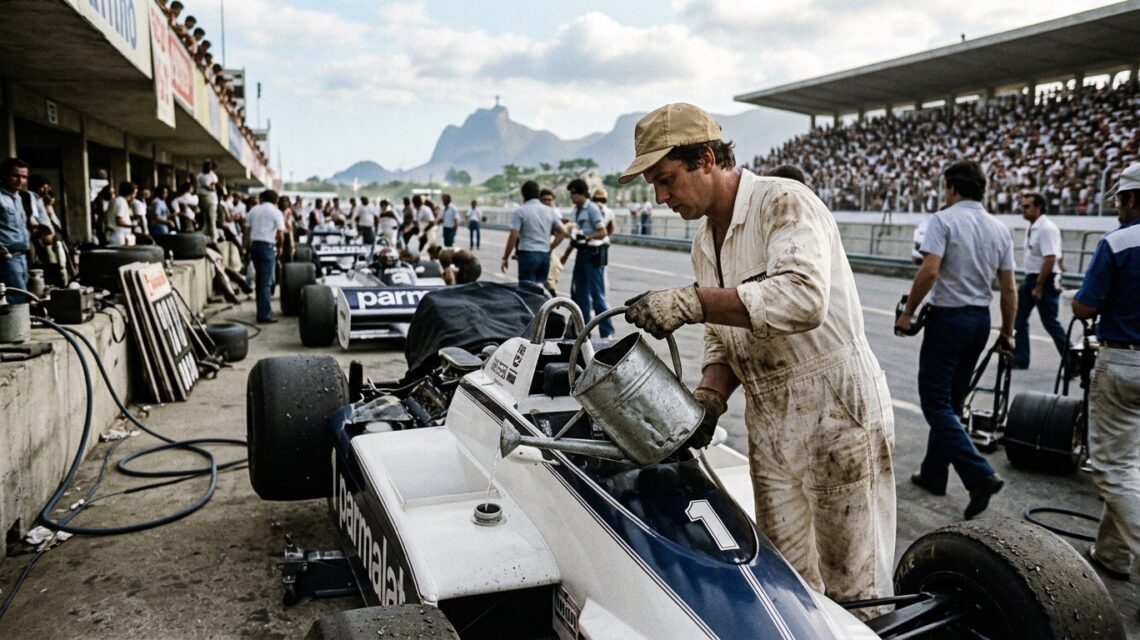
The cars started with water in onboard reservoirs. During the race, the liquid was discharged, reducing their weight. After the finish, the teams could replenish the tanks before the official weighing procedure.
The system allowed cars to compete below the intended minimum weight while potentially satisfying the interpretation of the rules favored by their constructors.
The controversy became a flashpoint in Formula 1’s political struggle between the Formula One Constructors Association, known as FOCA, and the sport’s governing authorities.
The disqualifications helped trigger a boycott of the San Marino Grand Prix on April 25, 1982.
Only 14 cars appeared at Imola.
What began as an ingenious interpretation of technical regulations had escalated into a confrontation over who controlled Formula 1.
Why Formula 1 teams were desperate to save weight in 1982
The early 1980s were a period of rapid technological change in Formula 1.
Turbocharged engines were becoming increasingly competitive.
Renault and Ferrari were developing powerful turbo engines that offered significant advantages on circuits with long straights.
The leading turbocharged cars could produce substantially more power than their naturally aspirated rivals.
Most British independent constructors relied on the Ford-Cosworth DFV V8.
The engine was reliable, relatively affordable and had powered numerous championship-winning cars.
But by 1982, its power disadvantage was becoming difficult to overcome.
Teams such as Williams, Brabham, McLaren and Lotus needed other ways to remain competitive.
One solution was to reduce weight.
A lighter Formula 1 car accelerates more effectively, requires less energy to brake and can change direction more quickly.
Those benefits were especially important during the ground-effect era, when cornering speeds were extremely high.
But the regulations imposed a minimum weight.
Teams could not simply remove unlimited material from their cars.
They needed to find ways to make the cars lighter without failing technical inspections.
That challenge created the opportunity for the water-ballast scheme.
The loophole was hidden in the rules for replacing fluids
Formula 1’s technical regulations required cars to satisfy a minimum-weight limit.
Contemporary reporting on the 1982 Brazilian Grand Prix consistently identifies the relevant figure as 580 kilograms.
The rules also contained provisions concerning the replenishment of fluids before post-race weighing.
That created an unusual opportunity.
Teams could argue that liquid consumed or discharged during a race should be restored before the car was placed on the scales.
In an ordinary cooling system, such a procedure might account for fluid loss during competition.
But the British constructors recognized that the wording could be interpreted much more broadly.
They installed reservoirs supposedly intended to supply water for brake cooling.
The tanks were filled before the start.
During the race, the water was discharged.
The cars became lighter.
After the finish, the teams replenished the tanks before scrutineering.
The weight returned to the required level.
The teams argued that they were following the regulations.
Their opponents argued that the system was a deliberate attempt to evade the minimum-weight requirement.
The distinction became the central issue in the dispute. <Cite refs={[“turn784086search5″,”turn784086search14”]}/>
How the water-ballast system worked
The principle was mechanically simple.
A car carried a reservoir containing water.
The tank was connected to a system described as brake cooling.
At the start of the race, the liquid contributed to the car’s total weight.
Once the race began, the water could be discharged toward the brake-cooling ducts.
The car became lighter as the reservoir emptied.
The weight reduction was not a minor detail.
Some historical accounts describe teams using systems capable of shedding approximately 50 kilograms or more.
For a Formula 1 car weighing around 580 kilograms, losing 50 kilograms represented a reduction of approximately 8.6%.
That is a substantial change.
The lighter car could accelerate, brake and corner more effectively.
The advantage could accumulate over an entire race.
But it would be misleading to assign a universal lap-time gain to the system.
The effect depended on the circuit, the car, the amount of water discharged and other performance characteristics.
Claims that every team automatically gained half a second or a full second per lap are not established by a single reliable measurement.
The important point is that the weight reduction was large enough to matter competitively.
The tanks were presented as brake-cooling equipment
The engineering explanation offered by the teams was that the water helped cool the brakes.
Brake temperatures were a legitimate concern.
Formula 1 cars subjected their braking systems to enormous thermal loads.
Cooling was essential to maintaining performance and reliability.
But the disputed systems raised an obvious question.
Were the tanks genuinely designed to improve brake cooling, or were they primarily intended to provide disposable ballast?
Contemporary observers were skeptical.
The water could be discharged early in the race, leaving the car lighter for much of the distance.
That made the system valuable even if its contribution to brake cooling was limited.
The controversy therefore centered on purpose as well as procedure.
The teams emphasized what the rules permitted.
Their opponents emphasized what the minimum-weight rule was supposed to prevent.
The governing authorities ultimately sided with the latter interpretation.
Colin Chapman was involved, but he did not invent the scheme alone
The scandal is sometimes attributed primarily to Colin Chapman, the influential founder and designer of Lotus.
Chapman was one of Formula 1’s most inventive engineers.
His teams had introduced major innovations in chassis design, aerodynamics and ground-effect technology.
Lotus was also among the constructors associated with the water-ballast controversy.
But the scheme was not a single invention controlled by Chapman.
Several teams used similar interpretations of the regulations.
Brabham, Williams, McLaren and Lotus were among the prominent constructors involved.
The broader political campaign was led through FOCA, whose leading figures included Bernie Ecclestone and Max Mosley.
Gordon Murray, Brabham’s technical director, was another major engineering figure during the period.
The water tanks were therefore part of a collective response by independent constructors to the growing competitiveness of turbocharged manufacturers.
The controversy was not simply a story about one designer finding a clever loophole.
It was a coordinated challenge to the way Formula 1’s technical rules were interpreted and enforced. <Cite refs={[“turn784086search4″,”turn784086search6”]}/>
The Brazilian Grand Prix exposed the entire arrangement
The second round of the 1982 season took place at Jacarepaguá on March 21.
The circuit was physically demanding.
High temperatures placed enormous strain on drivers and machinery.
The race also featured a major confrontation between the turbocharged and naturally aspirated cars.
Piquet drove for Brabham.
Rosberg drove for Williams.
Both used Ford-Cosworth engines.
The Renault and Ferrari teams had made clear that they objected to the water-ballast systems.
They believed the independent constructors were gaining an illegal advantage.
The dispute was already active before the race began.
On track, Piquet delivered an extraordinary performance.
He fought through the heat and intense physical demands to finish first.
Rosberg followed in second place.
Alain Prost, driving a turbocharged Renault, finished third.
The apparent result was a major success for the naturally aspirated teams.
But it immediately became the subject of a technical protest. <Cite refs={[“turn784086search0″,”turn784086search5”]}/>
Piquet collapsed on the podium after one of the hardest races of his career
The physical toll of the Brazilian Grand Prix became visible during the podium ceremony.
Piquet was severely exhausted.
He had endured the heat, the demands of ground-effect cornering and the intense effort required to control the car.
After climbing onto the podium, he collapsed.
Rosberg helped support him.
The moment became one of the defining images of the 1982 season.
At the time, Piquet appeared to have secured a memorable home victory.
The performance was particularly significant because he had won the world championship the previous year.
He was attempting to defend his title while Brabham competed against increasingly powerful turbocharged rivals.
But the celebration was overshadowed by the technical controversy.
Renault and Ferrari challenged the legality of the water-ballast arrangements.
The dispute would continue long after the drivers had left Brazil.
Renault and Ferrari protested the results
The turbocharged manufacturers argued that the water tanks were not legitimate cooling systems.
They contended that the cars had been operating below the required minimum weight during the race.
The independent constructors responded that the regulations allowed fluids to be replenished before weighing.
Their interpretation was that the cars complied with the written requirements.
The disagreement was not merely technical.
It reflected the growing division between Formula 1’s established independent teams and the manufacturers investing heavily in turbocharged engines.
Renault and Ferrari believed that the British constructors were using regulatory loopholes to offset their power disadvantage.
FOCA teams believed that the governing authorities were interpreting the rules in ways that favored the manufacturers.
The protests therefore became part of a larger political struggle.
The outcome would determine not only the Brazilian Grand Prix classification but also whether the water-ballast systems could continue to be used.
The disqualifications came weeks after the race
Piquet and Rosberg were not immediately removed from the results at Jacarepaguá.
The matter proceeded through the sport’s disciplinary and appeals process.
On April 19, 1982, an international tribunal upheld the decision to exclude the two drivers.
Piquet lost first place.
Rosberg lost second.
Alain Prost inherited the victory.
John Watson moved into second place.
Nigel Mansell was promoted to third.
The decision also clarified the interpretation of the minimum-weight rules.
Cars could not legally operate below the required weight during competition merely because liquid could later be restored.
The authorities also moved to prevent teams from replenishing fluids before post-race weighing.
The ruling effectively closed the loophole.
But it created an immediate political crisis.
The next race was scheduled for Imola less than a week later. <Cite refs={[“turn784086search3″,”turn784086search11”]}/>
The result of the Brazilian Grand Prix was rewritten
The revised classification changed the outcome of one of the season’s most memorable races.
| Position | Original finish | Official result after disqualifications |
|---|---|---|
| 1 | Nelson Piquet, Brabham | Alain Prost, Renault |
| 2 | Keke Rosberg, Williams | John Watson, McLaren |
| 3 | Alain Prost, Renault | Nigel Mansell, Lotus |
The changes were substantial.
The first two finishers disappeared from the classification.
Prost gained the victory.
Watson and Mansell moved onto the podium.
For Piquet, the ruling erased what would have been a home Grand Prix win.
For Rosberg, it removed a valuable second-place result.
The consequences were especially important in a season that would eventually be decided by a narrow championship margin.
Rosberg went on to win the 1982 world championship with 44 points.
The Brazilian disqualification did not prevent him from taking the title.
But it became part of one of the most politically turbulent seasons in Formula 1 history.
The FOCA-FISA war turned a technical ruling into a political crisis
The water-ballast dispute occurred during a broader struggle over control of Formula 1.
FOCA represented many of the independent constructors.
Its leading figures sought greater influence over commercial rights, regulations and the organization of the championship.
The Fédération Internationale du Sport Automobile, or FISA, was the FIA’s sporting authority.
Its president, Jean-Marie Balestre, was a central figure in the conflict.
The dispute involved much more than engine technology.
It concerned who had the authority to make and enforce rules.
It also involved television revenue, race organization and the commercial future of Formula 1.
The first Concorde Agreement, signed in 1981, had temporarily reduced tensions.
But the underlying rivalry remained.
The water-ballast ruling reopened the conflict.
FOCA teams believed that the decision threatened their ability to compete with the turbocharged manufacturers.
The governing authorities insisted that the minimum-weight rule had to be enforced.
Neither side was willing to retreat.
FOCA responded by boycotting the San Marino Grand Prix
The San Marino Grand Prix was scheduled for April 25, 1982, at Imola.
After the tribunal’s ruling, FOCA members decided to withdraw from the race.
Brabham, Williams, McLaren and Lotus were among the teams that stayed away.
Other constructors also joined the boycott.
The decision was intended to pressure the governing authorities and demonstrate the collective strength of the independent teams.
But the boycott was not unanimous.
Tyrrell, ATS, Osella and Toleman participated despite the broader FOCA action.
Ferrari, Renault and Alfa Romeo also attended.
Only 14 cars appeared for the event.
That was an unusually small field for a Formula 1 Grand Prix.
The boycott exposed the depth of the political division.
Teams were no longer merely arguing about the legality of a technical innovation.
They were willing to withdraw from a world championship race to challenge the governing authorities. <Cite refs={[“turn784086search1″,”turn784086search2″,”turn784086search3”]}/>
The Imola boycott created another famous controversy
The reduced field at Imola produced an unusual race.
Renault qualified first and second with René Arnoux and Alain Prost.
But both cars retired.
Ferrari’s Gilles Villeneuve and Didier Pironi moved into the leading positions.
The race then developed into a tense battle between the teammates.
Ferrari had signaled that its drivers should conserve their cars once the main opposition had disappeared.
Villeneuve believed that the team had effectively instructed the drivers to maintain their positions.
Pironi continued racing aggressively.
He overtook Villeneuve and won.
Villeneuve finished second.
The result created a bitter dispute within Ferrari.
Villeneuve believed that Pironi had broken an understanding between them.
The controversy became one of the most famous internal conflicts in Formula 1 history.
It was also Villeneuve’s final Grand Prix.
He died during qualifying for the Belgian Grand Prix at Zolder less than two weeks later.
The connection between the water-ballast scandal and the Imola race is therefore historically significant.
The technical dispute contributed to the boycott.
The boycott reduced the field.
The reduced field helped create the circumstances in which the Ferrari teammates fought for victory.
But it would be misleading to claim that the water-ballast controversy directly caused Villeneuve’s later fatal accident.
Those were separate events. <Cite refs={[“turn784086search11″,”turn784086search12”]}/>
Why the water-ballast trick was so effective
The system exploited a basic principle of racing performance.
Weight affects nearly every aspect of a car’s behavior.
A lighter car requires less energy to accelerate.
Its brakes have less mass to decelerate.
Its tires experience different loads during cornering.
Its suspension and aerodynamic systems may also behave differently.
In Formula 1, even relatively small weight differences can matter.
The water-ballast system allowed teams to gain a much larger reduction than would normally be possible through incremental engineering improvements.
A car that started near the 580-kilogram limit could shed tens of kilograms during the race.
That represented a major competitive advantage.
The system was especially attractive to naturally aspirated teams.
They could not easily match the turbocharged engines’ power.
But they could attempt to compensate through lower weight and stronger cornering performance.
The loophole therefore offered a way to fight an engine-power disadvantage without developing a new engine.
The trick was not the same as ordinary fuel consumption
Formula 1 cars naturally become lighter as they burn fuel.
That is an expected part of racing.
The water-ballast controversy involved a different principle.
The disputed tanks were not necessary to power the car.
Their primary competitive value was the ability to remove weight while still restoring it before inspection.
The distinction was crucial.
Fuel consumption is an unavoidable consequence of operating an internal-combustion engine.
Disposable ballast is a deliberate method of changing the car’s mass.
The governing authorities concluded that the latter could not be used to evade the minimum-weight requirement.
The controversy therefore helped clarify the relationship between fluid consumption, ballast and technical compliance.
It also reinforced the importance of measuring cars under conditions that reflect their actual racing configuration.
The minimum-weight rule was not merely a bureaucratic detail
Minimum-weight regulations serve several purposes.
They prevent teams from pursuing extreme weight reduction without limits.
They also establish a common technical framework.
Without such restrictions, manufacturers might attempt to remove material from critical components to gain performance.
That could create safety concerns.
But the 1982 controversy was not primarily about a demonstrated structural failure.
It was about competitive fairness.
Teams that complied with the intended weight requirement could be disadvantaged by rivals using disposable ballast.
The loophole created an uneven playing field.
The governing authorities therefore had to decide whether compliance should be judged by the car’s weight after fluids were restored or by its actual operating condition during the race.
The tribunal’s decision favored the latter principle.
Did the teams technically cheat?
The answer depends on the distinction between exploiting ambiguous wording and violating the governing body’s final interpretation.
The FOCA teams argued that their systems were permitted by the written regulations.
They maintained that the rules allowed fluid replenishment before weighing.
The manufacturers argued that the tanks were a sham.
They believed the systems existed primarily to reduce weight during competition.
The tribunal ultimately ruled against the teams using the loophole.
That decision established the official result.
Piquet and Rosberg were disqualified.
The system could no longer be used in the same way.
But it is historically important to acknowledge that the controversy began with a genuine dispute over regulatory interpretation.
The teams did not simply conceal an obviously prohibited device.
They exploited wording that they believed could be defended.
The governing authorities rejected that defense.
The episode became a classic example of Formula 1 engineering pushing the boundaries of what the rules appeared to allow.
The water-ballast controversy was part of a larger technological arms race
The early 1980s were filled with innovations that challenged Formula 1’s regulations.
Ground-effect aerodynamics had already transformed car design.
Teams were experimenting with suspension systems, ride heights and aerodynamic devices.
Turbocharged engines were becoming increasingly powerful.
The technical regulations struggled to keep pace.
The water-ballast scheme emerged from that environment.
It was a response to the competitive pressure created by rapidly advancing technology.
Independent teams sought advantages wherever they could find them.
Manufacturers invested in more powerful engines.
The governing authorities attempted to maintain a common regulatory framework.
The result was a constant struggle between innovation and enforcement.
The water tanks were one of the most visible examples because they produced a direct confrontation over race results.
The scandal helped establish stricter scrutiny of fluid systems
After the tribunal’s decision, the authorities moved to prevent the same loophole from being exploited again.
Cars would be weighed without allowing teams to restore the disputed fluids first.
That removed the central advantage of the water-ballast arrangement.
A team could no longer discharge large quantities of liquid during a race and then rely on replenishment to satisfy the minimum-weight requirement.
The ruling also sent a broader message.
Technical compliance could not depend solely on how a car appeared after a team had restored components or fluids.
The car’s condition during competition mattered.
That principle became increasingly important as Formula 1’s technical regulations grew more complex.
Modern scrutineering includes detailed procedures governing weight, fuel, components and post-race inspections.
The 1982 controversy remains an early example of why those procedures must be precise.
The numbers behind the 1982 water-ballast scandal
| Detail | Historical record |
|---|---|
| Season | 1982 Formula 1 World Championship |
| Minimum weight cited in contemporary race reports | 580 kg |
| Teams associated with the scheme | Brabham, Williams, McLaren, Lotus and others |
| Engine used by leading independent teams | Ford-Cosworth DFV V8 |
| Main turbocharged rivals | Renault and Ferrari |
| Brazilian Grand Prix | March 21, 1982 |
| Circuit | Jacarepaguá, Rio de Janeiro |
| Original first-place finisher | Nelson Piquet, Brabham |
| Original second-place finisher | Keke Rosberg, Williams |
| Official winner after sanctions | Alain Prost, Renault |
| Tribunal ruling | April 19, 1982 |
| San Marino Grand Prix | April 25, 1982 |
| Cars entered at Imola | 14 |
| San Marino winner | Didier Pironi, Ferrari |
The figures illustrate the scale of the controversy.
A technical dispute involving tens of kilograms of water overturned the first two positions in a Grand Prix.
The ruling then contributed to a boycott that reduced the next race to 14 cars.
The consequences extended far beyond the performance of individual cars.
The scandal exposed the fragility of Formula 1’s political arrangements.
What the 1982 scandal reveals about Formula 1’s rulebook
The water-ballast controversy demonstrates a recurring problem in motorsport.
Regulations are written to establish limits.
Engineers search for ways to gain performance within those limits.
When the wording is ambiguous, teams may discover opportunities that the rulemakers did not intend.
The 1982 systems were effective because they exploited the difference between a car’s weight during competition and its weight during inspection.
The teams treated the fluid-replenishment provision as permission to restore large quantities of water.
The governing authorities concluded that this interpretation undermined the minimum-weight rule.
The dispute was therefore not simply about water tanks.
It was about the meaning of technical compliance.
Should a car be legal because it satisfies a literal reading of the inspection procedure?
Or should the rules be interpreted according to the competitive conditions they are intended to establish?
Formula 1’s governing authorities answered that question by disqualifying Piquet and Rosberg.
FOCA answered by withdrawing teams from the next race.
The conflict revealed how a small ambiguity could become a major political confrontation.
The water tanks disappeared, but the political struggle continued
The tribunal’s ruling ended the particular loophole.
But it did not resolve the broader FOCA-FISA conflict.
The dispute over commercial rights, technical authority and the balance of power between independent teams and manufacturers continued.
Formula 1 would undergo further changes in the following years.
Turbocharged engines became dominant.
Ground-effect technology was restricted.
The sport’s commercial structure continued evolving.
The 1982 season remained one of the most turbulent in Formula 1 history.
Rosberg eventually won the championship.
Ferrari secured the constructors’ title.
The year was also marked by serious accidents, internal team conflicts and political instability.
The water-ballast scandal was one episode in that larger crisis.
But it remains one of the clearest examples of how Formula 1’s technical regulations can become weapons in a political struggle.
A few dozen kilograms of water were enough to overturn a Grand Prix result, provoke a boycott and expose the divisions threatening the sport.
+ Siga o Giro no Facebook
+ Siga o Giro no Instagram
Leia Mais: