

The United States entered the Munich final with 63 consecutive Olympic victories and seven straight gold medals. A contested timeout, a malfunctioning clock and intervention by FIBA’s top official gave the Soviet Union a final possession that ended the streak. More than five decades later, the Americans still have not accepted their silver medals.
By Marcio Tamer
Updated October 28, 2026
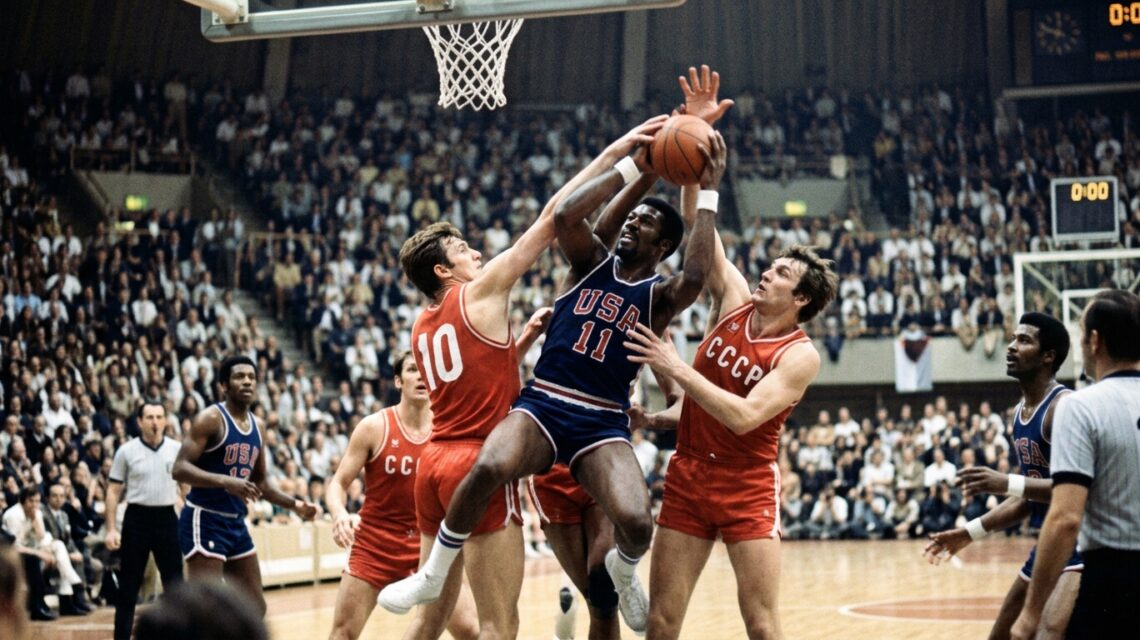
Doug Collins had just made two free throws to put the United States ahead 50-49 in the Olympic men’s basketball final. Three seconds remained. The Soviet Union needed a basket to win.
What happened next, in the early hours of September 10, 1972, became one of the most disputed endings in Olympic history.
The Soviets inbounded the ball, but play was interrupted after a problem at the scorer’s table. They were allowed to resume. The clock then expired, and American players began celebrating what they believed was their eighth consecutive Olympic gold medal.
But the game was not over.
R. William Jones, secretary-general of the International Amateur Basketball Federation, intervened in the timekeeping dispute. The clock was restored to three seconds, and the Soviets received another opportunity.
Ivan Edeshko threw a long pass downcourt. Aleksandr Belov caught the ball near the basket and scored.
The Soviet Union won 51-50.
The result ended the United States’ 63-game unbeaten record in Olympic men’s basketball, a streak stretching back to the sport’s debut as an official Olympic event in 1936.
The Americans protested, arguing that the final seconds had been improperly replayed. A five-member appeals jury upheld the result by a 3-2 vote.
The U.S. players unanimously refused their silver medals.
The extraordinary aftermath has often been described as proof that officials deliberately kept restarting the game until the Soviets scored. But historical footage, contemporary reports and later investigations reveal a more complicated sequence.
There were genuine officiating errors, an unresolved dispute about the authority of a senior basketball official and sharply different interpretations of what the rules required.
What the evidence does not establish is a coordinated plan to guarantee a Soviet victory. <Cite refs={[“turn571685search0″,”turn696859search24″,”turn571685search6”]}/>
The Americans had never lost an Olympic basketball game
Before Munich, the United States had dominated Olympic men’s basketball for 36 years.
The Americans won gold at Berlin in 1936, London in 1948, Helsinki in 1952, Melbourne in 1956, Rome in 1960, Tokyo in 1964 and Mexico City in 1968.
They arrived in Munich with seven consecutive titles.
After winning their first eight games at the 1972 tournament, their all-time Olympic record stood at 63 victories and no defeats.
The record was especially remarkable because the United States did not send its NBA stars.
Olympic eligibility rules at the time excluded professional players.
American teams were therefore assembled largely from college athletes, many of whom were still developing their careers.
The Soviet Union operated under a different sporting system.
Its leading players competed for clubs within a state-supported structure while remaining eligible for Olympic competition.
That gave the Soviets a relatively experienced and established national team.
The distinction mattered.
The Americans possessed outstanding individual talent, but the Soviet team had greater continuity and extensive experience playing international basketball together.
The Munich final was not a contest between an unbeatable professional superteam and an inferior opponent.
It was a confrontation between two strong teams built under different sporting systems.
The final was played under the shadow of the Cold War and the Munich massacre
The game took place during an Olympics already marked by tragedy.
On September 5, members of the Palestinian militant organization Black September attacked the Israeli Olympic delegation.
Eleven Israeli team members were killed during the hostage crisis, along with a West German police officer. Five attackers also died.
The Games were suspended before competition resumed.
The basketball final was played days later, in an atmosphere shaped by grief, heightened security and political tension.
The United States and Soviet Union were also the world’s principal Cold War rivals.
Their competition extended from military power and space exploration to international sport.
An Olympic basketball gold medal was not equivalent to a diplomatic or military victory, but the symbolism was unmistakable.
For the Soviets, defeating the United States in basketball would be a historic achievement.
For the Americans, losing the event they had dominated since 1936 was almost unthinkable.
The final began late on September 9, with the decisive moments unfolding after midnight in Munich.
FIBA’s official historical record lists the game’s scheduled start on September 9. Accounts dating the finish to September 10 are referring to the same contest, not a different match. <Cite refs={[“turn571685search0″,”turn696859search24”]}/>
The Soviet Union led for almost the entire game
The final did not begin with an American display of superiority.
The Soviet Union controlled much of the first half.
Its offense was disciplined, and its defense limited the Americans’ opportunities to play at their preferred pace.
U.S. coach Hank Iba favored a deliberate style rather than a constant fast break.
The Soviets led 26-21 at halftime.
Their advantage later reached double figures.
With just over six minutes remaining, they still held an eight-point lead.
The Americans gradually increased their defensive pressure.
Their comeback was built on steals, defensive stops and increasingly urgent attacking play.
With approximately 40 seconds remaining, Jim Forbes scored to cut the Soviet lead to 49-48.
The Soviets still controlled possession and appeared close to winning.
But a turnover changed everything.
Doug Collins was fouled hard, then made the two most important free throws of his career
With only seconds remaining, Soviet player Aleksandr Belov attempted a pass that Doug Collins intercepted.
Collins sprinted toward the basket.
Zurab Sakandelidze fouled him hard to prevent a potential game-winning layup.
The collision sent Collins crashing toward the basket support.
He was visibly shaken.
But he remained in the game and went to the free-throw line.
The United States trailed 49-48.
Collins made his first free throw to tie the score.
He then made the second to give the Americans their first lead of the game, 50-49.
Three seconds remained.
Under normal circumstances, the Soviet Union would have needed to advance the ball and score almost immediately.
But during the free throws, the Soviet bench had been attempting to request a timeout.
The confusion over that request became the central issue in the controversy. <Cite refs={[“turn696859search24″,”turn571685search5”]}/>
The disputed timeout was not invented after the buzzer
A common version of the story suggests that Soviet coach Vladimir Kondrashin demanded a timeout only after the United States had apparently won.
The historical record is more complicated.
Kondrashin had attempted to request a timeout during Collins’ free throws.
Under the rules used at the time, a coach could request a timeout between free throws under specified conditions.
A signal sounded from the scorer’s table around the time Collins released his second shot.
The officials did not stop the free throw.
After Collins scored, the Soviets inbounded the ball.
Play continued briefly before referee Renato Righetto stopped the action after noticing a disturbance at the scorer’s table.
Approximately one second remained.
The Soviet bench argued that its timeout request had not been properly administered.
That complaint was not baseless.
Video reviews and later investigations support the conclusion that a timeout had been requested and that communication between the bench, table officials and referees had failed.
But establishing that an administrative error occurred did not automatically resolve how much time should be restored or who had the authority to order the correction.
Those questions became the heart of the dispute. <Cite refs={[“turn696859search6″,”turn571685search6”]}/>
William Jones intervened, and the controversy became much bigger
R. William Jones was one of international basketball’s most powerful officials.
As secretary-general of FIBA, he had played a major role in the sport’s international development.
When the confusion at the scorer’s table escalated, Jones approached the officials and became directly involved.
He indicated that the clock should show three seconds.
The reasoning was that the Soviets should receive the time they had possessed when the timeout request was originally made.
But Jones’s authority to intervene was disputed.
American officials argued that he had no right to override the referees.
Some later accounts of the match have reached the same conclusion.
Others, including former senior FIBA official Borislav Stanković, defended Jones’s intervention as an attempt to correct an error by the scorer’s table.
This distinction matters.
The controversy was not simply about whether three seconds remained.
It was also about who was entitled to make that determination.
The referees were responsible for administering the game.
Jones was a senior federation official.
His intervention blurred the line between administrative oversight and decisions normally controlled by match officials.
That ambiguity became one reason the final remained disputed for decades. <Cite refs={[“turn696859search24″,”turn571685search6”]}/>
The Soviet Union inbounded the ball three times, but the clock was not correctly reset on every attempt
The phrase three chances is central to the Munich story.
It is accurate that the Soviets were allowed three inbound sequences during the disputed ending.
But the details explain why the restarts occurred.
The first inbound came immediately after Collins’ free throws.
Play was stopped with approximately one second remaining because of the timeout dispute.
The second inbound followed the decision to restore time.
However, the game clock had not been properly reset.
Video analysis showed that the clock displayed 50 seconds rather than three when play resumed.
The horn sounded almost immediately, and the Americans celebrated again.
The scorer’s table had not completed the necessary correction before the ball was put into play.
That created another administrative problem.
The officials then ordered the clock properly restored to three seconds.
The Soviets were allowed a third inbound.
This was the possession that produced the winning basket.
The sequence supports criticism of the game’s administration.
It also explains why later analysts have disagreed about whether the second failed inbound should have counted as a completed opportunity.
The clock malfunction was real.
The dispute concerned the appropriate remedy. <Cite refs={[“turn696859search3″,”turn571685search5″,”turn696859search24”]}/>
The final pass traveled almost the length of the court
For the decisive possession, Soviet coach Kondrashin sent Ivan Edeshko onto the floor.
Edeshko was an excellent passer.
He stood behind his own baseline with three seconds remaining.
The Soviet Union needed a basket.
Rather than attempt several passes, Edeshko launched the ball toward the opposite end of the court.
His target was Aleksandr Belov.
The pass traveled almost the full length of the playing surface.
Belov positioned himself between American defenders near the basket.
He caught the ball, maneuvered past the defenders and scored from close range.
The final horn sounded.
The Soviet Union had won 51-50.
Belov’s basket became one of the most famous plays in Olympic basketball history.
It was also the decisive moment in a controversy that had already lasted far longer than the three seconds supposedly remaining on the clock.
Did the referee improperly move Tom McMillen away from the inbound passer?
Another disputed detail concerns American center Tom McMillen.
McMillen was defending Edeshko as the Soviet player prepared to inbound the ball.
He initially positioned himself close to the baseline.
A referee gestured toward him.
McMillen moved away.
That gave Edeshko a clearer view downcourt.
Some American accounts have argued that the referee improperly ordered McMillen to retreat, making the winning pass easier.
But later video analysis has challenged that interpretation.
A review discussed by Referee magazine concluded that the official appeared to be indicating the boundary line rather than explicitly instructing McMillen to abandon his defensive position.
The distinction remains important.
McMillen’s movement may have affected the play.
But whether the referee improperly directed him to move is disputed.
It should not be presented as a proven rule violation. <Cite ref=”turn571685search6″/>
The American protest was rejected by a 3-2 vote
The United States immediately challenged the result.
Its officials argued that the game had already ended and that the Soviet Union had been granted time it was not entitled to receive.
The protest went before a five-member FIBA appeals jury.
The panel upheld the Soviet victory by three votes to two.
Representatives of Hungary, Poland and Cuba voted in favor of the result.
Representatives of Italy and Puerto Rico voted against it.
The division quickly became another source of controversy.
Because the vote appeared to align with Cold War political blocs, many Americans interpreted it as evidence that politics had influenced the decision.
That interpretation is understandable given the circumstances.
But the nationalities of the jury members do not, by themselves, prove that the vote was predetermined.
The official result remained Soviet Union 51, United States 50.
No subsequent appeal overturned it. <Cite refs={[“turn696859search24″,”turn696859search12”]}/>
The Brazilian referee also questioned the ending
Renato Righetto, one of the referees who worked the final, became an important figure in the controversy.
He had stopped play during the first Soviet inbound after the scorer’s-table problem became apparent.
Accounts of the aftermath report that Righetto refused to sign the official scoresheet.
He also questioned the decision to replay the final seconds.
That detail matters because opposition to the ending did not come only from the losing American team.
At least one of the referees involved in administering the match disputed the handling of the final sequence.
However, his objections did not change the appeals jury’s decision.
The Soviet Union remained the official winner.
The referee’s disagreement became part of the historical record rather than a basis for overturning the result. <Cite ref=”turn696859search0″/>
Why the Americans refused their silver medals
After the protest failed, the American players met to decide whether to accept their medals.
They voted unanimously against doing so.
All 12 players refused the silver medals.
The team did not appear on the second-place podium during the medal ceremony.
The empty position became one of the most enduring images of the controversy.
The refusal was not simply a reaction to losing.
The players believed that the game had been improperly extended after they had already won.
Their position remained consistent over the following decades.
Several members of the team repeatedly stated that they would accept a silver medal for a legitimate defeat but not for the result in Munich.
The refusal became a defining part of their sporting identities.
For some, it was a matter of principle.
For others, it was also a painful reminder of a lost opportunity that could never be replayed.
The silver medals remain unclaimed, but not all 12 are in the same vault
The medals themselves have become a second historical mystery.
For decades, reports described all 12 silver medals as sitting together in a vault in Lausanne, Switzerland.
That description is incomplete.
According to reporting published in 2022, the International Olympic Committee received seven of the medals from the local organizing committee in 1992.
Those seven entered the Olympic Museum’s collections in Lausanne.
The whereabouts of the remaining five were not established.
The distinction is significant.
The medals are still unclaimed by the American players, but it is inaccurate to state confidently that all 12 are stored together in a Swiss bank vault.
The unresolved whereabouts of five medals have become part of the story.
The IOC continues to recognize the Soviet Union as the gold-medal winner and the United States as the silver-medal team. <Cite refs={[“turn571685search10″,”turn571685search16”]}/>
The Americans tried to place the medals in a museum, but the IOC refused
The refusal did not end with the players’ original decision in 1972.
Decades later, some members of the team explored ways to preserve the medals without personally accepting them.
Tom McMillen, one of the American players, proposed transferring the medals to a museum.
The idea was to recognize the historical significance of the event while respecting the team’s refusal to accept the result.
Possible destinations included the Smithsonian Institution, the Naismith Memorial Basketball Hall of Fame and the U.S. Olympic & Paralympic Museum.
In 2022, McMillen asked the IOC to release the medals to a legal representative acting on behalf of the team.
The IOC declined.
It maintained that the players would first need to accept the medals through the established process.
That requirement conflicted with the team’s longstanding position.
The proposed museum transfer therefore did not proceed.
The medals remained unclaimed. <Cite refs={[“turn571685search7″,”turn571685search11”]}/>
The Soviet victory was more than a clock controversy
The final is often remembered almost exclusively for its ending.
That can obscure the Soviet Union’s performance during the preceding 39 minutes and 57 seconds.
The Soviets led for nearly the entire game.
They built a substantial advantage against a team that had never lost in Olympic competition.
Their defense limited American scoring.
Their experienced players handled much of the contest effectively.
The United States produced an impressive comeback, but it did not dominate the game.
The Soviets’ performance deserves recognition independently of the officiating dispute.
That does not resolve whether the final possession should have been allowed.
It does mean that the Soviet victory cannot be reduced to the idea that officials simply awarded a basket to an otherwise overmatched team.
The Soviets had played well enough to be within one point with three seconds remaining.
They then executed an extraordinary full-court pass and finish.
The controversy concerns whether they were entitled to that final opportunity.
The disputed ending changed Olympic basketball history
The Munich result was the first Olympic men’s basketball gold medal won by a country other than the United States.
It ended seven consecutive American titles.
It also demonstrated that the Soviet Union could defeat the United States in a sport the Americans had long considered their own.
The result carried enormous Cold War symbolism.
But its longer-term sporting importance was broader.
International basketball was becoming increasingly competitive.
The Soviet Union had established itself as a major force.
Yugoslavia was also developing into an elite international team.
Other countries would continue narrowing the gap.
The United States remained highly successful, but the assumption of automatic Olympic victory had been shattered.
The 1972 final became a turning point in how international basketball was perceived.
What happened to the players after Munich?
The aftermath affected players on both teams.
Doug Collins went on to become an NBA player, coach and television analyst.
His two free throws remained among the most memorable moments of his career.
Aleksandr Belov, who scored the winning basket, became a celebrated figure in Soviet basketball.
He died in 1978 at the age of 26.
Sergei Belov, another major Soviet star, went on to become one of Europe’s most influential basketball figures.
Ivan Edeshko remained associated with the long pass that decided the game.
For the Americans, the controversy remained personal.
Some players avoided discussing the match for years.
Others became outspoken about what they considered an injustice.
Kenny Davis even included instructions in his will that his family should never accept the 1972 silver medal on his behalf.
The game had lasted 40 minutes.
Its emotional consequences lasted a lifetime. <Cite refs={[“turn696859search0″,”turn571685search3”]}/>
The numbers behind the most controversial Olympic basketball final
| Detail | Historical record |
|---|---|
| Competition | 1972 Munich Olympic men’s basketball final |
| Game began | September 9, 1972, late evening |
| Decisive finish | September 10, 1972, after midnight |
| Venue | Munich, West Germany |
| Final score | Soviet Union 51, United States 50 |
| U.S. Olympic record before the final | 63 wins, 0 losses |
| Previous American Olympic gold medals | Seven consecutive titles |
| Score after Collins’ free throws | USA 50, USSR 49 |
| Time remaining | Three seconds |
| Soviet inbound sequences during disputed ending | Three |
| Winning scorer | Aleksandr Belov |
| Winning passer | Ivan Edeshko |
| Senior FIBA official who intervened | R. William Jones |
| Appeals jury decision | 3-2 in favor of the Soviet result |
| U.S. players who refused silver | All 12 |
| Silver medals confirmed in IOC museum collections in 2022 | Seven |
| Remaining medals’ whereabouts | Five not accounted for in that reporting |
The figures reveal why the final remains unique.
A team that had never lost an Olympic basketball game was defeated by one point.
The decisive basket came after repeated administrative interruptions.
The result survived a divided appeals vote.
And the losing team rejected its medals, creating a dispute that continued for decades.
Was the Soviet Union given an unfair advantage?
The evidence supports several conclusions.
The Soviet bench attempted to request a timeout before the final possession.
The scorer’s table and referees failed to administer that request smoothly.
The clock was not correctly reset before one of the subsequent inbound plays.
William Jones intervened in a manner that raised legitimate questions about his authority.
And the Soviet Union ultimately received a final possession that the Americans believed should never have occurred.
Those facts establish serious procedural failures.
They do not establish that officials intentionally manipulated the clock to guarantee a Soviet victory.
The distinction is important.
An officiating error can produce an unfair result without proving a conspiracy.
A legitimate timeout request can be mishandled without making every later correction valid.
And a technically justified clock correction can still be controversial if it is ordered by someone whose authority is disputed.
The Munich final contained all three problems.
That is why the controversy has endured.
The three seconds that never truly ended
More than half a century later, the official result remains unchanged.
The Soviet Union won 51-50.
The United States received silver in the Olympic record.
The Americans never accepted the medals.
The final is remembered not only because it ended a 63-game winning streak, but because the decisive moment exposed a fundamental problem in sports officiating.
When the clock fails, who decides how much time remains?
When officials disagree, whose decision controls the game?
And when a result becomes official, what happens if the losing team believes the process itself was invalid?
Munich never produced answers that satisfied everyone.
The Soviet Union left with its first Olympic basketball gold medal.
The United States left without the gold it believed it had won.
The official scoreboard recorded a one-point defeat.
The American players saw something different: a game they believed had already ended before the winning basket was scored.
That disagreement has outlasted the Cold War, the Soviet Union and several generations of Olympic basketball.
+ Siga o Giro no Facebook
+ Siga o Giro no Instagram
Leia Mais: