

Jürgen Sparwasser scored the only goal in the two countries’ sole senior international meeting. Declassified Stasi files reveal that East Germany’s players were monitored by informants, while the unexpected result sent the communist state into a tougher second-round group and left West Germany on the path to becoming world champions.
By Marcio Tamer
Updated October 28, 2026
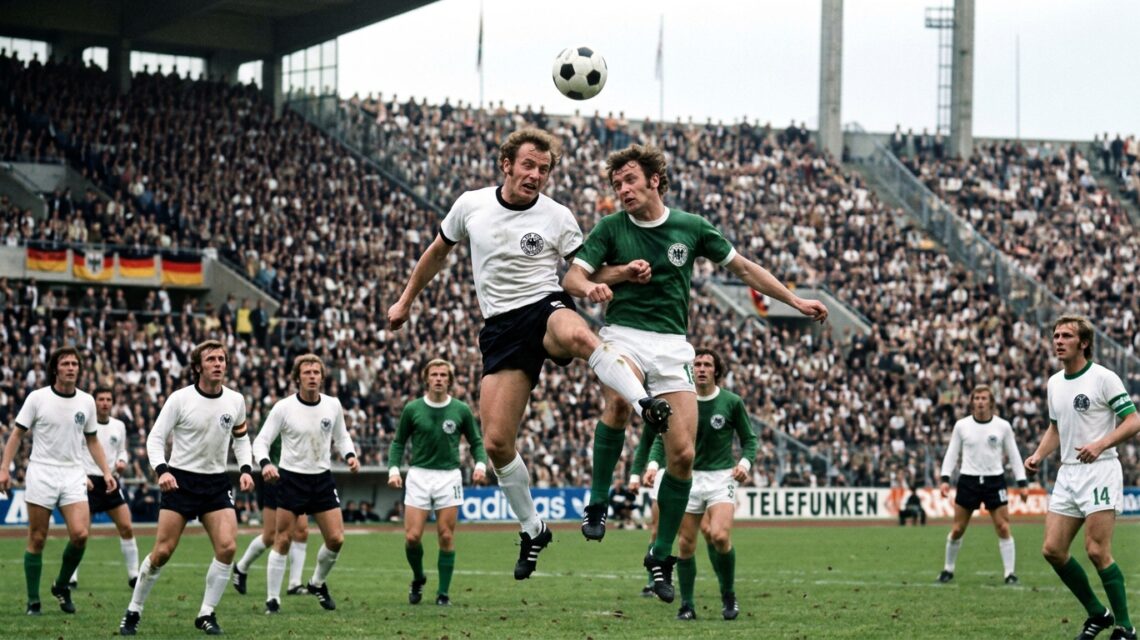
On June 22, 1974, East Germany defeated West Germany 1-0 at Hamburg’s Volksparkstadion in the only senior international football match ever played between the two countries.
The winning goal came in the 77th minute, when Jürgen Sparwasser broke through the West German defense and beat goalkeeper Sepp Maier.
It was an extraordinary result.
West Germany was hosting the World Cup and possessed one of the strongest teams in international football, led by Franz Beckenbauer, Gerd Müller and Paul Breitner.
East Germany was appearing in its first and only World Cup as a separate nation.
The victory immediately became a political symbol for the communist government in East Berlin.
But the result also produced an unexpected sporting consequence.
By finishing first in their opening group, the East Germans advanced into a second-round section containing the Netherlands, Brazil and Argentina.
West Germany finished second and entered the other group, alongside Poland, Sweden and Yugoslavia.
The East Germans would not win another match.
The West Germans would win every remaining game, including the final against Johan Cruyff’s Netherlands.
The country that won the Cold War confrontation lost the tournament. The country that lost the confrontation lifted the trophy.
Behind the match was another story, documented in the files of East Germany’s Ministry for State Security, better known as the Stasi.
The government had sent its footballers to compete in the West while secretly monitoring them for possible defections, unauthorized contacts and recruitment attempts by professional clubs.
The players were representing their country on the pitch, but they were also subjects of surveillance by their own state. <Cite refs={[“turn734613search0″,”turn734613search5″,”turn814717search3”]}/>
Why the 1974 World Cup became a confrontation between two German states
Germany had been divided since the aftermath of the Second World War.
The Federal Republic of Germany, commonly known as West Germany, developed as a parliamentary democracy aligned with the Western powers.
The German Democratic Republic, or East Germany, became a socialist state under the ruling Socialist Unity Party and was closely aligned with the Soviet Union.
The Berlin Wall, constructed in 1961, became the most recognizable symbol of that division.
The two states also competed for international recognition.
Sport was an important part of that rivalry.
East Germany invested heavily in elite athletic performance, using international victories to demonstrate the achievements of its political system.
West Germany had already won the 1954 World Cup and remained an established force in international football.
The 1974 tournament created an unprecedented opportunity for direct comparison.
For the first time, both countries qualified for the same World Cup.
Then the draw placed them in Group 1.
The match would take place in Hamburg, inside West German territory.
For East Germany’s leadership, that created both an opportunity and a security problem.
A victory could deliver an enormous propaganda success.
But the tournament also required East German athletes, officials and selected supporters to spend time on the other side of the Iron Curtain.
The Stasi’s own files reveal how seriously it treated the match
The most revealing evidence about the political pressure surrounding the game comes from the German Federal Archives.
A Stasi document dated May 22, 1974, detailed preparations for monitoring the East German national team during the World Cup.
The report identified possible risks involving contact with West German citizens and attempts by professional clubs to recruit East German players.
It also examined individual footballers.
The document specifically named players who had relatives in West Germany.
Others were subject to additional scrutiny because of personal connections considered politically sensitive.
The Stasi’s objective was not merely to protect the team from external interference.
It wanted to prevent players from establishing unauthorized relationships or remaining in the West.
The report stated that informants had been placed within the traveling delegation.
Some players themselves had been recruited as unofficial collaborators.
A full-time security officer was also assigned to maintain contact with Stasi headquarters in East Berlin.
This was not a rumor created decades after the tournament.
It was an internal security operation recorded before the team traveled to West Germany. <Cite ref=”turn734613search0″/>
East Germany’s World Cup delegation included secret informants
The Stasi’s monitoring system was extensive.
The May 1974 document described a delegation containing 22 players and 16 members of the team’s leadership and technical staff.
An additional ten-person observation delegation was planned.
The footballers were scheduled to stay at a hotel in Quickborn, north of Hamburg.
The security service documented their travel arrangements and the locations of their matches.
It also established procedures for reporting suspicious incidents.
The presence of informants within the delegation meant that ordinary interactions could be reported to state security officials.
A conversation with a West German acquaintance, contact with a foreign journalist or an approach from a professional club could attract attention.
The surveillance extended beyond the footballers.
Coaches, medical personnel, officials and journalists were also subject to scrutiny.
A separate security operation, known as Aktion Leder, was established to manage risks surrounding the tournament.
The evidence supports describing the team as closely monitored.
It does not justify assuming that every player was personally threatened with imprisonment or that every member of the delegation was a secret agent.
The documented system was already intrusive without adding claims that the archival record does not establish. <Cite refs={[“turn734613search0″,”turn734613search7”]}/>
Even East German supporters were selected for political reliability
The Stasi’s concerns extended to spectators.
East Germany was entitled to thousands of tickets for World Cup matches.
But allowing ordinary citizens to travel freely to West Germany created a dilemma.
The government feared that some supporters might attempt to remain in the West.
Others might express sympathy for West German society or establish politically sensitive contacts.
Refusing to send supporters would create another problem.
It would publicly expose the restrictions placed on East German citizens.
The authorities therefore selected supporters according to political criteria.
A Stasi directive required travelers to demonstrate loyalty to the socialist state.
The operation also involved background checks and restrictions on the number of people allowed to travel.
The contrast was striking.
West Germany was hosting a major international sporting event.
East Germany was treating attendance at that event as a potential internal-security threat.
The football match had become a test of how much contact the government was willing to permit between its citizens and the outside world. <Cite refs={[“turn734613search3″,”turn734613search7”]}/>
Both German teams had already qualified before the showdown
The match carried enormous symbolic weight, but its sporting stakes require clarification.
By June 22, both countries had already secured qualification for the second round.
West Germany had beaten Chile 1-0 and Australia 3-0.
East Germany had defeated Australia 2-0 and drawn 1-1 with Chile.
Neither side needed to win to avoid elimination.
The remaining question was which team would finish first in the group.
That mattered because the 1974 World Cup used an unusual format.
There were no conventional quarterfinals or semifinals.
Instead, the eight teams advancing from the first round were divided into two new groups of four.
Each group winner would reach the final.
The second-place teams would contest third place.
The result in Hamburg therefore determined the two German teams’ second-round paths.
But it did not determine whether they would remain in the tournament.
This distinction helps explain the remarkable aftermath.
East Germany achieved the more prestigious victory on June 22.
West Germany ultimately benefited from the opportunity to regroup and then navigate a different set of opponents.
West Germany entered as the favorite, but the match was far from one-sided
West Germany’s team contained several players who had already established international reputations.
Beckenbauer captained the side.
Gerd Müller was among the most prolific strikers in football history.
Paul Breitner, Wolfgang Overath and Uli Hoeneß added experience and technical quality.
The team was coached by Helmut Schön.
East Germany, led by Georg Buschner, relied on disciplined defending, organization and quick attacking transitions.
Its goalkeeper, Jürgen Croy, was a key figure.
Bernd Bransch captained the team.
Sparwasser and Martin Hoffmann provided attacking options.
The East Germans were not expected to dominate possession or overwhelm their opponents.
They aimed to remain compact and exploit opportunities.
The first half demonstrated that they were capable of troubling the favorites.
West Germany had chances, but East Germany also threatened.
Hans-Jürgen Kreische missed an important opportunity from close range.
At the other end, Gerd Müller struck the post.
The match remained scoreless.
As the second half progressed, the possibility of a draw appeared increasingly likely.
Then came the decisive attack.
The 77th-minute goal began with East Germany’s goalkeeper
The winning move was not simply a long clearance followed by an isolated individual run.
FIFA’s historical account provides a more precise sequence.
East German goalkeeper Jürgen Croy collected a West German header.
He released the ball to substitute Erich Hamann on the right.
Hamann advanced into space.
Beckenbauer moved toward him but did not immediately stop the attack.
Hamann then delivered the ball toward the edge of the penalty area.
Sparwasser moved between defenders.
His first contact was awkward rather than perfectly controlled.
The ball struck his upper body and bounced into a favorable position.
He continued into the penalty area and drove a right-footed shot past Sepp Maier.
The goal came in the 77th minute, commonly described as the 78th minute when counting the minute in progress.
East Germany led 1-0.
West Germany had little time to respond.
The final whistle confirmed one of the most politically charged upsets in World Cup history. <Cite ref=”turn734613search5″/>
Sparwasser’s goal became a propaganda victory for East Germany
The result had significance far beyond football.
East Germany’s government presented the victory as evidence of the strength and legitimacy of its socialist system.
The country had defeated its larger, wealthier Western rival on West German soil.
For the ruling party, the symbolism was irresistible.
But the political interpretation was not necessarily shared by the players.
Sparwasser later emphasized that the team had approached the match as a sporting contest.
The players wanted to win because they were competitive athletes.
They did not necessarily regard the match as a personal ideological battle.
In later interviews, Sparwasser criticized the way his goal had been turned into a political symbol.
He said the authorities treated the victory as proof that socialism had defeated capitalism.
His own experience was more complicated.
He had scored an important goal in a World Cup match.
The government then attached a political meaning to it that he had not chosen.
The distinction is central to the story.
The footballers achieved the victory.
The state attempted to control its meaning. <Cite refs={[“turn814717search7″,”turn814717search8”]}/>
The victory gave East Germany the tougher second-round group
The most surprising consequence of the match was revealed by the tournament structure.
East Germany finished first in Group 1 with five points under the two-points-for-a-win system.
West Germany finished second with four.
That placed East Germany in the second-round group containing the Netherlands, Brazil and Argentina.
West Germany entered the group containing Poland, Sweden and Yugoslavia.
The difference was substantial.
The Netherlands, led by Johan Cruyff and coached by Rinus Michels, were producing some of the tournament’s most impressive football.
Brazil arrived as the defending world champion.
Argentina was another established South American power.
West Germany’s opponents were also strong.
Poland, in particular, had an outstanding team and would eventually finish third.
But the routes were different.
East Germany’s reward for winning the group was a sequence of matches against three major international football nations.
West Germany avoided the Netherlands and Brazil until a possible final.
The result did not guarantee an easier tournament for the hosts.
But it altered the competitive landscape in a way that would prove significant.
East Germany failed to win another match
East Germany’s second-round campaign began against Brazil on June 26.
The defending champions won 1-0 through a goal by Rivellino.
Four days later, East Germany faced the Netherlands.
Cruyff’s team won 2-0.
The East Germans were unable to contain the Dutch movement and attacking combinations.
Their final match came against Argentina on July 3.
It ended 1-1.
East Germany finished third in its second-round group.
The team had produced the most politically celebrated victory in its football history but failed to reach the semifinals-equivalent stage of the tournament.
Its World Cup campaign ended after six matches.
The final record was two wins, two draws and two defeats.
The victory over West Germany remained its defining achievement.
But it was not enough to carry the team into the championship match. <Cite refs={[“turn734613search4″,”turn814717search3”]}/>
West Germany recovered by winning three consecutive matches
West Germany responded to the Hamburg defeat with a stronger second-round campaign.
On June 26, it defeated Yugoslavia 2-0.
Four days later, it beat Sweden 4-2 after trailing during the match.
The final group game against Poland was effectively a semifinal.
Both teams had won their opening two second-round matches.
The winner would advance to the World Cup final.
The match took place in Frankfurt on July 3 under difficult conditions after heavy rain.
Poland possessed one of the tournament’s most dangerous attacking teams.
Grzegorz Lato would finish as the World Cup’s leading scorer with seven goals.
But West Germany prevailed.
Gerd Müller scored the only goal in the 76th minute.
The 1-0 victory sent the hosts into the final.
They had now won three consecutive matches since losing to East Germany.
The turnaround reflected tactical adjustments, improved performances and the quality of a team that had entered the competition among the favorites.
It would be too simplistic to claim that the defeat alone created the eventual champions.
But it clearly marked a turning point in their tournament. <Cite refs={[“turn814717search0″,”turn814717search5”]}/>
Beckenbauer’s leadership became central to the recovery
The defeat against East Germany intensified criticism of West Germany’s performances.
The team had already faced questions about its cohesion and attacking play.
Beckenbauer played an important role in helping the squad regain stability.
Schön also made changes to the lineup.
Players such as Rainer Bonhof and Bernd Hölzenbein became important during the later stages.
The West Germans developed a more balanced approach.
They remained capable of controlling possession, but their defensive organization and counterattacking improved.
The victory over Yugoslavia restored confidence.
The comeback against Sweden demonstrated resilience.
The narrow win over Poland showed that the team could withstand pressure against elite opposition.
By the time the final arrived, West Germany had recovered much of the authority expected from the host nation.
The team that had been embarrassed in Hamburg was now one victory away from becoming world champion.
West Germany defeated Cruyff’s Netherlands in the final
The 1974 World Cup final took place in Munich on July 7.
West Germany faced the Netherlands.
The Dutch had become the tournament’s most admired team through their fluid style of play, widely known as Total Football.
Cruyff was its central figure.
The match began disastrously for the hosts.
The Netherlands won a penalty before West Germany had touched the ball.
Johan Neeskens converted in the second minute.
West Germany equalized through a Paul Breitner penalty in the 25th minute.
Then, shortly before halftime, Gerd Müller scored.
His 43rd-minute goal gave West Germany a 2-1 lead.
The hosts defended their advantage through the second half.
When the final whistle sounded, West Germany had won its second World Cup.
The achievement created a remarkable historical contrast.
Fifteen days earlier, the team had lost to East Germany in Hamburg.
Now it was celebrating the world title in Munich.
East Germany had won the only direct confrontation.
West Germany had won the competition that mattered most internationally. <Cite refs={[“turn814717search1″,”turn814717search3”]}/>
The two German teams followed completely different paths
| Stage | East Germany | West Germany |
|---|---|---|
| Opening group | First place | Second place |
| Head-to-head match | Won 1-0 | Lost 0-1 |
| Second-round opponents | Brazil, Netherlands, Argentina | Yugoslavia, Sweden, Poland |
| Second-round record | 0 wins, 1 draw, 2 defeats | 3 wins, 0 draws, 0 defeats |
| Second-round goals | 1 scored, 4 conceded | 7 scored, 2 conceded |
| Tournament outcome | Eliminated in second round | World champions |
The comparison illustrates why the Hamburg result remains so unusual.
East Germany achieved the more memorable political victory.
West Germany achieved the greater sporting success.
The result also demonstrates how tournament formats can produce unexpected consequences.
Winning a group does not always guarantee a more favorable route.
In 1974, the group winner and runner-up entered different second-round sections.
The consequences of that allocation became visible almost immediately.
The Stasi had already planned for the possibility of a group victory
One of the most revealing details in the surviving security records is that East German officials had considered the possibility of finishing first.
The May 22 Stasi document outlined different travel arrangements depending on the team’s progress.
It identified the venues and dates that would apply if East Germany won its opening group.
The authorities were therefore preparing for more than the symbolic match against West Germany.
They expected the team to compete seriously in the tournament.
Their primary security concerns remained consistent.
They wanted to prevent defections, monitor contacts and maintain political control over the delegation.
The document shows how closely sporting planning and state surveillance were intertwined.
The Stasi was not merely reacting to events.
It had established procedures before the tournament began.
The victory over West Germany intensified the team’s public significance, but the machinery of surveillance was already operating. <Cite ref=”turn734613search0″/>
Sparwasser later left East Germany
The political meaning attached to Sparwasser’s goal followed him long after the tournament.
He became one of East Germany’s most recognizable footballers.
His name remained associated with the victory over West Germany.
But his later relationship with the state was complicated.
In 1988, Sparwasser traveled to West Germany and did not return to the East.
He settled in the Federal Republic.
The move was particularly striking because he had once been celebrated as the scorer of the goal that symbolized East Germany’s superiority over its Western rival.
In later interviews, Sparwasser explained that the fame associated with the goal had brought difficulties as well as recognition.
He also rejected the idea that the players had experienced the match primarily as an ideological battle.
The government’s interpretation of the victory was not the same as his own.
His later departure demonstrated the limits of the state’s attempt to turn an individual athlete into a permanent political symbol. <Cite refs={[“turn814717search2″,”turn814717search8”]}/>
The 1974 match remains the only senior international between East and West Germany
The two countries never met again in a senior international football match.
East Germany continued competing separately until German reunification in 1990.
Its national team disappeared as a separate international side.
West Germany’s football federation became the governing body for the unified German national team.
The 1974 encounter therefore remains unique.
It was not one match in a long rivalry.
It was the only senior international meeting between two states that had emerged from the division of Germany after the Second World War.
That gives Sparwasser’s goal an unusual historical significance.
There was no rematch.
There was no later opportunity for West Germany to reverse the result in direct competition.
The official head-to-head record remains one match, one East German victory and one goal.
What the match reveals about football and Cold War politics
The 1974 encounter demonstrated how international sport could become a stage for political competition.
East Germany’s government wanted the national team to represent the achievements of socialism.
West Germany faced pressure to defend its sporting reputation on home soil.
The match attracted attention because it brought two political systems into direct competition.
But the players’ experiences were more complex than the propaganda surrounding them.
The East German footballers were monitored by their own security service.
Their movements and contacts were restricted.
Their victory was used for political purposes.
Sparwasser later made clear that he did not regard the goal as a personal declaration of ideological superiority.
The contrast is important.
A government can attempt to control the meaning of a sporting achievement.
But it cannot fully control how athletes and supporters understand it.
The match was a political event because of the historical circumstances.
It was also a football match decided by a single goal.
The numbers behind the 1974 German World Cup derby
| Detail | Historical record |
|---|---|
| Date | June 22, 1974 |
| Competition | FIFA World Cup, first group stage |
| Stadium | Volksparkstadion, Hamburg |
| Result | East Germany 1-0 West Germany |
| Goalscorer | Jürgen Sparwasser |
| Goal time | 77th minute |
| East Germany coach | Georg Buschner |
| West Germany coach | Helmut Schön |
| East Germany captain | Bernd Bransch |
| West Germany captain | Franz Beckenbauer |
| East Germany goalkeeper | Jürgen Croy |
| West Germany goalkeeper | Sepp Maier |
| Attendance | 60,200 according to FIFA |
| East Germany’s final outcome | Eliminated in second round |
| West Germany’s final outcome | World champions |
| Subsequent senior meetings | None |
The figures capture the extraordinary contrast.
East Germany won the only match between the two national teams.
West Germany won the World Cup 15 days later.
The Stasi’s own records confirm that the East German delegation had been monitored throughout the tournament.
And the player who scored the decisive goal eventually left the state that had celebrated him as a national hero.
The victory that East Germany could never repeat
The 1974 World Cup match remains one of the most remarkable examples of football intersecting with international politics.
It brought two German states onto the same field during the Cold War.
It exposed the surveillance practices of East Germany’s security apparatus.
It produced a result that contradicted the expectations of most observers.
And it created a sporting paradox that has endured for more than half a century.
East Germany defeated West Germany.
But the victory did not lead to the World Cup title.
Instead, the East Germans entered a second-round group containing the Netherlands, Brazil and Argentina.
They were eliminated.
West Germany recovered from the defeat, defeated Yugoslavia, Sweden and Poland, and then beat the Netherlands in the final.
The contrast became even more striking after reunification.
The two national teams never met again.
The record remained frozen at 1-0.
For East Germany, Sparwasser’s goal became an enduring symbol of a state that no longer exists.
For West Germany, the defeat became a footnote in a championship campaign.
The same match produced two different histories.
One country won the confrontation.
The other won the World Cup.
+ Siga o Giro no Facebook
+ Siga o Giro no Instagram
Leia Mais: